BIOM3901 – Clinical Biochemistry
Dr Pena – Lecture 2
Proteins
Learning objectives:
Study of the major classes of blood, plasma and serum proteins and their functions.
Description of albumin and globulins in their relationship with disease.
Detection of proteins in serum and CSF.
Blood
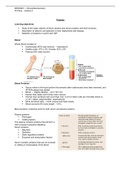
Whole blood consists of
Erythrocytes (45% total volume) haematocrit
Healthy male: 47% ± 5%; Female: 42% ± 5%
Plasma (55% total volume)
Blood Proteins:
Serum refers to the liquid portion that remains after erythrocytes have been removed, and
AFTER plasma has clotted.
Blood slightly alkaline pH 7.35-7.45.
Denser than water and 5 times more viscous.
Women less red blood cell count than men: 4.2-5.4 million cells per microliter blood vs.
4.7-6.1 million cells/microliter. (haematocrit)
More red blood cells more viscous and flows slowly.
Blood accounts 8% body weight 5-6 L.
Blood proteins: Collective term for both serum and plasma proteins.
Plasma proteins:
Fibrinogen
Clotting factors
The plasma contains proteins that will form a
clot to prevent excessive bleeding.
Serum proteins:
Albumins
Globulins
Gene regulation proteins
Enzymes and transcription factors
Serum contains proteins that are not involved
in clotting or homeostasis of the blood.
, BIOM3901 – Clinical Biochemistry
Dr Pena – Lecture 2
Fibrinogen
Major protein involved in haemostasis,
coagulation and the clotting cascade
Inactivated soluble form (fibrinogen) is
cleaved by enzymes (thrombin) to form
fibrin.
Fibrin is insoluble and forms thin
strands of protein that form a mesh
across damaged vessels to create a
thrombus (blocks veins, arteries and
capillaries). This can cause death due
to lack of nutrients and oxygen. If clots
do not form, excessive blood loss can
occur.
When activated form a mesh for
coagulation
Abnormalities of Fibrinogen and Clotting
Factors
Thrombophilia – excessive clotting.
Clots can fragment and travel through
vessels. They become embolisms
where they block vessels.
Embolisms cause hypoxia and tissue
infarct downstream of their location.
Severe disease – can cause brain or
heart infarctions.
Haemophilia – absence of clotting
Multiple causes
Iatrogenic (heparin/warfarin)
Genetic
Albumin
Produced in the liver. Measuring albumin concentrations = a way to measure liver function.
Accounts for some 60% plasma protein
Major functions include:
• Maintenance of osmotic or oncotic pressure pressure helps to keep water in the
bloodstream
• Transport of hormones and fatty acids
• Transport of drug metabolites to target cells
• Transport of unconjugated bilirubin
• Binds free serum calcium
• Buffers blood pH (acid-base balance)
Oncotic pressure (osmotic pressure due to proteins)
• Vessels and capillaries are permeable
• Serum able to permeate through cell membranes and through pores in vascular endothelium
• Albumin too large to pass through endothelial pores and junctions and not easily transported
across membranes
• Concentration of albumin in vessels draws extracellular fluid into capillaries.
Dr Pena – Lecture 2
Proteins
Learning objectives:
Study of the major classes of blood, plasma and serum proteins and their functions.
Description of albumin and globulins in their relationship with disease.
Detection of proteins in serum and CSF.
Blood
Whole blood consists of
Erythrocytes (45% total volume) haematocrit
Healthy male: 47% ± 5%; Female: 42% ± 5%
Plasma (55% total volume)
Blood Proteins:
Serum refers to the liquid portion that remains after erythrocytes have been removed, and
AFTER plasma has clotted.
Blood slightly alkaline pH 7.35-7.45.
Denser than water and 5 times more viscous.
Women less red blood cell count than men: 4.2-5.4 million cells per microliter blood vs.
4.7-6.1 million cells/microliter. (haematocrit)
More red blood cells more viscous and flows slowly.
Blood accounts 8% body weight 5-6 L.
Blood proteins: Collective term for both serum and plasma proteins.
Plasma proteins:
Fibrinogen
Clotting factors
The plasma contains proteins that will form a
clot to prevent excessive bleeding.
Serum proteins:
Albumins
Globulins
Gene regulation proteins
Enzymes and transcription factors
Serum contains proteins that are not involved
in clotting or homeostasis of the blood.
, BIOM3901 – Clinical Biochemistry
Dr Pena – Lecture 2
Fibrinogen
Major protein involved in haemostasis,
coagulation and the clotting cascade
Inactivated soluble form (fibrinogen) is
cleaved by enzymes (thrombin) to form
fibrin.
Fibrin is insoluble and forms thin
strands of protein that form a mesh
across damaged vessels to create a
thrombus (blocks veins, arteries and
capillaries). This can cause death due
to lack of nutrients and oxygen. If clots
do not form, excessive blood loss can
occur.
When activated form a mesh for
coagulation
Abnormalities of Fibrinogen and Clotting
Factors
Thrombophilia – excessive clotting.
Clots can fragment and travel through
vessels. They become embolisms
where they block vessels.
Embolisms cause hypoxia and tissue
infarct downstream of their location.
Severe disease – can cause brain or
heart infarctions.
Haemophilia – absence of clotting
Multiple causes
Iatrogenic (heparin/warfarin)
Genetic
Albumin
Produced in the liver. Measuring albumin concentrations = a way to measure liver function.
Accounts for some 60% plasma protein
Major functions include:
• Maintenance of osmotic or oncotic pressure pressure helps to keep water in the
bloodstream
• Transport of hormones and fatty acids
• Transport of drug metabolites to target cells
• Transport of unconjugated bilirubin
• Binds free serum calcium
• Buffers blood pH (acid-base balance)
Oncotic pressure (osmotic pressure due to proteins)
• Vessels and capillaries are permeable
• Serum able to permeate through cell membranes and through pores in vascular endothelium
• Albumin too large to pass through endothelial pores and junctions and not easily transported
across membranes
• Concentration of albumin in vessels draws extracellular fluid into capillaries.