

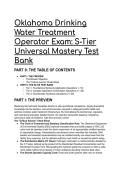
Oklahoma Drinking
Water Treatment
Operator Exam: S-Tier
Universal Mastery Test
Bank
PART 0: THE TABLE OF CONTENTS
● PART I: THE PREVIEW
○ The Mission Objective
○ The "Critical Axioms" Cheat Sheet
● PART II: THE ELITE TEST BANK
○ Tier 1: Foundational Syntax & Application (Questions 1–10)
○ Tier 2: Complex Application & Simulation (Questions 11–20)
○ Tier 3: Grandmaster Synthesis (Questions 21–30)
PART I: THE PREVIEW
Mastering this test bank translates directly to elite operational competence, forging theoretical
knowledge into the decisive, real-world execution required to safeguard public health and
optimize complex water treatment infrastructure. By internalizing the biochemical, regulatory,
and mechanical principles detailed herein, the operator transcends baseline compliance,
achieving a state of predictive, high-level process control.
The "Critical Axioms" Cheat Sheet
● The Chain of Command and Statutory Classification Rule: The Oklahoma Department
of Environmental Quality (DEQ) explicitly mandates that any facility subject to OAC 252
rules must be operated under the direct supervision of an appropriately certified operator
in responsible charge. Administrative convenience never overrides this mandate. Shift
leaders and assistant superintendents may be certified exactly one class lower than the
facility they supervise, but the ultimate authority must match or exceed the plant's rating.
● The Disinfection Matrix (CT Value): Pathogen inactivation is mathematically dictated by
the CT Value, defined as the product of the Disinfectant Residual Concentration and the
Disinfectant Contact Time. Manipulating the hydraulic grade line (volume) is often a safer,
more stable method of increasing CT than recklessly elevating chemical feed rates.
● The Shared Operator Capacity Limit: Rural and small systems often rely on shared
, personnel. However, the DEQ imposes strict geographical and numerical limits to prevent
operational dilution.
System Type Managed Minimum Certification Minimum On-Site Maximum Systems
by Shared Operator Required Attendance Allowed
Public Water Supply Class C 5 days per week 3 systems
(using disinfection)
Public Water Supply Class C 2 days per week 5 systems
(no disinfection)
Small Wastewater Class C 2 days per week 5 systems
System
● The Enhanced Coagulation Imperative (EPA Step 1 Matrix): Total Organic Carbon
(TOC) removal is the primary defense against the formation of carcinogenic Disinfection
Byproducts (DBPs). The EPA mandates specific percentage removals based on the
source water's raw TOC and alkalinity. Alkalinity acts as a chemical buffer, making the
necessary pH depression (typically to a range of 5.0–6.0) much more difficult to achieve,
thus lowering the required removal percentage for high-alkalinity waters.
Source Water Alkalinity Source Water TOC: > Source Water TOC: > Source Water TOC: >
(mg/L as CaCO3) 2.0 to 4.0 mg/L 4.0 to 8.0 mg/L 8.0 mg/L
0 to 60 35.0% required 45.0% required 50.0% required
removal removal removal
> 60 to 120 25.0% required 35.0% required 40.0% required
removal removal removal
> 120 15.0% required 25.0% required 30.0% required
removal removal removal
● The Archival Mandate: Regulatory compliance is fundamentally a data-driven enterprise.
Laboratory operators associated with waterworks must record the results of all analyses
in a bound volume or secure electronic database. These records must be retained on file
for a strict duration of ten (10) years for drinking water systems, compared to only three
(3) years for wastewater works.
PART II: THE ELITE TEST BANK
Tier 1: Foundational Syntax & Application
Q1: A municipal water treatment facility is classified as a Class A system due to its complex
surface water treatment processes. The current superintendent unexpectedly resigns, leaving
the facility to be temporarily managed by the shift supervisors. According to OAC 252:710,
which configuration of temporary leadership is the MOST ACCURATE regarding daily
operational decisions that directly impact water quality? A) A Class B certified shift supervisor
may assume the role of operator in responsible charge for up to 90 days under standard DEQ
emergency staffing provisions. B) A Class B certified shift supervisor may manage the plant's
overall process control, provided they are actively enrolled in a DEQ-approved Class A training
course and testing within six months. C) The facility must be operated under the direct
supervision of an operator holding a valid Class A certification to act as the operator in
responsible charge. D) An environmental professional possessing a specialized engineering
degree may assume responsible charge without a Class A certification until a permanent
replacement is hired.
, ● Answer: C (The facility must be operated under the direct supervision of an operator
holding a valid Class A certification to act as the operator in responsible charge.)
● Distractor Analysis:
○ A is incorrect: Oklahoma Administrative Code (OAC) 252:710-3-34 does not grant a
90-day grace period for lower-tier operators to assume the official role of
responsible charge in a higher-tier facility. This is a common misconception
imported from other municipal labor contracts, but it violates state environmental
law.
○ B is incorrect: Active enrollment in professional development or training courses
does not legally substitute for possessing the finalized, active certification required
for making critical process control decisions.
○ D is incorrect: While an environmental professional possesses a highly relevant
academic background, statutory compliance explicitly requires state-issued DEQ
certification equal to or higher than the facility's classification. Academic credentials
do not bypass operational licensure.
The Mentor's Analysis: Regulatory architecture operates on absolute statutory boundaries, not
operational convenience or academic equivalence. The individual making process control
decisions must empirically prove their competency through the acquisition of the exact
classification tier of the facility they govern. By utilizing strict certification parity, you bypass the
common trap of assuming academic degrees or subordinate operational experience legally
override regulatory mandates. Professional/Academic Intuition: The facility's classification
sets the absolute minimum floor for the license of the operator in responsible charge; there are
no administrative shortcuts or grace periods around this hard deck.
Q2: A laboratory operator at a conventional surface water treatment plant diligently records the
daily analytical results for turbidity, pH, and residual disinfection. To maintain compliance with
DEQ regulations regarding data retention and potential epidemiological auditing, what is the
MINIMUM duration these specific waterworks records must be kept on file for inspection? A)
Three (3) years, aligned with standard industrial wastewater monitoring parameters. B) Five (5)
years, matching the standard cycle of comprehensive state sanitary surveys. C) Ten (10) years,
to ensure long-term historical tracking of public health metrics. D) Until the next DEQ sanitary
survey is completed and the facility is granted operational clearance.
● Answer: C (Ten (10) years, to ensure long-term historical tracking of public health
metrics.)
● Distractor Analysis:
○ A is incorrect: Three years is the mandated retention period for wastewater works
records. This represents a common categorical confusion for dual-certified
operators managing both municipal systems.
○ B is incorrect: Five years is a standard legacy timeframe for general municipal
business archiving and taxation, but it falls substantially short of the specific
environmental regulatory standard for drinking water analytics.
○ D is incorrect: Sanitary surveys occur at routine intervals, but discarding data
immediately following an inspector's departure violates the statutory decade-long
archiving rule designed to track long-term health trends.
The Mentor's Analysis: Data integrity over extended periods is the bedrock of epidemiological
tracking and system performance auditing. When facing disputes over historical water quality or
latent health impacts, the immediate priority is producing uninterrupted data logs. By utilizing
ten-year retention protocols, you bypass the common trap of applying wastewater archiving
standards to drinking water systems. Professional/Academic Intuition: Drinking water records
Water Treatment
Operator Exam: S-Tier
Universal Mastery Test
Bank
PART 0: THE TABLE OF CONTENTS
● PART I: THE PREVIEW
○ The Mission Objective
○ The "Critical Axioms" Cheat Sheet
● PART II: THE ELITE TEST BANK
○ Tier 1: Foundational Syntax & Application (Questions 1–10)
○ Tier 2: Complex Application & Simulation (Questions 11–20)
○ Tier 3: Grandmaster Synthesis (Questions 21–30)
PART I: THE PREVIEW
Mastering this test bank translates directly to elite operational competence, forging theoretical
knowledge into the decisive, real-world execution required to safeguard public health and
optimize complex water treatment infrastructure. By internalizing the biochemical, regulatory,
and mechanical principles detailed herein, the operator transcends baseline compliance,
achieving a state of predictive, high-level process control.
The "Critical Axioms" Cheat Sheet
● The Chain of Command and Statutory Classification Rule: The Oklahoma Department
of Environmental Quality (DEQ) explicitly mandates that any facility subject to OAC 252
rules must be operated under the direct supervision of an appropriately certified operator
in responsible charge. Administrative convenience never overrides this mandate. Shift
leaders and assistant superintendents may be certified exactly one class lower than the
facility they supervise, but the ultimate authority must match or exceed the plant's rating.
● The Disinfection Matrix (CT Value): Pathogen inactivation is mathematically dictated by
the CT Value, defined as the product of the Disinfectant Residual Concentration and the
Disinfectant Contact Time. Manipulating the hydraulic grade line (volume) is often a safer,
more stable method of increasing CT than recklessly elevating chemical feed rates.
● The Shared Operator Capacity Limit: Rural and small systems often rely on shared
, personnel. However, the DEQ imposes strict geographical and numerical limits to prevent
operational dilution.
System Type Managed Minimum Certification Minimum On-Site Maximum Systems
by Shared Operator Required Attendance Allowed
Public Water Supply Class C 5 days per week 3 systems
(using disinfection)
Public Water Supply Class C 2 days per week 5 systems
(no disinfection)
Small Wastewater Class C 2 days per week 5 systems
System
● The Enhanced Coagulation Imperative (EPA Step 1 Matrix): Total Organic Carbon
(TOC) removal is the primary defense against the formation of carcinogenic Disinfection
Byproducts (DBPs). The EPA mandates specific percentage removals based on the
source water's raw TOC and alkalinity. Alkalinity acts as a chemical buffer, making the
necessary pH depression (typically to a range of 5.0–6.0) much more difficult to achieve,
thus lowering the required removal percentage for high-alkalinity waters.
Source Water Alkalinity Source Water TOC: > Source Water TOC: > Source Water TOC: >
(mg/L as CaCO3) 2.0 to 4.0 mg/L 4.0 to 8.0 mg/L 8.0 mg/L
0 to 60 35.0% required 45.0% required 50.0% required
removal removal removal
> 60 to 120 25.0% required 35.0% required 40.0% required
removal removal removal
> 120 15.0% required 25.0% required 30.0% required
removal removal removal
● The Archival Mandate: Regulatory compliance is fundamentally a data-driven enterprise.
Laboratory operators associated with waterworks must record the results of all analyses
in a bound volume or secure electronic database. These records must be retained on file
for a strict duration of ten (10) years for drinking water systems, compared to only three
(3) years for wastewater works.
PART II: THE ELITE TEST BANK
Tier 1: Foundational Syntax & Application
Q1: A municipal water treatment facility is classified as a Class A system due to its complex
surface water treatment processes. The current superintendent unexpectedly resigns, leaving
the facility to be temporarily managed by the shift supervisors. According to OAC 252:710,
which configuration of temporary leadership is the MOST ACCURATE regarding daily
operational decisions that directly impact water quality? A) A Class B certified shift supervisor
may assume the role of operator in responsible charge for up to 90 days under standard DEQ
emergency staffing provisions. B) A Class B certified shift supervisor may manage the plant's
overall process control, provided they are actively enrolled in a DEQ-approved Class A training
course and testing within six months. C) The facility must be operated under the direct
supervision of an operator holding a valid Class A certification to act as the operator in
responsible charge. D) An environmental professional possessing a specialized engineering
degree may assume responsible charge without a Class A certification until a permanent
replacement is hired.
, ● Answer: C (The facility must be operated under the direct supervision of an operator
holding a valid Class A certification to act as the operator in responsible charge.)
● Distractor Analysis:
○ A is incorrect: Oklahoma Administrative Code (OAC) 252:710-3-34 does not grant a
90-day grace period for lower-tier operators to assume the official role of
responsible charge in a higher-tier facility. This is a common misconception
imported from other municipal labor contracts, but it violates state environmental
law.
○ B is incorrect: Active enrollment in professional development or training courses
does not legally substitute for possessing the finalized, active certification required
for making critical process control decisions.
○ D is incorrect: While an environmental professional possesses a highly relevant
academic background, statutory compliance explicitly requires state-issued DEQ
certification equal to or higher than the facility's classification. Academic credentials
do not bypass operational licensure.
The Mentor's Analysis: Regulatory architecture operates on absolute statutory boundaries, not
operational convenience or academic equivalence. The individual making process control
decisions must empirically prove their competency through the acquisition of the exact
classification tier of the facility they govern. By utilizing strict certification parity, you bypass the
common trap of assuming academic degrees or subordinate operational experience legally
override regulatory mandates. Professional/Academic Intuition: The facility's classification
sets the absolute minimum floor for the license of the operator in responsible charge; there are
no administrative shortcuts or grace periods around this hard deck.
Q2: A laboratory operator at a conventional surface water treatment plant diligently records the
daily analytical results for turbidity, pH, and residual disinfection. To maintain compliance with
DEQ regulations regarding data retention and potential epidemiological auditing, what is the
MINIMUM duration these specific waterworks records must be kept on file for inspection? A)
Three (3) years, aligned with standard industrial wastewater monitoring parameters. B) Five (5)
years, matching the standard cycle of comprehensive state sanitary surveys. C) Ten (10) years,
to ensure long-term historical tracking of public health metrics. D) Until the next DEQ sanitary
survey is completed and the facility is granted operational clearance.
● Answer: C (Ten (10) years, to ensure long-term historical tracking of public health
metrics.)
● Distractor Analysis:
○ A is incorrect: Three years is the mandated retention period for wastewater works
records. This represents a common categorical confusion for dual-certified
operators managing both municipal systems.
○ B is incorrect: Five years is a standard legacy timeframe for general municipal
business archiving and taxation, but it falls substantially short of the specific
environmental regulatory standard for drinking water analytics.
○ D is incorrect: Sanitary surveys occur at routine intervals, but discarding data
immediately following an inspector's departure violates the statutory decade-long
archiving rule designed to track long-term health trends.
The Mentor's Analysis: Data integrity over extended periods is the bedrock of epidemiological
tracking and system performance auditing. When facing disputes over historical water quality or
latent health impacts, the immediate priority is producing uninterrupted data logs. By utilizing
ten-year retention protocols, you bypass the common trap of applying wastewater archiving
standards to drinking water systems. Professional/Academic Intuition: Drinking water records


