

HUP Critical Care Course
Study online at https://quizlet.com/_f6usib
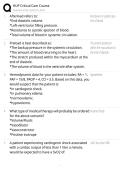
1. Afterload refers to: Resistance to systolic ejec-
*End-diastolic volume. tion of blood.
*Left-ventricular filling pressure.
*Resistance to systolic ejection of blood.
*Total volume of blood in systemic circulation.
2. Preload is best described as: The stretch produced
*The backup pressure in the systemic circulation. within the myocardium at
*The amount of blood returning to the heart. the end of diastole.
*The stretch produced within the myocardium at the
end of diastole.
*The volume of blood in the ventricle after systole.
3. Hemodynamic data for your patient includes: RA = 1, hypovolemic
PAP = 15/8, PAOP = 4, CO = 3.5. Based on this data, you
would suspect that the patient is:
*in cardiogenic shock.
*in pulmonary edema.
*normovolemic.
*hypovolemic.
4. What type of medical therapy will probably be ordered Volume/Fluids
for the above scenario?
*Volume/Fluids
*Vasodilator
*Vasoconstrictor
*Positive inotrope
5. A patient experiencing cardiogenic shock associated SvO2 less than 50%
with a cardiac output of less than 1 liter a minute,
would be expected to have a SvO2 of:
, HUP Critical Care Course
Study online at https://quizlet.com/_f6usib
*SvO2 greater than 70%.
*SvO2 less than 50%.
6. A patient post-thoraco-abdominal aneurysm repair is Treat it as a medical emer-
complaining of extreme weakness of the lower extrem- gency, call the provider,
ities and is unable to lift bilateral lower extremities off and give intravenous fluids
the bed. The nurse would: and vasopressors
*Treat it as a medical emergency, call the provider, and
give intravenous fluids and vasopressors.
*Treat this as a narcotic overmedication and give
naloxone
*Do nothing as this is a temporary expectation
post-thoraco-abdominal aneurysm repair.
*Raise the patient's legs to improve circulation.
7. Which item below describes the pain associated with a Sharp, stabbing, tearing
dissecting aneurysm? back, chest, and/or ab-
*Squeezing tight pressure under the ribs and in the dominal pain
back
*Pressure radiating to the arm, back, neck and ab-
domen
*Sharp, stabbing, tearing back, chest, and/or abdomi-
nal pain
*Intermittent dull aching back and/or abdominal pain
8. Which of the following parameters indicate successful Decreased central venous
management of right ventricular failure? pressure (CVP)
*Decreased pulmonary arterial occlusive/wedge pres-
sure (PAOP)
*Increased pulmonary arterial diastolic (PAD) pres-
sure
Study online at https://quizlet.com/_f6usib
1. Afterload refers to: Resistance to systolic ejec-
*End-diastolic volume. tion of blood.
*Left-ventricular filling pressure.
*Resistance to systolic ejection of blood.
*Total volume of blood in systemic circulation.
2. Preload is best described as: The stretch produced
*The backup pressure in the systemic circulation. within the myocardium at
*The amount of blood returning to the heart. the end of diastole.
*The stretch produced within the myocardium at the
end of diastole.
*The volume of blood in the ventricle after systole.
3. Hemodynamic data for your patient includes: RA = 1, hypovolemic
PAP = 15/8, PAOP = 4, CO = 3.5. Based on this data, you
would suspect that the patient is:
*in cardiogenic shock.
*in pulmonary edema.
*normovolemic.
*hypovolemic.
4. What type of medical therapy will probably be ordered Volume/Fluids
for the above scenario?
*Volume/Fluids
*Vasodilator
*Vasoconstrictor
*Positive inotrope
5. A patient experiencing cardiogenic shock associated SvO2 less than 50%
with a cardiac output of less than 1 liter a minute,
would be expected to have a SvO2 of:
, HUP Critical Care Course
Study online at https://quizlet.com/_f6usib
*SvO2 greater than 70%.
*SvO2 less than 50%.
6. A patient post-thoraco-abdominal aneurysm repair is Treat it as a medical emer-
complaining of extreme weakness of the lower extrem- gency, call the provider,
ities and is unable to lift bilateral lower extremities off and give intravenous fluids
the bed. The nurse would: and vasopressors
*Treat it as a medical emergency, call the provider, and
give intravenous fluids and vasopressors.
*Treat this as a narcotic overmedication and give
naloxone
*Do nothing as this is a temporary expectation
post-thoraco-abdominal aneurysm repair.
*Raise the patient's legs to improve circulation.
7. Which item below describes the pain associated with a Sharp, stabbing, tearing
dissecting aneurysm? back, chest, and/or ab-
*Squeezing tight pressure under the ribs and in the dominal pain
back
*Pressure radiating to the arm, back, neck and ab-
domen
*Sharp, stabbing, tearing back, chest, and/or abdomi-
nal pain
*Intermittent dull aching back and/or abdominal pain
8. Which of the following parameters indicate successful Decreased central venous
management of right ventricular failure? pressure (CVP)
*Decreased pulmonary arterial occlusive/wedge pres-
sure (PAOP)
*Increased pulmonary arterial diastolic (PAD) pres-
sure


