

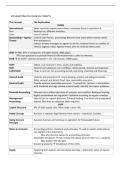
EXPLANATIONS ON FINANCIAL CONEPTS
The Concept The Explanation
INTRO
Internationals Some countries require you to have a company there to operate in it.
Pros Reduces tax, different branches.
Cons Loss of control.
Stewardship + Agency Control over finance, purchasing. Records must show where money comes
Theory from and goes to.
Owners employ managers as agents to do this, however there is a conflict of
interest (agency costs). Agency theory aims to minimise these costs.
IASB → IFRS: 87% of companies, principles-based, 2000 pages.
- IFRS says purpose is to provide financial information that’s useful to investors.
FASB → US GAAP: national standards in US, rules-based, 25000 pages.
SOFP Oldest, one moment in time, assets and liabilities.
SOPL Commercial substance over cashflows, states period, revenue and expenses.
CASHFLOW Flows in and out, for accounting period, operating, investing and financing.
Internal Audit Controls and procedure for record keeping, protect and safeguard assets.
Deter, prevent and detect fraud. Give reasonable assurance.
External Audit Provide external reasonable assurance: ‘true and fair’ opinion. In accordance
with standards and regs. Review internal audit. Identify and report problems.
Financial Accounting External use to inform decisions of investors and creditors. Backward looking.
Highly standardised and regulated. Published according to regular schedule.
Management Internal use to support decisions. Forward looking. Free form and unregulated
Accounting reports. Real time or published when required.
SOFP
Capital Structure Mix of debt-equity ratio. More debt = more risk.
Entity Concept Business is separate legal identity from owners – treated as 2 parties.
Going Concern Assumes business will continue in operation for foreseeable future.
Principle
Notes to Accounts Accounting policies, standards and estimates → used to explain what policies
are applied in the statements.
- May also disclose values for accounting estimates.
Qualitative disclosure → may include info about what an item is i.e., property.
- May explain YOY changes.
Greater granularity → breakdown of line items.
Equity Financing from owners and reinvested earnings – represents value of owners
interests.
, Owners’ Equity Share capital, retained earnings, other reserves.
Historical Cost Historic cost → most assets recorded at the costs expended on them.
Convention Fair value → rather than at liquidation or replacement value.
SOPL
Payment Means Cash on delivery → paid for at the time they are consumed/received.
Paid in arrears → paid for after delivery, may be invoiced at time of delivery
(goods) or later (services).
Paid in advance → ordered and paid for in advance.
Revenue Recognition Based on satisfying contractual obligations.
by IFRS Only recognise when: rights to all economic benefits and responsibility for any
risks have been transferred from seller to buyer without recourse.
- Amount of revenue and associated costs can be measured reliably.
- For goods transfer requires delivery.
Accrual Principle Revenue should be recognised when earned regardless of when paid for.
Expenses should be recognised when incurred regardless of when paid for.
- Focus on commercial substance over payment means.
- Must include costs for the whole time it is ‘enjoyed’.
Period Costs Costs that cannot easily be matched with revenues.
Manufacturing overhead to product costs.
Corporate overheads to costs of running business.
Matching Principle Costs associated with revenues should be recognised in the same periods in
which the revenues are recognised.
WORKING CAPITAL
Credit (losses) Losses arising from giving credit to customers to buy products/services.
- Every time a firm extends it, they risk the loss that customers
cannot/will not pay what is owed on time.
Credit
Pros Companies extend credit to gain sales.
More generous payments terms attract customers.
Cons The longer customers are given to pay, the higher the risk they will default.
Companies must estimate future credit losses.
Impairment Estimate by management of value of credit loss in outstanding receivables.
Allowance - Reported in notes.
Operating expense – SOPL.
Impairment Charge Based on charge in impairment allowance needed.
Current asset – SOFP.
Prepayments Assets created when a firm pays for goods/services in advance.
- Relate to consumption in a later period but paid for in the current one.
Unearned Income Liability created when a firm accepts payment from a customer for
goods/services to be delivered at a future date.
The Concept The Explanation
INTRO
Internationals Some countries require you to have a company there to operate in it.
Pros Reduces tax, different branches.
Cons Loss of control.
Stewardship + Agency Control over finance, purchasing. Records must show where money comes
Theory from and goes to.
Owners employ managers as agents to do this, however there is a conflict of
interest (agency costs). Agency theory aims to minimise these costs.
IASB → IFRS: 87% of companies, principles-based, 2000 pages.
- IFRS says purpose is to provide financial information that’s useful to investors.
FASB → US GAAP: national standards in US, rules-based, 25000 pages.
SOFP Oldest, one moment in time, assets and liabilities.
SOPL Commercial substance over cashflows, states period, revenue and expenses.
CASHFLOW Flows in and out, for accounting period, operating, investing and financing.
Internal Audit Controls and procedure for record keeping, protect and safeguard assets.
Deter, prevent and detect fraud. Give reasonable assurance.
External Audit Provide external reasonable assurance: ‘true and fair’ opinion. In accordance
with standards and regs. Review internal audit. Identify and report problems.
Financial Accounting External use to inform decisions of investors and creditors. Backward looking.
Highly standardised and regulated. Published according to regular schedule.
Management Internal use to support decisions. Forward looking. Free form and unregulated
Accounting reports. Real time or published when required.
SOFP
Capital Structure Mix of debt-equity ratio. More debt = more risk.
Entity Concept Business is separate legal identity from owners – treated as 2 parties.
Going Concern Assumes business will continue in operation for foreseeable future.
Principle
Notes to Accounts Accounting policies, standards and estimates → used to explain what policies
are applied in the statements.
- May also disclose values for accounting estimates.
Qualitative disclosure → may include info about what an item is i.e., property.
- May explain YOY changes.
Greater granularity → breakdown of line items.
Equity Financing from owners and reinvested earnings – represents value of owners
interests.
, Owners’ Equity Share capital, retained earnings, other reserves.
Historical Cost Historic cost → most assets recorded at the costs expended on them.
Convention Fair value → rather than at liquidation or replacement value.
SOPL
Payment Means Cash on delivery → paid for at the time they are consumed/received.
Paid in arrears → paid for after delivery, may be invoiced at time of delivery
(goods) or later (services).
Paid in advance → ordered and paid for in advance.
Revenue Recognition Based on satisfying contractual obligations.
by IFRS Only recognise when: rights to all economic benefits and responsibility for any
risks have been transferred from seller to buyer without recourse.
- Amount of revenue and associated costs can be measured reliably.
- For goods transfer requires delivery.
Accrual Principle Revenue should be recognised when earned regardless of when paid for.
Expenses should be recognised when incurred regardless of when paid for.
- Focus on commercial substance over payment means.
- Must include costs for the whole time it is ‘enjoyed’.
Period Costs Costs that cannot easily be matched with revenues.
Manufacturing overhead to product costs.
Corporate overheads to costs of running business.
Matching Principle Costs associated with revenues should be recognised in the same periods in
which the revenues are recognised.
WORKING CAPITAL
Credit (losses) Losses arising from giving credit to customers to buy products/services.
- Every time a firm extends it, they risk the loss that customers
cannot/will not pay what is owed on time.
Credit
Pros Companies extend credit to gain sales.
More generous payments terms attract customers.
Cons The longer customers are given to pay, the higher the risk they will default.
Companies must estimate future credit losses.
Impairment Estimate by management of value of credit loss in outstanding receivables.
Allowance - Reported in notes.
Operating expense – SOPL.
Impairment Charge Based on charge in impairment allowance needed.
Current asset – SOFP.
Prepayments Assets created when a firm pays for goods/services in advance.
- Relate to consumption in a later period but paid for in the current one.
Unearned Income Liability created when a firm accepts payment from a customer for
goods/services to be delivered at a future date.


