

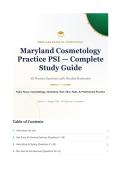
MARYL AND BOARD OF COSMETOLOGY
Maryland Cosmetology
Practice PSI — Complete
Study Guide
All Practice Questions with Detailed Rationales
Topic Focus: Cosmetology, Sanitation, Hair, Skin, Nails, & Professional Practice
Edition 1 · August 2026 · All Questions Complete
Table of Contents
1. Instructions for Use 2
2. Hair Color & Chemical Services (Questions 1–30) 2
3. Haircutting & Styling (Questions 31–55) 5
4. Skin Care & Hair Removal (Questions 56–75) 7
,5. Nail Care & Pedicure (Questions 76–95) 8
6. Sanitation, Safety & Infection Control (Questions 96–120) 9
7. Professional Practice & Client Consultation (Questions 121–140) 11
Maryland Cosmetology Practice PSI Page 1
,MARYLAND COSMETOLOGY STUDY GUIDE HAIR COLOR & CHEMICAL — Q1–30
How to Use This Guide
Read each stem, choose your answer, then check the rationale directly below it. The correct
option is marked, and each wrong option is explained so you understand why it's wrong — not
just that it is. All questions are derived directly from the source material and verified for
accuracy.
Category: Hair Color & Chemical Services — Questions 1–30
1 All of the following have insufficient structure to color except?
A Green cast
B Natural hair
C Highly bleached hair
D Damaged hair
Why B is correct: Natural hair has sufficient structure to color. Damaged, highly bleached
hair, and hair with a green cast (from mineral buildup) have insufficient structure to hold
color effectively.
A — Green cast indicates mineral buildup and insufficient structure.
C — Highly bleached hair is damaged and lacks structure.
D — Damaged hair lacks sufficient structure to hold color.
, 2 The cosmetic products in the salon are of concern to the FDA except?
A Product safety
B Product labeling
C To legally require companies to share information on their products
D Product claims
Why C is correct: The FDA does not have the authority to legally require companies to
share information on their cosmetic products. The FDA regulates product safety, labeling,
and claims but does not mandate sharing proprietary information.
A — The FDA is concerned with product safety.
B — The FDA is concerned with product labeling.
D — The FDA is concerned with product claims.
3 Where do the guidelines for human blood and bloody fluids come from?
A Universal Precautions
B OSHA
C CDC
D FDA
Why A is correct: Universal Precautions are the guidelines for handling human blood and
bloody fluids. These guidelines treat all human blood and certain body fluids as potentially
infectious.
B — OSHA enforces safety standards but Universal Precautions are the specific guidelines.
C — The CDC provides recommendations, but Universal Precautions are the specific
guidelines.
D — The FDA regulates products, not bloodborne pathogen guidelines.
Maryland Cosmetology
Practice PSI — Complete
Study Guide
All Practice Questions with Detailed Rationales
Topic Focus: Cosmetology, Sanitation, Hair, Skin, Nails, & Professional Practice
Edition 1 · August 2026 · All Questions Complete
Table of Contents
1. Instructions for Use 2
2. Hair Color & Chemical Services (Questions 1–30) 2
3. Haircutting & Styling (Questions 31–55) 5
4. Skin Care & Hair Removal (Questions 56–75) 7
,5. Nail Care & Pedicure (Questions 76–95) 8
6. Sanitation, Safety & Infection Control (Questions 96–120) 9
7. Professional Practice & Client Consultation (Questions 121–140) 11
Maryland Cosmetology Practice PSI Page 1
,MARYLAND COSMETOLOGY STUDY GUIDE HAIR COLOR & CHEMICAL — Q1–30
How to Use This Guide
Read each stem, choose your answer, then check the rationale directly below it. The correct
option is marked, and each wrong option is explained so you understand why it's wrong — not
just that it is. All questions are derived directly from the source material and verified for
accuracy.
Category: Hair Color & Chemical Services — Questions 1–30
1 All of the following have insufficient structure to color except?
A Green cast
B Natural hair
C Highly bleached hair
D Damaged hair
Why B is correct: Natural hair has sufficient structure to color. Damaged, highly bleached
hair, and hair with a green cast (from mineral buildup) have insufficient structure to hold
color effectively.
A — Green cast indicates mineral buildup and insufficient structure.
C — Highly bleached hair is damaged and lacks structure.
D — Damaged hair lacks sufficient structure to hold color.
, 2 The cosmetic products in the salon are of concern to the FDA except?
A Product safety
B Product labeling
C To legally require companies to share information on their products
D Product claims
Why C is correct: The FDA does not have the authority to legally require companies to
share information on their cosmetic products. The FDA regulates product safety, labeling,
and claims but does not mandate sharing proprietary information.
A — The FDA is concerned with product safety.
B — The FDA is concerned with product labeling.
D — The FDA is concerned with product claims.
3 Where do the guidelines for human blood and bloody fluids come from?
A Universal Precautions
B OSHA
C CDC
D FDA
Why A is correct: Universal Precautions are the guidelines for handling human blood and
bloody fluids. These guidelines treat all human blood and certain body fluids as potentially
infectious.
B — OSHA enforces safety standards but Universal Precautions are the specific guidelines.
C — The CDC provides recommendations, but Universal Precautions are the specific
guidelines.
D — The FDA regulates products, not bloodborne pathogen guidelines.


