

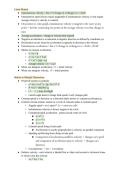
Linear Motion
● Instantaneous velocity = lim t→0 change in x/change in t = dx/dt
● Instantaneous speed always equals magnitude of instantaneous velocity; it only equals
average velocity is velocity is constant
● On position vs. time graph, instantaneous velocity is tangent to the curve at any
point → the line connecting two points in the average velocity over that change in
time
● Average acceleration = change of velocity/time elapsed
● Negative acceleration is acceleration in negative direction as defined by coordinate sys
● Deceleration occurs when the acceleration is opposite in direction to the velocity
● Instantaneous acceleration = lim t→0 change in v/change in t = dv/dt = d 2x/dt2
● Motion at constant acceleration
○ v = v0 + at
○ x = x0 + v0t + ½ at2
○ v2 = v02 + 2a(x - x0)
○ average velocity = (v + v0)/2
● When you integrate acceleration, +C = initial velocity
● When you integrate velocity, +C = initial position
Motion in Multiple Dimensions
● Projectile motion is parabolic
○ y = (vy0 / vx0) * x - (g / 2vx02) * x2
○ R = (v02 * sin(2θ )) / g
○ t = √ ❑ → time for flight
○ Launch angle doesn’t change final speed; it only changes path
● Constant speed in x direction; in y direction object moves w/ constant acceleration g
● Uniform circular motion: motion in a circle of constant radius at constant speed
○ Angular speed = rev/s speed * 2 π → units are rad/s
○ Instantaneous velocity is always tangent to the circle
○ Centripetal/radial acceleration - points toward center of circle
■ a = v2 / r
■ a = ω2 * r
■ v=ω*r
○ Constant speed along circular path
■ Acceleration is exactly perpendicular to velocity; no parallel component
○ Speeding up/Slowing down along circular path
■ Component of acceleration parallel to velocity → changes car’s speed
and component of acceleration perp to velocity → changes car’s
direction
○ Circumference = 2 π r = 1 revolution
● Relative velocity - each velocity is labeled first w/ object and second w/ reference frame
in which it has this velocity
○ vBS = vBW + vWS
● Instantaneous velocity = lim t→0 change in x/change in t = dx/dt
● Instantaneous speed always equals magnitude of instantaneous velocity; it only equals
average velocity is velocity is constant
● On position vs. time graph, instantaneous velocity is tangent to the curve at any
point → the line connecting two points in the average velocity over that change in
time
● Average acceleration = change of velocity/time elapsed
● Negative acceleration is acceleration in negative direction as defined by coordinate sys
● Deceleration occurs when the acceleration is opposite in direction to the velocity
● Instantaneous acceleration = lim t→0 change in v/change in t = dv/dt = d 2x/dt2
● Motion at constant acceleration
○ v = v0 + at
○ x = x0 + v0t + ½ at2
○ v2 = v02 + 2a(x - x0)
○ average velocity = (v + v0)/2
● When you integrate acceleration, +C = initial velocity
● When you integrate velocity, +C = initial position
Motion in Multiple Dimensions
● Projectile motion is parabolic
○ y = (vy0 / vx0) * x - (g / 2vx02) * x2
○ R = (v02 * sin(2θ )) / g
○ t = √ ❑ → time for flight
○ Launch angle doesn’t change final speed; it only changes path
● Constant speed in x direction; in y direction object moves w/ constant acceleration g
● Uniform circular motion: motion in a circle of constant radius at constant speed
○ Angular speed = rev/s speed * 2 π → units are rad/s
○ Instantaneous velocity is always tangent to the circle
○ Centripetal/radial acceleration - points toward center of circle
■ a = v2 / r
■ a = ω2 * r
■ v=ω*r
○ Constant speed along circular path
■ Acceleration is exactly perpendicular to velocity; no parallel component
○ Speeding up/Slowing down along circular path
■ Component of acceleration parallel to velocity → changes car’s speed
and component of acceleration perp to velocity → changes car’s
direction
○ Circumference = 2 π r = 1 revolution
● Relative velocity - each velocity is labeled first w/ object and second w/ reference frame
in which it has this velocity
○ vBS = vBW + vWS


