BUSI 2065 Management Strategy
1. Strategic management is about matching a firm’s internal resources & capabilities to the opportunities
arising in external environment
2. Strategy Choices:
a. Business level strategy: Competing at individual business level (Toyota vs BMW)
b. Corporate level strategy: Corporation’s business portfolio, diversification (Unilever)
3. How are strategies made:
a. Design (Intended Strategy): Strategy comes
from rational analytical process of planning by top
management team
b. Emergence (Realised/Emergent strategy):
Strategy emerges from organisational decisional
making
4. Strategy must be sustainable, there is no ‘best’ in business, should focus on creating unique offering
that gives advantage to you and other competitors can’t offer.
5. CSR: Businesses should recognise the poor as potential customers, workers instead of burden.
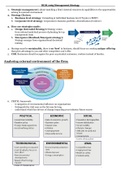
Analysing external environment of the firm:
6. PESTEL framework:
- 6 categories of environmental influence on organisations
- Extinguish the vital ones as the list may be long
- understand which key drivers of change impacting your industry/future sucess
,7. Spectrum of industry structures
- By examining an industry’s principal structural features & their interactions
o may be able to predict the type of competitive behaviour that is likely to emerge
o may be able to gauge the resulting level of profitability
8. Poster’s Five Forces Framework:
- Useful for assessment of the attractiveness of an industry in terms of industry structure
- Criticisms
o Not mentioned the effect of complimentary products, which have the opposite effect of
substitutes (i.e. enhances your business attractiveness to customers or suppliers)
o ‘Industry’ is too general of a concept. At times, boundaries are difficult to draw – industries may
converge; overlap; merge
o It is a static analysis. Cannot identify future trends and what features of an industry can be
changed
o Possibility of co-operative/collaborative strategies (linked to complementary ‘forces’ above) and
the contribution of game theory
9. Strategic Groups
- A group of firms in an industry that follow the same or similar strategies
- Used for detailed understanding of competition
, - Advantages:
o Better understanding of competition
▪ Allows focus on direct competitors in your group (vs. whole industry)
o Analysis of strategic opportunities
▪ Identifying ‘strategic spaces’ (see Dutch MBA example)
▪ Identifying possible ‘black holes’
o Analysis of mobility barriers
▪ Moving between strategic groups often involve difficult decisions.
▪ Strong mobility barriers within your strategic group may be good – to impede imitation
Analysing Internal environment of the firm:
10. Resource-based view
- Emphasis on profitability via firm’s uniqueness
- Focus on profiting from superiority of resources/capabilities instead of markets
- Markets are a secondary consideration; market-focused strategies may not provide sufficiently stable
foundation & constancy of direction
o Not easy to adjust to technological change within market
Eg. If product is about to become obsolete, should company focus on
• Continue to serve same customer needs?
• Deploy resources and capabilities in other markets?
- Competitive advantage
o Exploiting differences between firms
o The way resources are used/deployed
o Devising strategies that exploit the uniqueness of a firm’s portfolio of resources & capabilities
o So that such resources/competences permit, typically:
▪ Production at lower cost; or
▪ Generation of superior product or service at standard cost; compared to competitors
11. Analysis of Resource & capabilities in practice
a. Identifying Resource & capabilities
o Resources
▪ Tangible – physical, financial,
▪ Intangible – brand equity, reputation, intellectual property, culture
▪ Human – skills, motivation, capacity for communication & collaboration
o Resources are not productive on their own – need organizational capabilities/competences to
deploy them for a desired end result
1. Strategic management is about matching a firm’s internal resources & capabilities to the opportunities
arising in external environment
2. Strategy Choices:
a. Business level strategy: Competing at individual business level (Toyota vs BMW)
b. Corporate level strategy: Corporation’s business portfolio, diversification (Unilever)
3. How are strategies made:
a. Design (Intended Strategy): Strategy comes
from rational analytical process of planning by top
management team
b. Emergence (Realised/Emergent strategy):
Strategy emerges from organisational decisional
making
4. Strategy must be sustainable, there is no ‘best’ in business, should focus on creating unique offering
that gives advantage to you and other competitors can’t offer.
5. CSR: Businesses should recognise the poor as potential customers, workers instead of burden.
Analysing external environment of the firm:
6. PESTEL framework:
- 6 categories of environmental influence on organisations
- Extinguish the vital ones as the list may be long
- understand which key drivers of change impacting your industry/future sucess
,7. Spectrum of industry structures
- By examining an industry’s principal structural features & their interactions
o may be able to predict the type of competitive behaviour that is likely to emerge
o may be able to gauge the resulting level of profitability
8. Poster’s Five Forces Framework:
- Useful for assessment of the attractiveness of an industry in terms of industry structure
- Criticisms
o Not mentioned the effect of complimentary products, which have the opposite effect of
substitutes (i.e. enhances your business attractiveness to customers or suppliers)
o ‘Industry’ is too general of a concept. At times, boundaries are difficult to draw – industries may
converge; overlap; merge
o It is a static analysis. Cannot identify future trends and what features of an industry can be
changed
o Possibility of co-operative/collaborative strategies (linked to complementary ‘forces’ above) and
the contribution of game theory
9. Strategic Groups
- A group of firms in an industry that follow the same or similar strategies
- Used for detailed understanding of competition
, - Advantages:
o Better understanding of competition
▪ Allows focus on direct competitors in your group (vs. whole industry)
o Analysis of strategic opportunities
▪ Identifying ‘strategic spaces’ (see Dutch MBA example)
▪ Identifying possible ‘black holes’
o Analysis of mobility barriers
▪ Moving between strategic groups often involve difficult decisions.
▪ Strong mobility barriers within your strategic group may be good – to impede imitation
Analysing Internal environment of the firm:
10. Resource-based view
- Emphasis on profitability via firm’s uniqueness
- Focus on profiting from superiority of resources/capabilities instead of markets
- Markets are a secondary consideration; market-focused strategies may not provide sufficiently stable
foundation & constancy of direction
o Not easy to adjust to technological change within market
Eg. If product is about to become obsolete, should company focus on
• Continue to serve same customer needs?
• Deploy resources and capabilities in other markets?
- Competitive advantage
o Exploiting differences between firms
o The way resources are used/deployed
o Devising strategies that exploit the uniqueness of a firm’s portfolio of resources & capabilities
o So that such resources/competences permit, typically:
▪ Production at lower cost; or
▪ Generation of superior product or service at standard cost; compared to competitors
11. Analysis of Resource & capabilities in practice
a. Identifying Resource & capabilities
o Resources
▪ Tangible – physical, financial,
▪ Intangible – brand equity, reputation, intellectual property, culture
▪ Human – skills, motivation, capacity for communication & collaboration
o Resources are not productive on their own – need organizational capabilities/competences to
deploy them for a desired end result