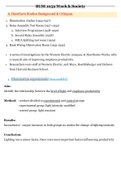
BUSI 1059 Work & Society
1. Illumination studies (1924-1927)
2. Relay Assembly Test Room (1927-1932)
a. Interview Programme (1928-1930)
b. Second Relay Assembly (1928)
c. MICA Splitting test room (1929)
3. Bank Wiring Observation Room (1931-1932)
• A series of investigations by the Western Electric company at Hawthorne Works, with
a research aim of improving employee productivity.
• Researchers were staff at Western Electric, and Mayo, Roethlisberger and Dickson
from Harvard Business School.
Aim:
identify the relationship between the level of light and employee productivity
Method: - workers divided to experimental and control groups
- experimental group: light intensity modified
- control group: light constant
Results:
Inconclusive - output increases in both groups no matter the change of lighting intensity
Conclusion:
Lighting was a minor factor, there were more important factors influencing productivity
,Aim:
to investigate the relationship between productivity and independent variables - physical
factors that cause fatigue and monotony.
Methods:
• 6 female employees and researcher were isolated from the main floor - control group
• 2 women were friends and selected 4 other women
• Normal working practices - systematic introduction of independent variables (rest
breaks: quantity, duration)
• Focus on impact of varied work conditions on the women
• 13 experimental treatments carried out
Results:
• Work conditions relaxed - increase in production (Sonnenfeld, 1985)
• Work conditions demanding - slightly decline in output (Sonnenfeld, 1985)
• Absenteeism reduced 1/3 both experiment and main floor workers (Sonnenfeld,
1985)
• Output seemed to increase even when experiment ended, thus conclusion was
inconclusive (Roethlisberger & Dickson )
Conclusion:
Productivity was increased due to:
1. Enhanced motivation for cooperation, performance
2. Consultation with experimenter, increased participation
3. Supervision style encouraged output
4. Friendlier supervision, freedom from tight quotas and harsh discipline has
improved morale and productivity
5. Self-selected group has better relationships. Climate for mutual dependence and
support, ideal for group working
,Aim:
to identify employees' attitudes and feelings
Method:
• Over 20,000 employees interviewed
• Open-ended interview, non-directive questions (was structured questions, but
workers wanted to talk) (Mayo)
Results:
• Workers brought up complains, mostly on employers
• Personal situation of workers understood - family, economic background. 'Emotional
release'
• Views of management and organisation. Hint of informal groups
Conclusions:
• Empathic listening by managers is important
• Employee Assistance Programme in Human Resources
Aim:
To observe social relations in workplace
Method:
• 14 male employees
• 3 teams - each 3 wirers, 1 supervisor
• 2 inspectors
Results:
• Existence of informal groups within formal structures
• Group norms and sanctions (Roethlisberger & Dickson, 2003)
a. Chisler: one who turned out too little work
, b. Rate buster: one who produces more than reasonable amount of work
c. Squeler: report things to supervisor
Conclusion: (Martin, 2005)
• Compared to pay or tangible benefits, rewards as member of informal group is more
significant and motivational
• Membership influences one's work behaviour and attitudes
• Influence of informal groups in working environment:
a. Frustrate management's intention and objectives
b. Engage in competitive activities that are against interest of organisation
• Management has little/no influence on the establishment and membership of
informal groups
Highlighted importance of human relations in organisational and industrial settings
o Mental attitude of workers
o Relationship between employees and management(relaxed, friendliness)
• Informal groups - social relationships & norms impact work behaviour
• Use of interviews - EAP
• Hawthorne Effect
o Subject reactivity to experimental conditions
o Changes in one's behaviour due to knowledge of taking part in research
o Unspecified whether affected entire or specific portion of Hawthorne Study
a. Ideological issues
i. Pro-management bias
o Conflict of interest - researchers biased towards management
o Bias in interpreting Hawthorne data (Bramel & Friend, 1981)
o Second Relay Assembly Test
• Single independent variable tested = incentives
1. Illumination studies (1924-1927)
2. Relay Assembly Test Room (1927-1932)
a. Interview Programme (1928-1930)
b. Second Relay Assembly (1928)
c. MICA Splitting test room (1929)
3. Bank Wiring Observation Room (1931-1932)
• A series of investigations by the Western Electric company at Hawthorne Works, with
a research aim of improving employee productivity.
• Researchers were staff at Western Electric, and Mayo, Roethlisberger and Dickson
from Harvard Business School.
Aim:
identify the relationship between the level of light and employee productivity
Method: - workers divided to experimental and control groups
- experimental group: light intensity modified
- control group: light constant
Results:
Inconclusive - output increases in both groups no matter the change of lighting intensity
Conclusion:
Lighting was a minor factor, there were more important factors influencing productivity
,Aim:
to investigate the relationship between productivity and independent variables - physical
factors that cause fatigue and monotony.
Methods:
• 6 female employees and researcher were isolated from the main floor - control group
• 2 women were friends and selected 4 other women
• Normal working practices - systematic introduction of independent variables (rest
breaks: quantity, duration)
• Focus on impact of varied work conditions on the women
• 13 experimental treatments carried out
Results:
• Work conditions relaxed - increase in production (Sonnenfeld, 1985)
• Work conditions demanding - slightly decline in output (Sonnenfeld, 1985)
• Absenteeism reduced 1/3 both experiment and main floor workers (Sonnenfeld,
1985)
• Output seemed to increase even when experiment ended, thus conclusion was
inconclusive (Roethlisberger & Dickson )
Conclusion:
Productivity was increased due to:
1. Enhanced motivation for cooperation, performance
2. Consultation with experimenter, increased participation
3. Supervision style encouraged output
4. Friendlier supervision, freedom from tight quotas and harsh discipline has
improved morale and productivity
5. Self-selected group has better relationships. Climate for mutual dependence and
support, ideal for group working
,Aim:
to identify employees' attitudes and feelings
Method:
• Over 20,000 employees interviewed
• Open-ended interview, non-directive questions (was structured questions, but
workers wanted to talk) (Mayo)
Results:
• Workers brought up complains, mostly on employers
• Personal situation of workers understood - family, economic background. 'Emotional
release'
• Views of management and organisation. Hint of informal groups
Conclusions:
• Empathic listening by managers is important
• Employee Assistance Programme in Human Resources
Aim:
To observe social relations in workplace
Method:
• 14 male employees
• 3 teams - each 3 wirers, 1 supervisor
• 2 inspectors
Results:
• Existence of informal groups within formal structures
• Group norms and sanctions (Roethlisberger & Dickson, 2003)
a. Chisler: one who turned out too little work
, b. Rate buster: one who produces more than reasonable amount of work
c. Squeler: report things to supervisor
Conclusion: (Martin, 2005)
• Compared to pay or tangible benefits, rewards as member of informal group is more
significant and motivational
• Membership influences one's work behaviour and attitudes
• Influence of informal groups in working environment:
a. Frustrate management's intention and objectives
b. Engage in competitive activities that are against interest of organisation
• Management has little/no influence on the establishment and membership of
informal groups
Highlighted importance of human relations in organisational and industrial settings
o Mental attitude of workers
o Relationship between employees and management(relaxed, friendliness)
• Informal groups - social relationships & norms impact work behaviour
• Use of interviews - EAP
• Hawthorne Effect
o Subject reactivity to experimental conditions
o Changes in one's behaviour due to knowledge of taking part in research
o Unspecified whether affected entire or specific portion of Hawthorne Study
a. Ideological issues
i. Pro-management bias
o Conflict of interest - researchers biased towards management
o Bias in interpreting Hawthorne data (Bramel & Friend, 1981)
o Second Relay Assembly Test
• Single independent variable tested = incentives