1. BODY WATER
Lecture summary
• Volumes and distribution
• Turnover
• Functions of water
• Dehydration and overhydration
Volumes and distribution
Total water content of the body varies according to
• Age
• Sex
• Body fat %
Variations in body fat content depends on body fat content e.g.
• 70% for a baby
• 60% for a healthy man
• 50% for an obese man
• 50% for a healthy woman
• 40% for an obese woman
Water content as percentage of total body mass by age and sex
Age Male Female
Infant 65% 65%
17-39 61% 51%
60+ 52% 46%
Body fluid components
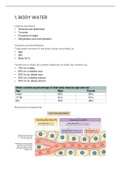
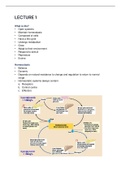
,• The body fluids are in two components: the extracellular fluid (ECF) and the
intracellular fluid (ICF)
• The ECF and ICF are in osmotic equilibrium but have very different chemical
composition
• Intracellular fluid is 2⁄3 of the total body water volume, material moving in and out
of the ICF must cross the cell membrane
• Extracellular fluid includes all fluid outside the cells, 1⁄3 of total body fluid volume
• ECF consists of interstitial fluid (IF) lies between the circulatory system and the
cells, is 75% of the ECF volume, and plasma, the liquid matrix of blood, is 25% of
the ECF volume
• Substances moving between the plasma and interstitial fluid must cross the leaky
exchange epithelium of the capillary wall
Example
Terminology
• Intracellular fluid: water inside cell
• Extracellular fluid: water in all spaces outside cell. Consists of:
a. Interstitial fluid: intercellular
b. Blood plasma
c. Trans-cellular fluid: inside hollow organs (lymph, cerebrospinal fluid, fluid in GI
tract, intra-ocular fluids etc.)
d. Intravascular fluid: inside blood vessels
e. Extravascular fluid: outside blood vessels
Water turnover
• The volume of water in the body is controlled by a delicate balance between
intake, excretion, and reabsorption
• Water gain is 2.2 l/day (2.2 l/day from food and drink, 0.3 l/day from metabolism
• Water loss is 2.5 l/day (insensible water loss 0.9 l/day from skin and lungs, 1.5
l/day from urine, and 0.1 l/day from faeces)
• Thus intake (2.2 l/day) + metabolic production (0.3 l/day) – output (2.5 l/day) = 0
,Water balance in the GI tract
• Fluid input into digestive system (9.0 l total input into lumen)
• Ingestion is 2.0 l food and drink
• Secretion is 1.5 l saliva (salivary glands), 0.5 l bile liver, 2.0 l gastric secretions,
1.5 l pancreatic secretions, and 1.5 l intestinal secretions
• Fluid removed from digestive system (9.0 l removed from lumen)
• Absorption is 7.5 l from small intestine, 1.4 l from large intestine
• Excretion is 0.1 l in faeces
, Functions of water
• Solvent and transport medium: soluble substances (ions) and insoluble
substances (lipids)
• Absorption: digestive system
• Excretion: skin and kidneys
• Medium for chemical reactions and reagent in some chemical reactions
• Ionization of atoms: determine electrical activity of cells
• Lubrication: joints and digestive system
• Stabilizing body temperature (thermo-homeostasis)
• Properties of water that makes it suitable are great heat capacity, good heat
conduction, and high latent temperature of evaporation
Dehydration and overhydration
Water loss
• The body has no water reserves
• 5% water loss causes thirst, 10% water loss makes you feel sick, and 20% water
loss causes death
• No water intake 4-6 days causes death
• Minimum intake is 0.5-1 l/day. Compulsory urine loss is 300-500 ml/day
• Anuria: no urine passed
Dehydration
• Dehydration: a state of excessive loss of body water
• Causes: persistent vomiting, diarrhoea, excessive sweating, diuresis, and
insufficient water intake
• Treatment: water per mouth, stomach tube, saline infusion
• Manifestation: thirst, dry mouth and throat, difficulty speaking and swallowing,
loss of mass, depression of the fontanelle in infants, increased pulse rate,
decreased blood pressure, increased haematocrit, acidosis, disorientation, and
collapse
Lecture summary
• Volumes and distribution
• Turnover
• Functions of water
• Dehydration and overhydration
Volumes and distribution
Total water content of the body varies according to
• Age
• Sex
• Body fat %
Variations in body fat content depends on body fat content e.g.
• 70% for a baby
• 60% for a healthy man
• 50% for an obese man
• 50% for a healthy woman
• 40% for an obese woman
Water content as percentage of total body mass by age and sex
Age Male Female
Infant 65% 65%
17-39 61% 51%
60+ 52% 46%
Body fluid components
,• The body fluids are in two components: the extracellular fluid (ECF) and the
intracellular fluid (ICF)
• The ECF and ICF are in osmotic equilibrium but have very different chemical
composition
• Intracellular fluid is 2⁄3 of the total body water volume, material moving in and out
of the ICF must cross the cell membrane
• Extracellular fluid includes all fluid outside the cells, 1⁄3 of total body fluid volume
• ECF consists of interstitial fluid (IF) lies between the circulatory system and the
cells, is 75% of the ECF volume, and plasma, the liquid matrix of blood, is 25% of
the ECF volume
• Substances moving between the plasma and interstitial fluid must cross the leaky
exchange epithelium of the capillary wall
Example
Terminology
• Intracellular fluid: water inside cell
• Extracellular fluid: water in all spaces outside cell. Consists of:
a. Interstitial fluid: intercellular
b. Blood plasma
c. Trans-cellular fluid: inside hollow organs (lymph, cerebrospinal fluid, fluid in GI
tract, intra-ocular fluids etc.)
d. Intravascular fluid: inside blood vessels
e. Extravascular fluid: outside blood vessels
Water turnover
• The volume of water in the body is controlled by a delicate balance between
intake, excretion, and reabsorption
• Water gain is 2.2 l/day (2.2 l/day from food and drink, 0.3 l/day from metabolism
• Water loss is 2.5 l/day (insensible water loss 0.9 l/day from skin and lungs, 1.5
l/day from urine, and 0.1 l/day from faeces)
• Thus intake (2.2 l/day) + metabolic production (0.3 l/day) – output (2.5 l/day) = 0
,Water balance in the GI tract
• Fluid input into digestive system (9.0 l total input into lumen)
• Ingestion is 2.0 l food and drink
• Secretion is 1.5 l saliva (salivary glands), 0.5 l bile liver, 2.0 l gastric secretions,
1.5 l pancreatic secretions, and 1.5 l intestinal secretions
• Fluid removed from digestive system (9.0 l removed from lumen)
• Absorption is 7.5 l from small intestine, 1.4 l from large intestine
• Excretion is 0.1 l in faeces
, Functions of water
• Solvent and transport medium: soluble substances (ions) and insoluble
substances (lipids)
• Absorption: digestive system
• Excretion: skin and kidneys
• Medium for chemical reactions and reagent in some chemical reactions
• Ionization of atoms: determine electrical activity of cells
• Lubrication: joints and digestive system
• Stabilizing body temperature (thermo-homeostasis)
• Properties of water that makes it suitable are great heat capacity, good heat
conduction, and high latent temperature of evaporation
Dehydration and overhydration
Water loss
• The body has no water reserves
• 5% water loss causes thirst, 10% water loss makes you feel sick, and 20% water
loss causes death
• No water intake 4-6 days causes death
• Minimum intake is 0.5-1 l/day. Compulsory urine loss is 300-500 ml/day
• Anuria: no urine passed
Dehydration
• Dehydration: a state of excessive loss of body water
• Causes: persistent vomiting, diarrhoea, excessive sweating, diuresis, and
insufficient water intake
• Treatment: water per mouth, stomach tube, saline infusion
• Manifestation: thirst, dry mouth and throat, difficulty speaking and swallowing,
loss of mass, depression of the fontanelle in infants, increased pulse rate,
decreased blood pressure, increased haematocrit, acidosis, disorientation, and
collapse