

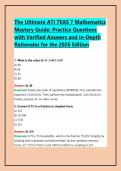
The Ultimate ATI TEAS 7 Mathematics
Mastery Guide: Practice Questions
with Verified Answers and In-Depth
Rationales for the 2026 Edition
1. What is the value of 43−2×843−2×8?
A) 48
B) 64
C) 32
D) 80
Answer: A) 48
Rationale: Follow the order of operations (PEMDAS). First, calculate the
exponent: 43=6443=64. Then, perform the multiplication: 2×8=162×8=16.
Finally, subtract: 64−16=4864−16=48.
2. Convert 0.75 to a fraction in simplest form.
A) 3/4
B) 75/100
C) 7/10
D) 3/5
Answer: A) 3/4
Rationale: 0.75 is 75 hundredths, which is the fraction 75/100. Simplify by
dividing both numerator and denominator by their greatest common
factor, 25: 75/25=375/25=3 and 100/25=4100/25=4, resulting in 3/4.
,3. What is the product of 1.5 and 0.2?
A) 0.3
B) 3.0
C) 0.03
D) 30
Answer: A) 0.3
Rationale: Multiply the numbers as if they were whole numbers: 15 × 2 =
30. Count the total number of decimal places in the factors (1.5 has one, 0.2
has one, total of two). Place the decimal point two places from the right in
the product: 0.30, which simplifies to 0.3.
4. Which of the following is equivalent to 235253?
A) 13/5
B) 10/5
C) 7/5
D) 6/5
Answer: A) 13/5
Rationale: To convert a mixed number to an improper fraction, multiply
the whole number by the denominator and add the
numerator: (2×5)+3=10+3=13(2×5)+3=10+3=13. Keep the same denominator:
13/5.
5. A nurse must administer 250 mg of a medication. The medication is
available in a liquid concentration of 100 mg/5 mL. How many mL
should the nurse administer?
A) 2.5 mL
B) 12.5 mL
C) 5 mL
D) 25 mL
,Answer: B) 12.5 mL
Rationale: Set up a proportion: 100 mg5 mL=250 mgx mL5 mL100 mg
=x mL250 mg. Cross-multiply: 100x=1250100x=1250. Divide both sides by
100: x=12.5x=12.5 mL.
6. What is the least common denominator (LCD) of 1331 and 2552?
A) 8
B) 15
C) 30
D) 3
Answer: B) 15
Rationale: The LCD is the least common multiple (LCM) of the
denominators. The multiples of 3 are 3, 6, 9, 12, 15, 18... The multiples of 5
are 5, 10, 15, 20... The smallest common multiple is 15.
7. Subtract: 78−1487−41
A) 5/8
B) 6/8
C) 6/4
D) 3/8
Answer: A) 5/8
Rationale: Find a common denominator. The LCD of 8 and 4 is 8.
Convert 1441 to 2882. Then subtract: 78−28=5887−82=85.
8. What is the value of 81+5281+52?
A) 34
B) 106
C) 14
D) 36
, Answer: A) 34
Rationale: 81=981=9 and 52=2552=25. Add them together: 9+25=349+25=34.
9. Which of the following is a prime number?
A) 21
B) 33
C) 47
D) 51
Answer: C) 47
Rationale: A prime number has exactly two factors: 1 and itself. 47 is only
divisible by 1 and 47. 21 (3×7), 33 (3×11), and 51 (3×17) are all composite.
10. Divide: 4.2÷0.74.2÷0.7
A) 0.6
B) 6
C) 60
D) 0.06
Answer: B) 6
Rationale: Move the decimal point in both the divisor and dividend one
place to the right to make the divisor a whole number: 42÷7=642÷7=6.
11. What is 30% of 200?
A) 6
B) 60
C) 600
D) 66.6
Answer: B) 60
Rationale: Convert the percentage to a decimal (30% = 0.30) and multiply:
0.30 × 200 = 60.
Mastery Guide: Practice Questions
with Verified Answers and In-Depth
Rationales for the 2026 Edition
1. What is the value of 43−2×843−2×8?
A) 48
B) 64
C) 32
D) 80
Answer: A) 48
Rationale: Follow the order of operations (PEMDAS). First, calculate the
exponent: 43=6443=64. Then, perform the multiplication: 2×8=162×8=16.
Finally, subtract: 64−16=4864−16=48.
2. Convert 0.75 to a fraction in simplest form.
A) 3/4
B) 75/100
C) 7/10
D) 3/5
Answer: A) 3/4
Rationale: 0.75 is 75 hundredths, which is the fraction 75/100. Simplify by
dividing both numerator and denominator by their greatest common
factor, 25: 75/25=375/25=3 and 100/25=4100/25=4, resulting in 3/4.
,3. What is the product of 1.5 and 0.2?
A) 0.3
B) 3.0
C) 0.03
D) 30
Answer: A) 0.3
Rationale: Multiply the numbers as if they were whole numbers: 15 × 2 =
30. Count the total number of decimal places in the factors (1.5 has one, 0.2
has one, total of two). Place the decimal point two places from the right in
the product: 0.30, which simplifies to 0.3.
4. Which of the following is equivalent to 235253?
A) 13/5
B) 10/5
C) 7/5
D) 6/5
Answer: A) 13/5
Rationale: To convert a mixed number to an improper fraction, multiply
the whole number by the denominator and add the
numerator: (2×5)+3=10+3=13(2×5)+3=10+3=13. Keep the same denominator:
13/5.
5. A nurse must administer 250 mg of a medication. The medication is
available in a liquid concentration of 100 mg/5 mL. How many mL
should the nurse administer?
A) 2.5 mL
B) 12.5 mL
C) 5 mL
D) 25 mL
,Answer: B) 12.5 mL
Rationale: Set up a proportion: 100 mg5 mL=250 mgx mL5 mL100 mg
=x mL250 mg. Cross-multiply: 100x=1250100x=1250. Divide both sides by
100: x=12.5x=12.5 mL.
6. What is the least common denominator (LCD) of 1331 and 2552?
A) 8
B) 15
C) 30
D) 3
Answer: B) 15
Rationale: The LCD is the least common multiple (LCM) of the
denominators. The multiples of 3 are 3, 6, 9, 12, 15, 18... The multiples of 5
are 5, 10, 15, 20... The smallest common multiple is 15.
7. Subtract: 78−1487−41
A) 5/8
B) 6/8
C) 6/4
D) 3/8
Answer: A) 5/8
Rationale: Find a common denominator. The LCD of 8 and 4 is 8.
Convert 1441 to 2882. Then subtract: 78−28=5887−82=85.
8. What is the value of 81+5281+52?
A) 34
B) 106
C) 14
D) 36
, Answer: A) 34
Rationale: 81=981=9 and 52=2552=25. Add them together: 9+25=349+25=34.
9. Which of the following is a prime number?
A) 21
B) 33
C) 47
D) 51
Answer: C) 47
Rationale: A prime number has exactly two factors: 1 and itself. 47 is only
divisible by 1 and 47. 21 (3×7), 33 (3×11), and 51 (3×17) are all composite.
10. Divide: 4.2÷0.74.2÷0.7
A) 0.6
B) 6
C) 60
D) 0.06
Answer: B) 6
Rationale: Move the decimal point in both the divisor and dividend one
place to the right to make the divisor a whole number: 42÷7=642÷7=6.
11. What is 30% of 200?
A) 6
B) 60
C) 600
D) 66.6
Answer: B) 60
Rationale: Convert the percentage to a decimal (30% = 0.30) and multiply:
0.30 × 200 = 60.


