

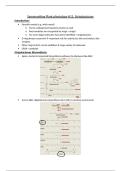
Samenvatting Plant physiology H11: Strigolactones
Introduction:
Parasitic weeds (e.g. witch weed)
o Forms underground haustoria (roots) as well
o Root exudates are recognized by striga = strigol
o Far more stigol molecules have been identified = strigolactones
D-ring always conserved important role for activity bcs this one binds to the
receptor
Other rings (A,B,C) can be modified large variety of molecules
GR24 = synthetic
Strigolactones Biosynthesis:
Again, started in terpenoid biosynthesis pathway (to phytoene like ABA)
Just as ABA, stigolactones biosynthesis start with -carotene as precursor
, Many intermediary steps remain unknown MAX1,3,4 play a big role
MAX2 is involved in signaling
Stigolactones are a root born signal
Strigolactones Signaling:
Receptor = D14 unusual bcs it is also a biochemical enzyme
o D14 is a hydrolase that cleaves strigolacton
o It changes conformation & requires the F-box protein MAX2
MAX2 is a member of SCF-complex
It targets SMXL’s for proteasomal degradation these are repressors
of strigolactone signaling & are tagged for degradation when
strigolactones are bound they inhibit downstream transcription
factors when strigolactones are not present
Introduction:
Parasitic weeds (e.g. witch weed)
o Forms underground haustoria (roots) as well
o Root exudates are recognized by striga = strigol
o Far more stigol molecules have been identified = strigolactones
D-ring always conserved important role for activity bcs this one binds to the
receptor
Other rings (A,B,C) can be modified large variety of molecules
GR24 = synthetic
Strigolactones Biosynthesis:
Again, started in terpenoid biosynthesis pathway (to phytoene like ABA)
Just as ABA, stigolactones biosynthesis start with -carotene as precursor
, Many intermediary steps remain unknown MAX1,3,4 play a big role
MAX2 is involved in signaling
Stigolactones are a root born signal
Strigolactones Signaling:
Receptor = D14 unusual bcs it is also a biochemical enzyme
o D14 is a hydrolase that cleaves strigolacton
o It changes conformation & requires the F-box protein MAX2
MAX2 is a member of SCF-complex
It targets SMXL’s for proteasomal degradation these are repressors
of strigolactone signaling & are tagged for degradation when
strigolactones are bound they inhibit downstream transcription
factors when strigolactones are not present


