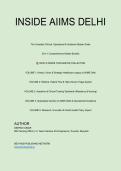
INSIDE AIIMS DELHI
The Complete Clinical, Operational & Academic Master Guide
(5-in-1 Comprehensive Master Bundle)
📚 WHAT'S INSIDE THIS MASTER COLLECTION
VOLUME 1: History, Vision & Strategic Healthcare Legacy of AIIMS Delhi
VOLUME 2: Referral, Patient Flow & High-Volume Triage System
VOLUME 3: Academic & Clinical Training Standards (Residency & Nursing)
VOLUME 4: Specialised Centres of AIIMS Delhi & Operational Excellence
VOLUME 5: Research, Innovation & Public Health Policy Impact
AUTHOR
DEEPAK KUMAR
MSc Nursing Officer | 3+ Years Intensive ICU Experience | Founder, Bexyhub
BEXYHUB PUBLISHING NETWORK
www.lexiv.bexyhub.in
,The Founding Era, Political Vision, and Legal
Genesis of AIIMS Delhi
Introduction: The Post-Independence Healthcare Crisis
When India attained independence in August 1947, it inherited a nation severely
fractured by centuries of colonial exploitation, widespread socioeconomic
impoverishment, and a virtually non-existent public health framework. The demographic
landscape of mid-20th century India was defined by staggering mortality rates, pervasive
infectious disease endemics, low life expectancy, and a drastic shortage of qualified
medical personnel.
The nation was plagued by recurring epidemics of smallpox, cholera, malaria, and
tuberculosis. Maternal and infant mortality rates were among the highest in the
developing world, while the total number of trained doctors across the country was
drastically insufficient for a population exceeding 330 million people. Furthermore, the
existing medical institutions were predominantly administrative relics of the British Raj,
designed primarily to serve colonial administrative centers and military cantonments
rather than to address the complex epidemiological needs of the general population.
More critically, India lacked an independent, self-sustaining ecosystem for higher medical
education and advanced scientific research. Young Indian physicians seeking specialized
post-graduate training, advanced surgical mentorship, or clinical research opportunities
were forced to travel abroad—primarily to the United Kingdom, Western Europe, or North
America. This reliance on Western institutions created a double jeopardy for the fledgling
nation:
1. Brain Drain: A vast majority of foreign-trained Indian medical professionals
remained abroad, depriving the country of top-tier clinical leadership.
2. Contextual Mismatch: The medical knowledge, research priorities, and clinical
methodologies taught in Western universities were tailored to high-resource,
industrialized nations and failed to address the tropical diseases, rural poverty,
and resource-constrained environments characteristic of South Asia.
It was against this backdrop of national necessity that the vision for an
autonomous, world-class medical institute was born—an institution that would
serve as a temple of modern medicine, an incubator for scientific innovation,
, and a self-reliant powerhouse for producing medical leaders tailored specifically
to the needs of India.
+------------------------------------------------------------------------
-+
| POST-INDEPENDENCE HEALTHCARE CRISIS
|
+------------------------------------------------------------------------
-+
| • Pervasive Epidemics (Malaria, TB, Smallpox, Cholera)
|
| • Crippling Shortage of Trained Medical & Nursing Professionals
|
| • Absolute Dependence on Western Universities for Advanced Training
|
| • Lack of Context-Specific Tropical & Public Health Research
|
+------------------------------------------------------------------------
-+
│
▼
+------------------------------------------------------------------------
-+
| THE STRATEGIC IMPERATIVE
|
+------------------------------------------------------------------------
-+
| Establish an Autonomous, National Institution to spearhead Medical
|
| Education, Tertiary Patient Care, and Indigenous Biomedical Research
|
+------------------------------------------------------------------------
-+
, The Bhore Committee Recommendations (1943-1946)
The conceptual blueprint for AIIMS Delhi originated prior to independence, rooted in the
landmark findings of the Health Survey and Development Committee, popularly
known as the Bhore Committee. Appointed by the Government of India in October 1943
under the chairmanship of Sir Joseph Bhore, the committee was tasked with conducting
a comprehensive national survey of existing health conditions and formulating
recommendations for future health development.
Published in 1946, the four-volume Bhore Committee Report stands as one of the most
visionary and comprehensive public health documents in modern history. Among its
most revolutionary observations was the assertion that health care and medical
education must be treated as fundamental public goods, fully integrated and
accessible to all citizens regardless of socio-economic status.
Key Mandates of the Bhore Committee for Higher Education:
Creation of a National Medical Center: The committee recommended the
establishment of a single, highly advanced "National Medical Center" that would
set the standard for medical education across the entire Indian subcontinent.
Focus on Quality over Quantity: While acknowledging the urgent need for
more doctors, the committee emphasized that the quality of undergraduate and
postgraduate training must never be compromised. The primary objective was to
produce "basic doctors" equipped with a strong background in preventive, social,
and clinical medicine.
Integration of Research and Clinical Care: The proposed center was
envisioned not merely as a hospital, but as a center of higher learning where
scientific research, pedagogical refinement, and high-volume clinical care
occurred under one roof.
Postgraduate Self-Reliance: The committee highlighted that until India
established its own postgraduate training centers, it could never achieve true
independence in healthcare policy or medical innovation.
The Bhore Committee's recommendations laid the intellectual groundwork for
what would eventually materialize a decade later as the All India Institute of
Medical Sciences.
The Complete Clinical, Operational & Academic Master Guide
(5-in-1 Comprehensive Master Bundle)
📚 WHAT'S INSIDE THIS MASTER COLLECTION
VOLUME 1: History, Vision & Strategic Healthcare Legacy of AIIMS Delhi
VOLUME 2: Referral, Patient Flow & High-Volume Triage System
VOLUME 3: Academic & Clinical Training Standards (Residency & Nursing)
VOLUME 4: Specialised Centres of AIIMS Delhi & Operational Excellence
VOLUME 5: Research, Innovation & Public Health Policy Impact
AUTHOR
DEEPAK KUMAR
MSc Nursing Officer | 3+ Years Intensive ICU Experience | Founder, Bexyhub
BEXYHUB PUBLISHING NETWORK
www.lexiv.bexyhub.in
,The Founding Era, Political Vision, and Legal
Genesis of AIIMS Delhi
Introduction: The Post-Independence Healthcare Crisis
When India attained independence in August 1947, it inherited a nation severely
fractured by centuries of colonial exploitation, widespread socioeconomic
impoverishment, and a virtually non-existent public health framework. The demographic
landscape of mid-20th century India was defined by staggering mortality rates, pervasive
infectious disease endemics, low life expectancy, and a drastic shortage of qualified
medical personnel.
The nation was plagued by recurring epidemics of smallpox, cholera, malaria, and
tuberculosis. Maternal and infant mortality rates were among the highest in the
developing world, while the total number of trained doctors across the country was
drastically insufficient for a population exceeding 330 million people. Furthermore, the
existing medical institutions were predominantly administrative relics of the British Raj,
designed primarily to serve colonial administrative centers and military cantonments
rather than to address the complex epidemiological needs of the general population.
More critically, India lacked an independent, self-sustaining ecosystem for higher medical
education and advanced scientific research. Young Indian physicians seeking specialized
post-graduate training, advanced surgical mentorship, or clinical research opportunities
were forced to travel abroad—primarily to the United Kingdom, Western Europe, or North
America. This reliance on Western institutions created a double jeopardy for the fledgling
nation:
1. Brain Drain: A vast majority of foreign-trained Indian medical professionals
remained abroad, depriving the country of top-tier clinical leadership.
2. Contextual Mismatch: The medical knowledge, research priorities, and clinical
methodologies taught in Western universities were tailored to high-resource,
industrialized nations and failed to address the tropical diseases, rural poverty,
and resource-constrained environments characteristic of South Asia.
It was against this backdrop of national necessity that the vision for an
autonomous, world-class medical institute was born—an institution that would
serve as a temple of modern medicine, an incubator for scientific innovation,
, and a self-reliant powerhouse for producing medical leaders tailored specifically
to the needs of India.
+------------------------------------------------------------------------
-+
| POST-INDEPENDENCE HEALTHCARE CRISIS
|
+------------------------------------------------------------------------
-+
| • Pervasive Epidemics (Malaria, TB, Smallpox, Cholera)
|
| • Crippling Shortage of Trained Medical & Nursing Professionals
|
| • Absolute Dependence on Western Universities for Advanced Training
|
| • Lack of Context-Specific Tropical & Public Health Research
|
+------------------------------------------------------------------------
-+
│
▼
+------------------------------------------------------------------------
-+
| THE STRATEGIC IMPERATIVE
|
+------------------------------------------------------------------------
-+
| Establish an Autonomous, National Institution to spearhead Medical
|
| Education, Tertiary Patient Care, and Indigenous Biomedical Research
|
+------------------------------------------------------------------------
-+
, The Bhore Committee Recommendations (1943-1946)
The conceptual blueprint for AIIMS Delhi originated prior to independence, rooted in the
landmark findings of the Health Survey and Development Committee, popularly
known as the Bhore Committee. Appointed by the Government of India in October 1943
under the chairmanship of Sir Joseph Bhore, the committee was tasked with conducting
a comprehensive national survey of existing health conditions and formulating
recommendations for future health development.
Published in 1946, the four-volume Bhore Committee Report stands as one of the most
visionary and comprehensive public health documents in modern history. Among its
most revolutionary observations was the assertion that health care and medical
education must be treated as fundamental public goods, fully integrated and
accessible to all citizens regardless of socio-economic status.
Key Mandates of the Bhore Committee for Higher Education:
Creation of a National Medical Center: The committee recommended the
establishment of a single, highly advanced "National Medical Center" that would
set the standard for medical education across the entire Indian subcontinent.
Focus on Quality over Quantity: While acknowledging the urgent need for
more doctors, the committee emphasized that the quality of undergraduate and
postgraduate training must never be compromised. The primary objective was to
produce "basic doctors" equipped with a strong background in preventive, social,
and clinical medicine.
Integration of Research and Clinical Care: The proposed center was
envisioned not merely as a hospital, but as a center of higher learning where
scientific research, pedagogical refinement, and high-volume clinical care
occurred under one roof.
Postgraduate Self-Reliance: The committee highlighted that until India
established its own postgraduate training centers, it could never achieve true
independence in healthcare policy or medical innovation.
The Bhore Committee's recommendations laid the intellectual groundwork for
what would eventually materialize a decade later as the All India Institute of
Medical Sciences.