testing different cognitive abilities, analytical skills, and subject-specific knowledge. In this essay, we will explore the nature of exams in business, law, and mathematics, their format, and how they evaluate students’ comprehension and
application of core concepts. We will also discuss the similarities and differences
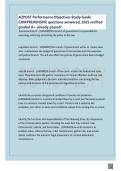
AZPOST Performance Objectives Study Guide
COMPREHENSIVE questions answered, 2025 verified
graded A+ already passed!
Executive branch - (ANSWER)This branch of government is responsible for
executing, enforcing and setting the policy of the law.
Legislative branch - (ANSWER)This branch of government writes or creates laws.
Also, it determines the budget of government that includes both the executive
and judicial branch. This will also affect the policies of government due to budget
constraints.
Judicial branch - (ANSWER)Consists of the courts at both the federal and state
level. They determine the guilt or innocence of criminal offenders and hear civil
disputes. Make judgments, decisions and interpretations concerning the law,
policies and decisions of the executive and legislative branches.
Identify the purposes and general conditions of parole and probation. -
(ANSWER)Probation is a sentence handed down by a court just the same as prison
time is a sentence handed down by a court. Parole is not a sentence like
probation, but rather an early and conditional release from serving time in prison.
Identify the functions and responsibilities of the following three (3) components
of the criminal justice system, including the ways that they interact: Law
Enforcement, Judicial, and Corrections - (ANSWER)Law enforcement is to
problem solve, enforce the law, order maintenance, gather info, and service
duties. Judicial is the arena for legal prosecution of criminal defendants.
Corrections is
,testing different cognitive abilities, analytical skills, and subject-specific
Stuvia.com knowledge.
- TheInMarketplace
this essay, we willto
explore
Buythe
andnature of exams
Sell yourinStudy
business,Material
law, and mathematics, their format, and how they evaluate students’
comprehension and application of core concepts. We will also discuss the similarities and differences
Victim/witness services - (ANSWER)They provide the victim with the following
services: Financial assistance for loss of wages, counseling, medical needs and
many other needs.
Police/Sheriff - (ANSWER)Responds to the victim's call for assistance. Helps
conduct the investigation of the incident, makes an arrest and prepares the facts
for prosecution.
Correctional officers - (ANSWER)A correction officer supervises inmates and
provides for the safety and security of staff and inmates in prison.
Parole officers - (ANSWER)If a person violates the conditions of his/her parole,
the parole officer, at a hearing, revokes it and he/she is sent back to prison.
Probation officers - (ANSWER)The probation officer is the person that oversees or
supervises the individual to see if the person is meeting those conditions. They
are under the court component.
Defense attorneys - (ANSWER)Responsibility is to represent anyone who is
accused of a crime, whether they are guilty or not regardless of personal feelings
Prosecuting attorneys - (ANSWER)Examines the case then determines whether to
prosecute or not. If yes, he/she prepares for the case by examining evidence and
preparing witnesses. Presents the case to the jury or judge, if it goes to trial.
,testing different cognitive abilities, analytical skills, and subject-specific
Stuvia.com knowledge.
- TheInMarketplace
this essay, we willto
explore
Buythe
andnature of exams
Sell yourinStudy
business,Material
law, and mathematics, their format, and how they evaluate students’
comprehension and application of core concepts. We will also discuss the similarities and differences
Judges - (ANSWER)Responsible for overseeing the judicial or trial process. To
ensure that the defendant's constitutional rights are protected and that proper
procedure is followed.
Laws of Hammurabi. - (ANSWER)King Hammurabi wanted one (1) set of laws for
his entire kingdom. So he developed the first set of written laws and criminal
justice system known to man. Justice belonged to the king. Private dealings were
to be handled between individuals.
Mutual pledge system. - (ANSWER)The public being responsible to enforce its
own laws and catch violators. The concept of "sheriff" was developed from the
office of Shire-Reeve. The Shire-Reeve was responsible for the jail and to gather
taxes for the king.
Magna Carta. - (ANSWER)In 1214 AD, the Magna Carta was signed by King John
(the Terrible) after losing a rebellion with his barons and other nobility. The
Magna Carta is important because it is the foundation of our procedural due
process and the Bill of Rights.
Peelian reform. - (ANSWER)In June of 1829, Parliament passed the Metropolitan
Police act which created the London Metropolitan Police. The Peelian principals
were centrally located headquarters, document enforcement actions (for the first
time), and distribution of criminal news.
, testing different cognitive abilities, analytical skills, and subject-specific
Stuvia.com knowledge.
- TheInMarketplace
this essay, we willto
explore
Buythe
andnature of exams
Sell yourinStudy
business,Material
law, and mathematics, their format, and how they evaluate students’
comprehension and application of core concepts. We will also discuss the similarities and differences
Development of police agencies in the United States. - (ANSWER)Political era
(1840-1920), Professional model era (1920-1970), community-problem solving era
(1970-present day), and number based policing.
Identify the five (5) categories of law enforcement in Arizona - (ANSWER)Federal,
State, Tribal, County, and Local
A.R.S. §13-3871 - (ANSWER)Authority of peace officers
A.R.S. §13-3874 - (ANSWER)Indian police; powers; qualifications
A.R.S. §13-3875 - (ANSWER)Cross-certification of federal peace officers
Chain of Command - (ANSWER)Every person has only ONE supervisor or boss.
That person in turn has a supervisor or boss. This continues to the top of the
organization. For an organization to run effectively, officers cannot be given
orders from different supervisors.
Span of Control - (ANSWER)There are a certain number of officers that a
supervisor can effectively supervise. This number is generally felt to be between
six to eight (6-8), depending on the types of assignments of the
officers. More than this can cause lack of control and
productivity.
application of core concepts. We will also discuss the similarities and differences
AZPOST Performance Objectives Study Guide
COMPREHENSIVE questions answered, 2025 verified
graded A+ already passed!
Executive branch - (ANSWER)This branch of government is responsible for
executing, enforcing and setting the policy of the law.
Legislative branch - (ANSWER)This branch of government writes or creates laws.
Also, it determines the budget of government that includes both the executive
and judicial branch. This will also affect the policies of government due to budget
constraints.
Judicial branch - (ANSWER)Consists of the courts at both the federal and state
level. They determine the guilt or innocence of criminal offenders and hear civil
disputes. Make judgments, decisions and interpretations concerning the law,
policies and decisions of the executive and legislative branches.
Identify the purposes and general conditions of parole and probation. -
(ANSWER)Probation is a sentence handed down by a court just the same as prison
time is a sentence handed down by a court. Parole is not a sentence like
probation, but rather an early and conditional release from serving time in prison.
Identify the functions and responsibilities of the following three (3) components
of the criminal justice system, including the ways that they interact: Law
Enforcement, Judicial, and Corrections - (ANSWER)Law enforcement is to
problem solve, enforce the law, order maintenance, gather info, and service
duties. Judicial is the arena for legal prosecution of criminal defendants.
Corrections is
,testing different cognitive abilities, analytical skills, and subject-specific
Stuvia.com knowledge.
- TheInMarketplace
this essay, we willto
explore
Buythe
andnature of exams
Sell yourinStudy
business,Material
law, and mathematics, their format, and how they evaluate students’
comprehension and application of core concepts. We will also discuss the similarities and differences
Victim/witness services - (ANSWER)They provide the victim with the following
services: Financial assistance for loss of wages, counseling, medical needs and
many other needs.
Police/Sheriff - (ANSWER)Responds to the victim's call for assistance. Helps
conduct the investigation of the incident, makes an arrest and prepares the facts
for prosecution.
Correctional officers - (ANSWER)A correction officer supervises inmates and
provides for the safety and security of staff and inmates in prison.
Parole officers - (ANSWER)If a person violates the conditions of his/her parole,
the parole officer, at a hearing, revokes it and he/she is sent back to prison.
Probation officers - (ANSWER)The probation officer is the person that oversees or
supervises the individual to see if the person is meeting those conditions. They
are under the court component.
Defense attorneys - (ANSWER)Responsibility is to represent anyone who is
accused of a crime, whether they are guilty or not regardless of personal feelings
Prosecuting attorneys - (ANSWER)Examines the case then determines whether to
prosecute or not. If yes, he/she prepares for the case by examining evidence and
preparing witnesses. Presents the case to the jury or judge, if it goes to trial.
,testing different cognitive abilities, analytical skills, and subject-specific
Stuvia.com knowledge.
- TheInMarketplace
this essay, we willto
explore
Buythe
andnature of exams
Sell yourinStudy
business,Material
law, and mathematics, their format, and how they evaluate students’
comprehension and application of core concepts. We will also discuss the similarities and differences
Judges - (ANSWER)Responsible for overseeing the judicial or trial process. To
ensure that the defendant's constitutional rights are protected and that proper
procedure is followed.
Laws of Hammurabi. - (ANSWER)King Hammurabi wanted one (1) set of laws for
his entire kingdom. So he developed the first set of written laws and criminal
justice system known to man. Justice belonged to the king. Private dealings were
to be handled between individuals.
Mutual pledge system. - (ANSWER)The public being responsible to enforce its
own laws and catch violators. The concept of "sheriff" was developed from the
office of Shire-Reeve. The Shire-Reeve was responsible for the jail and to gather
taxes for the king.
Magna Carta. - (ANSWER)In 1214 AD, the Magna Carta was signed by King John
(the Terrible) after losing a rebellion with his barons and other nobility. The
Magna Carta is important because it is the foundation of our procedural due
process and the Bill of Rights.
Peelian reform. - (ANSWER)In June of 1829, Parliament passed the Metropolitan
Police act which created the London Metropolitan Police. The Peelian principals
were centrally located headquarters, document enforcement actions (for the first
time), and distribution of criminal news.
, testing different cognitive abilities, analytical skills, and subject-specific
Stuvia.com knowledge.
- TheInMarketplace
this essay, we willto
explore
Buythe
andnature of exams
Sell yourinStudy
business,Material
law, and mathematics, their format, and how they evaluate students’
comprehension and application of core concepts. We will also discuss the similarities and differences
Development of police agencies in the United States. - (ANSWER)Political era
(1840-1920), Professional model era (1920-1970), community-problem solving era
(1970-present day), and number based policing.
Identify the five (5) categories of law enforcement in Arizona - (ANSWER)Federal,
State, Tribal, County, and Local
A.R.S. §13-3871 - (ANSWER)Authority of peace officers
A.R.S. §13-3874 - (ANSWER)Indian police; powers; qualifications
A.R.S. §13-3875 - (ANSWER)Cross-certification of federal peace officers
Chain of Command - (ANSWER)Every person has only ONE supervisor or boss.
That person in turn has a supervisor or boss. This continues to the top of the
organization. For an organization to run effectively, officers cannot be given
orders from different supervisors.
Span of Control - (ANSWER)There are a certain number of officers that a
supervisor can effectively supervise. This number is generally felt to be between
six to eight (6-8), depending on the types of assignments of the
officers. More than this can cause lack of control and
productivity.