

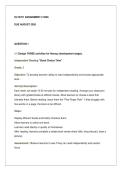
HLT3701 ASSIGNMENT 2 2026
DUE AUGUST 2026
QUESTION 1
1.1 Design THREE activities for literacy development stages.
Independent Reading "Book Choice Time"
Grade: 2
Objective: To develop learners' ability to read independently and choose appropriate
texts.
Activity Description:
Each week, set aside 15-20 minutes for independent reading. Arrange your classroom
library with graded books at different levels. Allow learners to choose a book that
interests them. Before reading, teach them the "Five Finger Rule" if they struggle with
five words on a page, the book is too difficult.
Steps:
Display different books and briefly introduce them.
Allow learners to select one book.
Learners read silently or quietly to themselves.
After reading, learners complete a simple book review sheet (title, favourite part, draw a
picture).
Assessment: Observe learners to see if they can read independently and sustain
focus.
,(Study Guide, Unit 1, p. 18)
Sentence Writing "Sentence of the Day"
Grade: 1
Objective: To develop learners' ability to write simple sentences using correct spacing,
capital letters, and full stops.
Activity Description:
Start each day with a "Sentence of the Day" based on the weekly theme. Write a
sentence on the board and read it aloud. Learners copy the sentence into their writing
books.
Steps:
Write a sentence related to the theme e.g., "I see a big dog.".
Read the sentence aloud and point to each word.
Discuss capital letters, full stops, and spacing.
Learners copy the sentence into their books.
Ask learners to draw a picture to match the sentence.
Assessment: Check learners' books for correct letter formation, spacing, and
punctuation.
(Study Guide, Unit 1, p. 23)
, Punctuation Activities "Punctuation Hunt"
Grade: 2
Objective: To help learners recognise and use punctuation marks correctly.
Activity Description:
Provide learners with short paragraphs or sentences without punctuation. Ask them to
add capital letters, full stops, question marks, and exclamation marks where needed.
Steps:
Display a sentence without punctuation on the board e.g., "the cat sat on the mat".
Ask learners to identify what is missing.
Learners rewrite the sentence with correct punctuation.
For advanced learners, give a short paragraph with missing punctuation.
Learners swap books and check each other's work.
Assessment: Use a checklist to assess if learners can identify and use capital letters
and full stops correctly.
(Study Guide, Unit 4, Part 2, p. 114)
1.2 Explain how to create a language-rich classroom with limited resources
Even with limited resources, you can create a language-rich classroom using simple,
homemade materials. Below are TWO practical examples:
DUE AUGUST 2026
QUESTION 1
1.1 Design THREE activities for literacy development stages.
Independent Reading "Book Choice Time"
Grade: 2
Objective: To develop learners' ability to read independently and choose appropriate
texts.
Activity Description:
Each week, set aside 15-20 minutes for independent reading. Arrange your classroom
library with graded books at different levels. Allow learners to choose a book that
interests them. Before reading, teach them the "Five Finger Rule" if they struggle with
five words on a page, the book is too difficult.
Steps:
Display different books and briefly introduce them.
Allow learners to select one book.
Learners read silently or quietly to themselves.
After reading, learners complete a simple book review sheet (title, favourite part, draw a
picture).
Assessment: Observe learners to see if they can read independently and sustain
focus.
,(Study Guide, Unit 1, p. 18)
Sentence Writing "Sentence of the Day"
Grade: 1
Objective: To develop learners' ability to write simple sentences using correct spacing,
capital letters, and full stops.
Activity Description:
Start each day with a "Sentence of the Day" based on the weekly theme. Write a
sentence on the board and read it aloud. Learners copy the sentence into their writing
books.
Steps:
Write a sentence related to the theme e.g., "I see a big dog.".
Read the sentence aloud and point to each word.
Discuss capital letters, full stops, and spacing.
Learners copy the sentence into their books.
Ask learners to draw a picture to match the sentence.
Assessment: Check learners' books for correct letter formation, spacing, and
punctuation.
(Study Guide, Unit 1, p. 23)
, Punctuation Activities "Punctuation Hunt"
Grade: 2
Objective: To help learners recognise and use punctuation marks correctly.
Activity Description:
Provide learners with short paragraphs or sentences without punctuation. Ask them to
add capital letters, full stops, question marks, and exclamation marks where needed.
Steps:
Display a sentence without punctuation on the board e.g., "the cat sat on the mat".
Ask learners to identify what is missing.
Learners rewrite the sentence with correct punctuation.
For advanced learners, give a short paragraph with missing punctuation.
Learners swap books and check each other's work.
Assessment: Use a checklist to assess if learners can identify and use capital letters
and full stops correctly.
(Study Guide, Unit 4, Part 2, p. 114)
1.2 Explain how to create a language-rich classroom with limited resources
Even with limited resources, you can create a language-rich classroom using simple,
homemade materials. Below are TWO practical examples:


