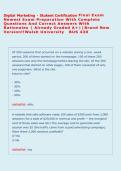
Digital Marketing - Stukent Certification F inal E xam
Newest Exam Prep aration With Comp lete
Questions And Co rrect Answe rs With
Rationa les | Alread y Grad ed A+||Bran d New
Version !! Walsh University B US 430
Of 500 sessions that occurred on a website during a one- week
period, 200 of them started on the homepage; 100 of these 200
sessions saw only the homepage before leaving the site. Of the 300
sessions that started on other pages, 100 of them consisted of only
one pageview. What is the site
bounce rate?
- 40%
- 30%
- 20%
- 50%
ANSWERS: 40%
A website that sells software made 100 sales of $200 each from 2,000
sessions (for a total of $20,000 in revenue and profit — the marginal
cost of these sales was $0.) The average cost to generate each
session was $5 (the traffic came from a paid advertising campaign).
Were these 2,000 sessions profitable?
© Yes
© No
ANSWERS: Yes
,A lead generation website received 1,000 visitors, gained 80 leads,
and booked jobs with 20 of those leads. What is the conversion rate
and what is the close rate?
© 8%; 25%
© 8%; 20%
© 20%; 25%
© 20%; 80%
ANSWERS: 8%; 25%
A low conversion rate can be caused by all of the following EXCEPT:
© Poor web design
©) Poor audience selection
© Technical glitches
© Overly responsive design
ANSWERS: Overly responsive design
Channel analysis enables an analytics user to:
© Determine which ad copy produced the highest click-through rate
© Investigate which traffic source produced the best-quality traffic
O Conduct counterfactual analyses of the effect of increased
marketing investments in any channel
© Find ways to shift paid traffic sources toward unpaid traffic sources
ANSWERS: Investigate which traffic source produced the best-quality
traffic
The most reliable way to measure advertising effectiveness is to:
© Stop advertising altogether
© Use Google's data-driven attribution tool ©) Use linear attribution
© Conduct a carefully controlled experiment
ANSWERS: Conduct a carefully controlled experiment
,Organic search results are typically displayed:
© On page 2
© At the top of the SERP
© Below the paid ads
© Interspersed with paid ads
ANSWERS: Below the paid ads
For a search engine, "relevance" refers to:
© The extent to which a web page's content matches the searcher's
query
© Whether a website has been visited by the searcher before
©) The traffic level of the website
© How many pages on the website link to one another
ANSWERS: The extent to which a web page's content matches the
searcher's query
Jane.com sells clothing and accessories. They want their line of
maternity clothing to show up on searches that include "maternity".
What should the URL for the maternity
category page be?
© https://jane.com/category5
© https://maternity.jane.com/
© https://jane.maternity.com/
© https://jane.com/maternity
ANSWERS: https://jane.com/maternity
, Including the word "maternity" in the alt text and file name of several
images on the maternity category page of Jane.com will improve the
page's relevance score for searches using
the word 'maternity'. What other benefit can result from this?
© The website will be better organized
O The images are more likely to show up on image searches that use
"maternity"
O Other category pages in the website will be more likely to show up
for searches that use the word "maternity"
O Individual product pages that sell maternity products will
automatically be optimized for relevant searches
ANSWERS: The images are more likely to show up on image searches
that use "maternity"
Even a highly relevant keyword may not be worth pursuing in your
SEO if:
© The keyword is too long
© The keyword has no traffic
© The keyword is synonymous with other terms
© The keyword is often misspelled
ANSWERS: The keyword has no traffic
"Long tail keywords" are:
© Search terms with lower volume than "fat head keywords"
© Search terms that produce a low conversion rate
(©) Search terms done on mobile devices
© Search terms for niche product categories
ANSWERS: Search terms with lower volume than "fat head keywords"
Newest Exam Prep aration With Comp lete
Questions And Co rrect Answe rs With
Rationa les | Alread y Grad ed A+||Bran d New
Version !! Walsh University B US 430
Of 500 sessions that occurred on a website during a one- week
period, 200 of them started on the homepage; 100 of these 200
sessions saw only the homepage before leaving the site. Of the 300
sessions that started on other pages, 100 of them consisted of only
one pageview. What is the site
bounce rate?
- 40%
- 30%
- 20%
- 50%
ANSWERS: 40%
A website that sells software made 100 sales of $200 each from 2,000
sessions (for a total of $20,000 in revenue and profit — the marginal
cost of these sales was $0.) The average cost to generate each
session was $5 (the traffic came from a paid advertising campaign).
Were these 2,000 sessions profitable?
© Yes
© No
ANSWERS: Yes
,A lead generation website received 1,000 visitors, gained 80 leads,
and booked jobs with 20 of those leads. What is the conversion rate
and what is the close rate?
© 8%; 25%
© 8%; 20%
© 20%; 25%
© 20%; 80%
ANSWERS: 8%; 25%
A low conversion rate can be caused by all of the following EXCEPT:
© Poor web design
©) Poor audience selection
© Technical glitches
© Overly responsive design
ANSWERS: Overly responsive design
Channel analysis enables an analytics user to:
© Determine which ad copy produced the highest click-through rate
© Investigate which traffic source produced the best-quality traffic
O Conduct counterfactual analyses of the effect of increased
marketing investments in any channel
© Find ways to shift paid traffic sources toward unpaid traffic sources
ANSWERS: Investigate which traffic source produced the best-quality
traffic
The most reliable way to measure advertising effectiveness is to:
© Stop advertising altogether
© Use Google's data-driven attribution tool ©) Use linear attribution
© Conduct a carefully controlled experiment
ANSWERS: Conduct a carefully controlled experiment
,Organic search results are typically displayed:
© On page 2
© At the top of the SERP
© Below the paid ads
© Interspersed with paid ads
ANSWERS: Below the paid ads
For a search engine, "relevance" refers to:
© The extent to which a web page's content matches the searcher's
query
© Whether a website has been visited by the searcher before
©) The traffic level of the website
© How many pages on the website link to one another
ANSWERS: The extent to which a web page's content matches the
searcher's query
Jane.com sells clothing and accessories. They want their line of
maternity clothing to show up on searches that include "maternity".
What should the URL for the maternity
category page be?
© https://jane.com/category5
© https://maternity.jane.com/
© https://jane.maternity.com/
© https://jane.com/maternity
ANSWERS: https://jane.com/maternity
, Including the word "maternity" in the alt text and file name of several
images on the maternity category page of Jane.com will improve the
page's relevance score for searches using
the word 'maternity'. What other benefit can result from this?
© The website will be better organized
O The images are more likely to show up on image searches that use
"maternity"
O Other category pages in the website will be more likely to show up
for searches that use the word "maternity"
O Individual product pages that sell maternity products will
automatically be optimized for relevant searches
ANSWERS: The images are more likely to show up on image searches
that use "maternity"
Even a highly relevant keyword may not be worth pursuing in your
SEO if:
© The keyword is too long
© The keyword has no traffic
© The keyword is synonymous with other terms
© The keyword is often misspelled
ANSWERS: The keyword has no traffic
"Long tail keywords" are:
© Search terms with lower volume than "fat head keywords"
© Search terms that produce a low conversion rate
(©) Search terms done on mobile devices
© Search terms for niche product categories
ANSWERS: Search terms with lower volume than "fat head keywords"