
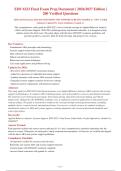
EDF 6223 Final Exam Prep Document | 2026/2027 Edition |
200 Verified Questions
EDF 6223 Final Exam 2026-2027 QUESTIONS AND ANSWERS ALREADY GRADED A+. 100% Verified
Solutions | Updated Per Latest Guidelines | Graded A+
This comprehensive study guide for EDF 6223 covers essential concepts in Applied Behavior Analysis
(ABA) and Systems Support. With 200 verified questions and detailed rationales, it is designed to help
students master the final exam. The guide aligns with the latest 2026/2027 academic guidelines and
provides graded A+ answers. Ideal for both self-study and group review sessions.
Key Features:
Foundational ABA principles and terminology
Systems support frameworks and interventions
Data collection and analysis methods
Ethical considerations in practice
Behavioral assessment techniques
Case study applications and problem-solving
Updates for 2026:
- Revised to reflect 2026/2027 curriculum changes
- Added new questions on telehealth and remote support
- Updated rationales with current ABA research citations
- Expanded systems support scenarios for diverse settings
- Improved answer explanations with distractor analysis
Abstract:
This study guide for EDF 6223 Final Exam integrates core Applied Behavior Analysis (ABA) content with systems
support methodologies. It comprises 200 verified questions, each with graded A+ answers and detailed rationales.
The material covers behavioral assessment, intervention design, data-driven decision-making, and ethical
frameworks. Updated for the 2026/2027 academic year, it emphasizes practical application in educational and
clinical settings. The guide is structured to reinforce key concepts through varied question formats, including
multiple-choice, scenario-based, and analytical items. It serves as a critical resource for students seeking to
demonstrate mastery in ABA and systems support, ensuring alignment with current professional standards and
exam expectations.
Keywords:
Applied Behavior Analysis, Systems Support, EDF 6223, Final Exam, Study Guide, Verified Questions, Graded A+,
2026/2027
Answer Format:
Each question includes the correct answer indicated as 'A+' and a comprehensive rationale explaining why the
answer is correct. Distractors are analyzed to clarify common misconceptions. All answers are verified and aligned
with the latest ABA and systems support guidelines.
Compliance Checklist:
All questions verified for accuracy and relevance
Rationales cite current ABA and systems support literature
Content aligns with 2026/2027 academic standards
Answer format consistent with graded A+ criteria
Page 1
, Distractor explanations address common student errors
Updated to reflect recent changes in the field
Content Area Overview:
Content Area Questions Key Topics Weight
Foundational ABA Concepts 1-40 Reinforcement, punishment, stimulus 20%
control, motivating operations, behavior
function
Behavioral Assessment and 41-80 Data collection methods, graphing, 20%
Measurement interobserver agreement, preference
assessments
Intervention Design and 81-120 Behavior support plans, token economies, 20%
Implementation self-management, generalization strategies
Systems Support Frameworks 121-160 RTI/MTSS, positive behavioral 20%
interventions and supports (PBIS),
consultation models
Ethics and Professional Practice 161-200 BACB guidelines, informed consent, 20%
confidentiality, cultural competence
Page 2
,Q1. In a systems-wide positive behavior support implementation, a researcher uses a
concurrent multiple-baseline design across three schools. Baseline data show stable
low rates of student office discipline referrals (ODR). Intervention is introduced at
staggered times across schools. What threat to internal validity is least controlled by
this design and could be addressed by adding a control group?
A. Instrumentation
B. Selection bias
C. Maturation
D. History
Correct Answer: D. History
Rationale: History is a threat when events outside the experiment coincide with
intervention introduction. In multiple-baseline designs, history is partially controlled
because the intervention is staggered, but an external event could affect all schools
simultaneously. Adding a non-intervention control group helps isolate history effects.
Instrumentation is controlled by consistent measurement, maturation is controlled by
baseline trends, and selection bias is less relevant as this is a quasi-experiment with intact
groups.
Why Wrong:
A - Instrumentation threat is minimal because the same ODR recording system is used
across phases and schools.
B - Selection bias is not a primary threat since the design uses the same schools across
phases; a control group could reduce differential selection.
C - Maturation would be evidenced by trends in baseline; staggered introduction helps
rule out maturation.
Reference: Kazdin, A.E. (2021). Single-Case Research Designs (3rd ed.). Oxford
University Press. Chapter 7.
Q2. A behavior analyst designs a token economy for a classroom. Students earn
tokens for academic engagement and exchange them for backup reinforcers. After
four weeks, engagement plateaus. Which ethical consideration most directly requires
the analyst to modify the system, according to the Behavior Analyst Certification
Board's Ethics Code?
A. Ensuring that the token economy does not restrict students' rights to fair educational
opportunities
B. Using the least restrictive procedures that are likely to be effective
C. Obtaining ongoing informed consent from parents and guardians
D. Maintaining client dignity by avoiding coercive control
Correct Answer: B. Using the least restrictive procedures that are likely to be
effective
Page 3
, Rationale: The Ethics Code (BACB, 2020) requires behavior analysts to use the least
restrictive procedures. A plateau suggests the current system may no longer be effective,
and a more restrictive change (e.g., increasing token value) could be considered, but the
principle of least restrictiveness demands first trying less intrusive modifications (e.g.,
varying backup reinforcers). Option A relates to rights, but the primary issue here is
effectiveness. Consent (C) is ongoing but not directly triggered by a plateau. Dignity (D) is
important but the plateau itself does not necessarily indicate coercion-it indicates a need
for procedural modification.
Why Wrong:
A - Rights to educational opportunity are broad but not specifically about token
economy effectiveness.
C - Informed consent is ongoing but a plateau does not necessarily require re-consent
unless procedures change substantially.
D - While important, client dignity is not the primary ethical principle directly
addressing the need to modify an ineffective system.
Reference: Behavior Analyst Certification Board. (2020). Ethics Code for Behavior
Analysts. Section 4.04 (Least Restrictive Procedures).
Q3. A systems analyst conducts a performance diagnostic for a call center. The staff
are trained in the correct script, but average call duration remains too long.
Immediate performance feedback is given but fails to reduce duration. According to
behavioral systems analysis, which systemic variable is most likely responsible for the
persistent inefficiency?
A. Antecedents are not adequately prompting the desired behavior
B. Consequences for fast versus slow calls are undifferentiated
C. Staff lack prerequisite skills despite initial training
D. The physical layout of the call center creates delays
Correct Answer: B. Consequences for fast versus slow calls are undifferentiated
Rationale: Behavioral systems analysis emphasizes aligning consequences with desired
performance. Since staff are trained (antecedents and skills are in place) but call duration
is long, the likely cause is that consequences (e.g., if customers are satisfied but managers
don't differentiate based on speed, or if longer calls reduce errors and avoid complaints)
do not differentially reinforce shorter calls. Feedback alone may not be a sufficiently
powerful consequence. Option A is ruled out because the script is present. Option C is
ruled out because training was effective. Option D is possible but less likely given the
focus on feedback and the principle that consequences drive behavior.
Why Wrong:
A - Antecedents are present (script) and staff are trained, so lack of prompting is not
the primary issue.
C - Staff have been trained and initial training was effective, so prerequisite skills are
not deficient.
Page 4
200 Verified Questions
EDF 6223 Final Exam 2026-2027 QUESTIONS AND ANSWERS ALREADY GRADED A+. 100% Verified
Solutions | Updated Per Latest Guidelines | Graded A+
This comprehensive study guide for EDF 6223 covers essential concepts in Applied Behavior Analysis
(ABA) and Systems Support. With 200 verified questions and detailed rationales, it is designed to help
students master the final exam. The guide aligns with the latest 2026/2027 academic guidelines and
provides graded A+ answers. Ideal for both self-study and group review sessions.
Key Features:
Foundational ABA principles and terminology
Systems support frameworks and interventions
Data collection and analysis methods
Ethical considerations in practice
Behavioral assessment techniques
Case study applications and problem-solving
Updates for 2026:
- Revised to reflect 2026/2027 curriculum changes
- Added new questions on telehealth and remote support
- Updated rationales with current ABA research citations
- Expanded systems support scenarios for diverse settings
- Improved answer explanations with distractor analysis
Abstract:
This study guide for EDF 6223 Final Exam integrates core Applied Behavior Analysis (ABA) content with systems
support methodologies. It comprises 200 verified questions, each with graded A+ answers and detailed rationales.
The material covers behavioral assessment, intervention design, data-driven decision-making, and ethical
frameworks. Updated for the 2026/2027 academic year, it emphasizes practical application in educational and
clinical settings. The guide is structured to reinforce key concepts through varied question formats, including
multiple-choice, scenario-based, and analytical items. It serves as a critical resource for students seeking to
demonstrate mastery in ABA and systems support, ensuring alignment with current professional standards and
exam expectations.
Keywords:
Applied Behavior Analysis, Systems Support, EDF 6223, Final Exam, Study Guide, Verified Questions, Graded A+,
2026/2027
Answer Format:
Each question includes the correct answer indicated as 'A+' and a comprehensive rationale explaining why the
answer is correct. Distractors are analyzed to clarify common misconceptions. All answers are verified and aligned
with the latest ABA and systems support guidelines.
Compliance Checklist:
All questions verified for accuracy and relevance
Rationales cite current ABA and systems support literature
Content aligns with 2026/2027 academic standards
Answer format consistent with graded A+ criteria
Page 1
, Distractor explanations address common student errors
Updated to reflect recent changes in the field
Content Area Overview:
Content Area Questions Key Topics Weight
Foundational ABA Concepts 1-40 Reinforcement, punishment, stimulus 20%
control, motivating operations, behavior
function
Behavioral Assessment and 41-80 Data collection methods, graphing, 20%
Measurement interobserver agreement, preference
assessments
Intervention Design and 81-120 Behavior support plans, token economies, 20%
Implementation self-management, generalization strategies
Systems Support Frameworks 121-160 RTI/MTSS, positive behavioral 20%
interventions and supports (PBIS),
consultation models
Ethics and Professional Practice 161-200 BACB guidelines, informed consent, 20%
confidentiality, cultural competence
Page 2
,Q1. In a systems-wide positive behavior support implementation, a researcher uses a
concurrent multiple-baseline design across three schools. Baseline data show stable
low rates of student office discipline referrals (ODR). Intervention is introduced at
staggered times across schools. What threat to internal validity is least controlled by
this design and could be addressed by adding a control group?
A. Instrumentation
B. Selection bias
C. Maturation
D. History
Correct Answer: D. History
Rationale: History is a threat when events outside the experiment coincide with
intervention introduction. In multiple-baseline designs, history is partially controlled
because the intervention is staggered, but an external event could affect all schools
simultaneously. Adding a non-intervention control group helps isolate history effects.
Instrumentation is controlled by consistent measurement, maturation is controlled by
baseline trends, and selection bias is less relevant as this is a quasi-experiment with intact
groups.
Why Wrong:
A - Instrumentation threat is minimal because the same ODR recording system is used
across phases and schools.
B - Selection bias is not a primary threat since the design uses the same schools across
phases; a control group could reduce differential selection.
C - Maturation would be evidenced by trends in baseline; staggered introduction helps
rule out maturation.
Reference: Kazdin, A.E. (2021). Single-Case Research Designs (3rd ed.). Oxford
University Press. Chapter 7.
Q2. A behavior analyst designs a token economy for a classroom. Students earn
tokens for academic engagement and exchange them for backup reinforcers. After
four weeks, engagement plateaus. Which ethical consideration most directly requires
the analyst to modify the system, according to the Behavior Analyst Certification
Board's Ethics Code?
A. Ensuring that the token economy does not restrict students' rights to fair educational
opportunities
B. Using the least restrictive procedures that are likely to be effective
C. Obtaining ongoing informed consent from parents and guardians
D. Maintaining client dignity by avoiding coercive control
Correct Answer: B. Using the least restrictive procedures that are likely to be
effective
Page 3
, Rationale: The Ethics Code (BACB, 2020) requires behavior analysts to use the least
restrictive procedures. A plateau suggests the current system may no longer be effective,
and a more restrictive change (e.g., increasing token value) could be considered, but the
principle of least restrictiveness demands first trying less intrusive modifications (e.g.,
varying backup reinforcers). Option A relates to rights, but the primary issue here is
effectiveness. Consent (C) is ongoing but not directly triggered by a plateau. Dignity (D) is
important but the plateau itself does not necessarily indicate coercion-it indicates a need
for procedural modification.
Why Wrong:
A - Rights to educational opportunity are broad but not specifically about token
economy effectiveness.
C - Informed consent is ongoing but a plateau does not necessarily require re-consent
unless procedures change substantially.
D - While important, client dignity is not the primary ethical principle directly
addressing the need to modify an ineffective system.
Reference: Behavior Analyst Certification Board. (2020). Ethics Code for Behavior
Analysts. Section 4.04 (Least Restrictive Procedures).
Q3. A systems analyst conducts a performance diagnostic for a call center. The staff
are trained in the correct script, but average call duration remains too long.
Immediate performance feedback is given but fails to reduce duration. According to
behavioral systems analysis, which systemic variable is most likely responsible for the
persistent inefficiency?
A. Antecedents are not adequately prompting the desired behavior
B. Consequences for fast versus slow calls are undifferentiated
C. Staff lack prerequisite skills despite initial training
D. The physical layout of the call center creates delays
Correct Answer: B. Consequences for fast versus slow calls are undifferentiated
Rationale: Behavioral systems analysis emphasizes aligning consequences with desired
performance. Since staff are trained (antecedents and skills are in place) but call duration
is long, the likely cause is that consequences (e.g., if customers are satisfied but managers
don't differentiate based on speed, or if longer calls reduce errors and avoid complaints)
do not differentially reinforce shorter calls. Feedback alone may not be a sufficiently
powerful consequence. Option A is ruled out because the script is present. Option C is
ruled out because training was effective. Option D is possible but less likely given the
focus on feedback and the principle that consequences drive behavior.
Why Wrong:
A - Antecedents are present (script) and staff are trained, so lack of prompting is not
the primary issue.
C - Staff have been trained and initial training was effective, so prerequisite skills are
not deficient.
Page 4


