

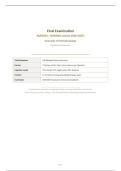
Final Examination
NUR2063 / NUR2063 (Latest 2026/2027)
Essentials of Pathophysiology
Rasmussen University
Total Questions 100 Multiple Choice Questions
Format 4 Options (A-D), One Correct Answer per Question
Cognitive Levels 25% Recall, 55% Application, 20% Analysis
Content 11 Sections covering all pathophysiology topics
Curriculum 2026/2027 Rasmussen University Standards
Comprehensive rationales with pathophysiology reasoning included for each question.
Focus: Disease processes, etiology, clinical manifestations, and pathophysiological mechanisms.
Page 1
, NUR2063 Essentials of Pathophysiology - Final Exam | Rasmussen University 2026/2027
Section 1: Cellular Adaptation, Injury, and Neoplasia (Q1-Q12)
Q1: A nurse is reviewing a patient's lab results and notes that the patient has been diagnosed with
Barrett's esophagus. The pathologist's report describes a change from normal stratified squamous
epithelium to columnar epithelium in the lower esophagus. The nurse recognizes this cellular adaptation
as which of the following?
A. A. Atrophy
B. B. Hypertrophy
C. C. Hyperplasia
D. D. Metaplasia [CORRECT]
Correct Answer: D
Rationale:
Metaplasia is the replacement of one fully differentiated cell type with another fully differentiated cell type. In Barrett's
esophagus, chronic acid reflux causes the normal stratified squamous epithelium of the esophagus to be replaced by
intestinal-type columnar epithelium as an adaptive response to chronic injury. Atrophy refers to a decrease in cell size,
hypertrophy refers to an increase in cell size, and hyperplasia refers to an increase in cell number. None of these describe
the replacement of one cell type with another, making metaplasia the correct answer. (Rasmussen NUR 2063 Module:
Cellular Adaptation)
Q2: A 65-year-old patient with a long history of uncontrolled hypertension presents with fatigue and
shortness of breath. An echocardiogram reveals thickening of the left ventricular wall without chamber
dilation. The nurse understands that which cellular adaptation has occurred in the myocardial cells?
A. A. Atrophy
B. B. Hypertrophy [CORRECT]
C. C. Hyperplasia
D. D. Dysplasia
Correct Answer: B
Rationale:
Hypertrophy is an increase in individual cell size, most commonly occurring in response to increased workload. In this
scenario, chronic hypertension increases afterload on the left ventricle, causing myocardial cells to enlarge in order to
generate more force to eject blood against elevated pressure. This results in concentric hypertrophy with wall thickening
but no chamber dilation. Atrophy would be a decrease in cell size, hyperplasia would increase cell number (which
cardiac muscle cells cannot do as they are terminally differentiated), and dysplasia refers to abnormal cell growth with
disorganized arrangement. (Rasmussen NUR 2063 Module: Cellular Adaptation)
Q3: A patient with chronic anemia has developed a decrease in the size of skeletal muscle cells due to
reduced oxygen-carrying capacity of the blood. The nurse identifies this adaptation as:
A. A. Physiologic atrophy
B. B. Pathologic atrophy [CORRECT]
C. C. Physiologic hypertrophy
D. D. Pathologic hypertrophy
Correct Answer: B
Rationale:
Atrophy is a decrease in cell size resulting from decreased workload, diminished blood supply, inadequate nutrition, or
loss of endocrine stimulation. In this case, chronic anemia leads to diminished oxygen delivery to tissues, causing skeletal
muscle cells to shrink in size. This is classified as pathologic atrophy because it results from a disease process.
Physiologic atrophy occurs with normal developmental changes such as the thymus gland decreasing in size during
childhood. Hypertrophy, whether physiologic or pathologic, involves an increase in cell size, not a decrease. (Rasmussen
NUR 2063 Module: Cellular Adaptation)
Page 2
, NUR2063 Essentials of Pathophysiology - Final Exam | Rasmussen University 2026/2027
Q4: A 22-year-old female presents with heavy menstrual bleeding. A complete blood count reveals an
elevated hemoglobin level and increased red blood cell mass. A bone marrow biopsy shows increased
erythroid precursor cells. The nurse recognizes this as which type of cellular adaptation?
A. A. Atrophy
B. B. Hyperplasia [CORRECT]
C. C. Hypertrophy
D. D. Metaplasia
Correct Answer: B
Rationale:
Hyperplasia is an increase in the number of cells in an organ or tissue, typically in response to a stimulus. In this case,
chronic blood loss from heavy menstrual bleeding stimulates the bone marrow to increase production of erythroid
precursors, resulting in compensatory hyperplasia of the red blood cell line. Atrophy is a decrease in cell size,
hypertrophy is an increase in cell size, and metaplasia is replacement of one differentiated cell type with another. The key
finding here is increased cell number, not size change or cell type replacement. (Rasmussen NUR 2063 Module: Cellular
Adaptation)
Q5: A pathologist examines a cervical biopsy specimen and notes abnormal-looking cells with
disorganized growth patterns, enlarged nuclei, and increased mitotic figures. However, the changes are
confined to the epithelial layer and have not invaded the basement membrane. The nurse understands this
finding represents:
A. A. Metaplasia
B. B. Hyperplasia
C. C. Dysplasia [CORRECT]
D. D. Neoplasia
Correct Answer: C
Rationale:
Dysplasia is abnormal cell growth characterized by changes in cell size, shape, and organization. It is considered a
precancerous condition. The key features include disorganized arrangement, nuclear enlargement, hyperchromatism, and
increased mitotic activity. Dysplasia that is confined to the epithelial layer without breaking through the basement
membrane is classified as carcinoma in situ. Metaplasia is the replacement of one cell type with another and is generally
a reversible adaptive response. Hyperplasia is an increase in cell number but with normal-looking cells. Neoplasia
implies autonomous, uncontrolled new growth, which would involve invasion beyond the basement membrane.
(Rasmussen NUR 2063 Module: Cellular Adaptation and Neoplasia)
Q6: A patient arrives at the emergency department after suffering a myocardial infarction. The nurse
understands that the primary cause of cell death during this event is which type of injury?
A. A. Chemical injury
B. B. Ischemic injury [CORRECT]
C. C. Free radical injury
D. D. Infectious injury
Correct Answer: B
Rationale:
Ischemic injury occurs when blood flow to tissues is reduced or stopped, leading to inadequate oxygen and nutrient
delivery. In a myocardial infarction, coronary artery occlusion deprives the myocardium of blood supply, causing
ischemic injury to cardiac myocytes. While free radicals do contribute to reperfusion injury after blood flow is restored,
the primary cause of the initial cell death is ischemia. Chemical injury involves direct toxic damage from substances, and
infectious injury involves damage from pathogens. Hypoxic injury, a subset of ischemic injury, is the most common cause
of cellular injury overall. (Rasmussen NUR 2063 Module: Cellular Injury)
Page 3
, NUR2063 Essentials of Pathophysiology - Final Exam | Rasmussen University 2026/2027
Q7: A patient with severe peripheral artery disease undergoes a surgical revascularization procedure.
After blood flow is restored to the affected limb, the nurse notes worsening tissue damage, increased
swelling, and pain. The nurse recognizes this phenomenon as:
A. A. Ischemic injury
B. B. Reperfusion injury [CORRECT]
C. C. Hypoxic injury
D. D. Chemical injury
Correct Answer: B
Rationale:
Reperfusion injury is tissue damage that occurs when blood flow is restored to an area after a period of ischemia.
Although restoration of blood flow is essential for tissue survival, the sudden return of oxygen generates a burst of
reactive oxygen species (free radicals) that cause additional cellular damage. This paradoxical worsening includes
oxidative stress, calcium overload, mitochondrial dysfunction, and an intense inflammatory response. Ischemic injury is
the initial damage from reduced blood flow, hypoxic injury is damage specifically from inadequate oxygen, and chemical
injury is from direct toxic substances. (Rasmussen NUR 2063 Module: Cellular Injury)
Q8: A nurse is caring for a patient who has been diagnosed with a well-differentiated, encapsulated tumor
that is slow-growing and non-invasive. The patient asks whether the tumor is cancer. The nurse's best
response is based on the understanding that this tumor is:
A. A. Malignant, because all tumors are cancerous
B. B. Benign, based on its well-differentiated and non-invasive characteristics [CORRECT]
C. C. Malignant, because it is encapsulated
D. D. Benign, because it causes no symptoms
Correct Answer: B
Rationale:
Benign neoplasms are characterized by well-differentiated cells that resemble the tissue of origin, slow growth,
encapsulation (a fibrous capsule surrounding the tumor), and non-invasive behavior (they do not invade surrounding
tissues or metastasize). The description of well-differentiated, encapsulated, slow-growing, and non-invasive features
clearly identifies a benign tumor. Malignant tumors, in contrast, are poorly differentiated, lack a capsule, grow rapidly,
invade surrounding tissues, and have the ability to metastasize to distant sites. Not all tumors are cancerous; benign
tumors are not considered cancer. Encapsulation is a feature of benign tumors, not malignant ones. (Rasmussen NUR
2063 Module: Neoplasia)
Q9: A patient has been diagnosed with a malignant tumor. The oncologist explains that the tumor has
already spread to regional lymph nodes. The nurse understands that this process of malignant cells
spreading to distant sites is called:
A. A. Dysplasia
B. B. Hyperplasia
C. C. Metaplasia
D. D. Metastasis [CORRECT]
Correct Answer: D
Rationale:
Metastasis is the spread of malignant cancer cells from the primary tumor site to distant tissues and organs through the
bloodstream, lymphatic system, or body cavities. The finding that cancer cells have spread to regional lymph nodes
indicates metastatic disease has begun. Dysplasia is abnormal but non-neoplastic cell growth, hyperplasia is an increase
in cell number that is still controlled, and metaplasia is the replacement of one differentiated cell type with another. None
of these terms describe the process of malignant spread, which is unique to metastasis. (Rasmussen NUR 2063 Module:
Neoplasia)
Page 4
NUR2063 / NUR2063 (Latest 2026/2027)
Essentials of Pathophysiology
Rasmussen University
Total Questions 100 Multiple Choice Questions
Format 4 Options (A-D), One Correct Answer per Question
Cognitive Levels 25% Recall, 55% Application, 20% Analysis
Content 11 Sections covering all pathophysiology topics
Curriculum 2026/2027 Rasmussen University Standards
Comprehensive rationales with pathophysiology reasoning included for each question.
Focus: Disease processes, etiology, clinical manifestations, and pathophysiological mechanisms.
Page 1
, NUR2063 Essentials of Pathophysiology - Final Exam | Rasmussen University 2026/2027
Section 1: Cellular Adaptation, Injury, and Neoplasia (Q1-Q12)
Q1: A nurse is reviewing a patient's lab results and notes that the patient has been diagnosed with
Barrett's esophagus. The pathologist's report describes a change from normal stratified squamous
epithelium to columnar epithelium in the lower esophagus. The nurse recognizes this cellular adaptation
as which of the following?
A. A. Atrophy
B. B. Hypertrophy
C. C. Hyperplasia
D. D. Metaplasia [CORRECT]
Correct Answer: D
Rationale:
Metaplasia is the replacement of one fully differentiated cell type with another fully differentiated cell type. In Barrett's
esophagus, chronic acid reflux causes the normal stratified squamous epithelium of the esophagus to be replaced by
intestinal-type columnar epithelium as an adaptive response to chronic injury. Atrophy refers to a decrease in cell size,
hypertrophy refers to an increase in cell size, and hyperplasia refers to an increase in cell number. None of these describe
the replacement of one cell type with another, making metaplasia the correct answer. (Rasmussen NUR 2063 Module:
Cellular Adaptation)
Q2: A 65-year-old patient with a long history of uncontrolled hypertension presents with fatigue and
shortness of breath. An echocardiogram reveals thickening of the left ventricular wall without chamber
dilation. The nurse understands that which cellular adaptation has occurred in the myocardial cells?
A. A. Atrophy
B. B. Hypertrophy [CORRECT]
C. C. Hyperplasia
D. D. Dysplasia
Correct Answer: B
Rationale:
Hypertrophy is an increase in individual cell size, most commonly occurring in response to increased workload. In this
scenario, chronic hypertension increases afterload on the left ventricle, causing myocardial cells to enlarge in order to
generate more force to eject blood against elevated pressure. This results in concentric hypertrophy with wall thickening
but no chamber dilation. Atrophy would be a decrease in cell size, hyperplasia would increase cell number (which
cardiac muscle cells cannot do as they are terminally differentiated), and dysplasia refers to abnormal cell growth with
disorganized arrangement. (Rasmussen NUR 2063 Module: Cellular Adaptation)
Q3: A patient with chronic anemia has developed a decrease in the size of skeletal muscle cells due to
reduced oxygen-carrying capacity of the blood. The nurse identifies this adaptation as:
A. A. Physiologic atrophy
B. B. Pathologic atrophy [CORRECT]
C. C. Physiologic hypertrophy
D. D. Pathologic hypertrophy
Correct Answer: B
Rationale:
Atrophy is a decrease in cell size resulting from decreased workload, diminished blood supply, inadequate nutrition, or
loss of endocrine stimulation. In this case, chronic anemia leads to diminished oxygen delivery to tissues, causing skeletal
muscle cells to shrink in size. This is classified as pathologic atrophy because it results from a disease process.
Physiologic atrophy occurs with normal developmental changes such as the thymus gland decreasing in size during
childhood. Hypertrophy, whether physiologic or pathologic, involves an increase in cell size, not a decrease. (Rasmussen
NUR 2063 Module: Cellular Adaptation)
Page 2
, NUR2063 Essentials of Pathophysiology - Final Exam | Rasmussen University 2026/2027
Q4: A 22-year-old female presents with heavy menstrual bleeding. A complete blood count reveals an
elevated hemoglobin level and increased red blood cell mass. A bone marrow biopsy shows increased
erythroid precursor cells. The nurse recognizes this as which type of cellular adaptation?
A. A. Atrophy
B. B. Hyperplasia [CORRECT]
C. C. Hypertrophy
D. D. Metaplasia
Correct Answer: B
Rationale:
Hyperplasia is an increase in the number of cells in an organ or tissue, typically in response to a stimulus. In this case,
chronic blood loss from heavy menstrual bleeding stimulates the bone marrow to increase production of erythroid
precursors, resulting in compensatory hyperplasia of the red blood cell line. Atrophy is a decrease in cell size,
hypertrophy is an increase in cell size, and metaplasia is replacement of one differentiated cell type with another. The key
finding here is increased cell number, not size change or cell type replacement. (Rasmussen NUR 2063 Module: Cellular
Adaptation)
Q5: A pathologist examines a cervical biopsy specimen and notes abnormal-looking cells with
disorganized growth patterns, enlarged nuclei, and increased mitotic figures. However, the changes are
confined to the epithelial layer and have not invaded the basement membrane. The nurse understands this
finding represents:
A. A. Metaplasia
B. B. Hyperplasia
C. C. Dysplasia [CORRECT]
D. D. Neoplasia
Correct Answer: C
Rationale:
Dysplasia is abnormal cell growth characterized by changes in cell size, shape, and organization. It is considered a
precancerous condition. The key features include disorganized arrangement, nuclear enlargement, hyperchromatism, and
increased mitotic activity. Dysplasia that is confined to the epithelial layer without breaking through the basement
membrane is classified as carcinoma in situ. Metaplasia is the replacement of one cell type with another and is generally
a reversible adaptive response. Hyperplasia is an increase in cell number but with normal-looking cells. Neoplasia
implies autonomous, uncontrolled new growth, which would involve invasion beyond the basement membrane.
(Rasmussen NUR 2063 Module: Cellular Adaptation and Neoplasia)
Q6: A patient arrives at the emergency department after suffering a myocardial infarction. The nurse
understands that the primary cause of cell death during this event is which type of injury?
A. A. Chemical injury
B. B. Ischemic injury [CORRECT]
C. C. Free radical injury
D. D. Infectious injury
Correct Answer: B
Rationale:
Ischemic injury occurs when blood flow to tissues is reduced or stopped, leading to inadequate oxygen and nutrient
delivery. In a myocardial infarction, coronary artery occlusion deprives the myocardium of blood supply, causing
ischemic injury to cardiac myocytes. While free radicals do contribute to reperfusion injury after blood flow is restored,
the primary cause of the initial cell death is ischemia. Chemical injury involves direct toxic damage from substances, and
infectious injury involves damage from pathogens. Hypoxic injury, a subset of ischemic injury, is the most common cause
of cellular injury overall. (Rasmussen NUR 2063 Module: Cellular Injury)
Page 3
, NUR2063 Essentials of Pathophysiology - Final Exam | Rasmussen University 2026/2027
Q7: A patient with severe peripheral artery disease undergoes a surgical revascularization procedure.
After blood flow is restored to the affected limb, the nurse notes worsening tissue damage, increased
swelling, and pain. The nurse recognizes this phenomenon as:
A. A. Ischemic injury
B. B. Reperfusion injury [CORRECT]
C. C. Hypoxic injury
D. D. Chemical injury
Correct Answer: B
Rationale:
Reperfusion injury is tissue damage that occurs when blood flow is restored to an area after a period of ischemia.
Although restoration of blood flow is essential for tissue survival, the sudden return of oxygen generates a burst of
reactive oxygen species (free radicals) that cause additional cellular damage. This paradoxical worsening includes
oxidative stress, calcium overload, mitochondrial dysfunction, and an intense inflammatory response. Ischemic injury is
the initial damage from reduced blood flow, hypoxic injury is damage specifically from inadequate oxygen, and chemical
injury is from direct toxic substances. (Rasmussen NUR 2063 Module: Cellular Injury)
Q8: A nurse is caring for a patient who has been diagnosed with a well-differentiated, encapsulated tumor
that is slow-growing and non-invasive. The patient asks whether the tumor is cancer. The nurse's best
response is based on the understanding that this tumor is:
A. A. Malignant, because all tumors are cancerous
B. B. Benign, based on its well-differentiated and non-invasive characteristics [CORRECT]
C. C. Malignant, because it is encapsulated
D. D. Benign, because it causes no symptoms
Correct Answer: B
Rationale:
Benign neoplasms are characterized by well-differentiated cells that resemble the tissue of origin, slow growth,
encapsulation (a fibrous capsule surrounding the tumor), and non-invasive behavior (they do not invade surrounding
tissues or metastasize). The description of well-differentiated, encapsulated, slow-growing, and non-invasive features
clearly identifies a benign tumor. Malignant tumors, in contrast, are poorly differentiated, lack a capsule, grow rapidly,
invade surrounding tissues, and have the ability to metastasize to distant sites. Not all tumors are cancerous; benign
tumors are not considered cancer. Encapsulation is a feature of benign tumors, not malignant ones. (Rasmussen NUR
2063 Module: Neoplasia)
Q9: A patient has been diagnosed with a malignant tumor. The oncologist explains that the tumor has
already spread to regional lymph nodes. The nurse understands that this process of malignant cells
spreading to distant sites is called:
A. A. Dysplasia
B. B. Hyperplasia
C. C. Metaplasia
D. D. Metastasis [CORRECT]
Correct Answer: D
Rationale:
Metastasis is the spread of malignant cancer cells from the primary tumor site to distant tissues and organs through the
bloodstream, lymphatic system, or body cavities. The finding that cancer cells have spread to regional lymph nodes
indicates metastatic disease has begun. Dysplasia is abnormal but non-neoplastic cell growth, hyperplasia is an increase
in cell number that is still controlled, and metaplasia is the replacement of one differentiated cell type with another. None
of these terms describe the process of malignant spread, which is unique to metastasis. (Rasmussen NUR 2063 Module:
Neoplasia)
Page 4


