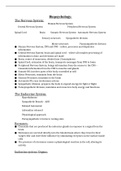
Biopsychology:
The Nervous System:
Human Nervous System
Central Nervous System Peripheral Nervous System
Spinal Cord Brain Somatic Nervous System Automatic Nervous System
Sensory neurones Sympathetic division
l l
llllllllll Motor neurones Parasympathetic division
● Human Nervous System; CNS and PNS – collect, processes and dispatches
information
● Central Nervous System; brain and spinal cord – where all complex processing of
information is done, and decisions are made
● Brain; centre of awareness, divided into 2 hemispheres
● Spinal Cord; extension of the brain, transports messages from PNS to brain
● Peripheral Nervous System; brings information from the senses to the CNS –
transmits information from the CNS to muscles and glands
● Somatic NS; involves parts of the body controlled at will
● Motor Neurones; transmits from the brain
● Sensory Neurones; transmits to the brain
● Automatic NS; runs involuntary actions
● Sympathetic division; prepares the body to expend energy for fight or flight
● Parasympathetic division; maintains and conserves body energy and functions
The Endocrine System:
Hypothalamus
Sympathetic Branch – ANS
Relaxed Autonomic
Adrenaline released
Physiological approach
Parasympathetic returns to resting state
Hormones:
● Chemicals that are produced by endocrine glands in response to a signal from the
brain
● Hormones are secreted directly into the bloodstream where they travel to their
‘target cells’ and exert their influence by stimulating receptors on the surface inside
cells
● The presence of a hormone causes a physiological reaction in the cell, altering its
activity
Endocrine system/ Organs:
, ● The endocrine system works alongside the nervous system to control vital functions
in the body
● Works more slowly than the nervous system but still has widespread and powerful
effects
● The master gland is the pituitary gland in the brain – controls the release of all other
hormones in the body
● The pituitary gland, hypothalamus, thyroid, parathyroid, adrenal gland, pancreas,
ovaries, testes
The Structure and Function of Neurons:
Neurons:
● Transmits signals electrically and chemically as the primary means of
communication for the nervous system
● 3 types
o Sensory – messages from PNS to CNS, long dendrites and short axons
o Relay – connect sensory to motor or another relay, short dendrites and axons
o Motor – connect CNS to effectors, short dendrites and long axons
Structure of a Neuron:
● The cell body includes a
nucleus which contains the genetic material of the cell
● Dendrites protrude from the cell body – these carry nerve impulses from
neighbouring neurons
● The axon carries impulses away from the cell body
● The axon is covered in the myelin sheath that protects the axon and speeds up the
electrical transmission
● It’s segmented by gaps called nodes of Ranvier which speeds up transmission by
forcing it to ‘jump’
● At the end of the axon, there are terminal buttons that communicate with the next
neuron across a synapse
Synaptic Transmission:
The Nervous System:
Human Nervous System
Central Nervous System Peripheral Nervous System
Spinal Cord Brain Somatic Nervous System Automatic Nervous System
Sensory neurones Sympathetic division
l l
llllllllll Motor neurones Parasympathetic division
● Human Nervous System; CNS and PNS – collect, processes and dispatches
information
● Central Nervous System; brain and spinal cord – where all complex processing of
information is done, and decisions are made
● Brain; centre of awareness, divided into 2 hemispheres
● Spinal Cord; extension of the brain, transports messages from PNS to brain
● Peripheral Nervous System; brings information from the senses to the CNS –
transmits information from the CNS to muscles and glands
● Somatic NS; involves parts of the body controlled at will
● Motor Neurones; transmits from the brain
● Sensory Neurones; transmits to the brain
● Automatic NS; runs involuntary actions
● Sympathetic division; prepares the body to expend energy for fight or flight
● Parasympathetic division; maintains and conserves body energy and functions
The Endocrine System:
Hypothalamus
Sympathetic Branch – ANS
Relaxed Autonomic
Adrenaline released
Physiological approach
Parasympathetic returns to resting state
Hormones:
● Chemicals that are produced by endocrine glands in response to a signal from the
brain
● Hormones are secreted directly into the bloodstream where they travel to their
‘target cells’ and exert their influence by stimulating receptors on the surface inside
cells
● The presence of a hormone causes a physiological reaction in the cell, altering its
activity
Endocrine system/ Organs:
, ● The endocrine system works alongside the nervous system to control vital functions
in the body
● Works more slowly than the nervous system but still has widespread and powerful
effects
● The master gland is the pituitary gland in the brain – controls the release of all other
hormones in the body
● The pituitary gland, hypothalamus, thyroid, parathyroid, adrenal gland, pancreas,
ovaries, testes
The Structure and Function of Neurons:
Neurons:
● Transmits signals electrically and chemically as the primary means of
communication for the nervous system
● 3 types
o Sensory – messages from PNS to CNS, long dendrites and short axons
o Relay – connect sensory to motor or another relay, short dendrites and axons
o Motor – connect CNS to effectors, short dendrites and long axons
Structure of a Neuron:
● The cell body includes a
nucleus which contains the genetic material of the cell
● Dendrites protrude from the cell body – these carry nerve impulses from
neighbouring neurons
● The axon carries impulses away from the cell body
● The axon is covered in the myelin sheath that protects the axon and speeds up the
electrical transmission
● It’s segmented by gaps called nodes of Ranvier which speeds up transmission by
forcing it to ‘jump’
● At the end of the axon, there are terminal buttons that communicate with the next
neuron across a synapse
Synaptic Transmission: