

1
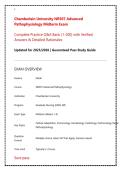
Chamberlain University NR507 Advanced
Pathophysiology Midterm Exam
Complete Practice Q&A Bank (1-200) with Verified
Answers & Detailed Rationales
Updated for 2025/2026 | Guaranteed Pass Study Guide
EXAM OVERVIEW
Feature Detail
Course NR507 Advanced Pathophysiology
Institution Chamberlain University
Program Graduate Nursing (MSN, NP)
Exam Type Midterm (Weeks 1-4)
Cellular Adaptation, Immunology, Hematology, Cardiology, Pulmonology, Renal
Key Topics
Pathophysiology
Question
Multiple-choice, Select All That Apply, Scenario-based
Format
Time Limit Typically 2-3 hours
Sure pass
,2
Feature Detail
Passing Score Determined by course faculty
SECTION 1: CELLULAR ADAPTATION, INJURY &
NEOPLASIA (Questions 1-40)
Question 1:
A patient with chronic hypertension has an enlarged heart. This increase in
muscle mass is primarily due to which cellular adaptation?
A) Hyperplasia
B) Metaplasia
C) Hypertrophy
D) Dysplasia
Correct Answer: C) Hypertrophy
Rationale: Hypertrophy is an increase in the size of cells, leading to an
enlarged organ. Cardiac muscle cells are terminally differentiated and cannot
divide, so they adapt to increased workload through hypertrophy, not
hyperplasia (increase in cell number). This is the primary mechanism by
which the heart compensates for chronic pressure overload in hypertension .
Question 2:
The irreversible point in cellular injury where cell death is inevitable, even if
the stressor is removed, is known as the:
Sure pass
,3
A) Point of no return
B) Cellular apoptosis threshold
C) Necrotic point
D) Ischemic threshold
Correct Answer: A) Point of no return
Rationale: The "point of no return" is a key concept in cellular injury where
mitochondrial damage becomes so severe that ATP production ceases
entirely, leading to irreversible membrane and DNA damage. Once this point
is reached, cell death is inevitable regardless of intervention .
Question 3:
Which of the following is a characteristic feature of apoptosis?
A) Elicits a significant inflammatory response
B) Results in cellular swelling and rupture
C) Involves organized cell shrinkage and fragmentation
D) Causes necrosis of surrounding tissue
Correct Answer: C) Involves organized cell shrinkage and
fragmentation
Rationale: Apoptosis is programmed cell death characterized by cell
shrinkage, chromatin condensation, and fragmentation into apoptotic bodies.
It does not elicit an inflammatory response because cellular contents are
contained within membrane-bound vesicles. Necrosis, in contrast, involves
cell swelling, membrane rupture, and inflammation .
Question 4:
Which type of cell death is characterized by cell swelling, membrane
rupture, and inflammation?
Sure pass
, 4
A) Apoptosis
B) Necrosis
C) Autophagy
D) Senescence
Correct Answer: B) Necrosis
Rationale: Necrosis involves uncontrolled cell death causing cell lysis and
inflammatory response. Key features include cellular swelling, organelle
breakdown, membrane rupture, and release of cellular contents that trigger
inflammation. This is in contrast to the clean, non-inflammatory process of
apoptosis .
Question 5:
Which cellular adaptation involves an increase in cell number due to
increased demand?
A) Hypertrophy
B) Hyperplasia
C) Atrophy
D) Metaplasia
Correct Answer: B) Hyperplasia
Rationale: Hyperplasia is an increase in cell number, often in response to
hormonal stimulation or increased functional demand. This differs from
hypertrophy, which increases cell size rather than number. Hyperplasia occurs
in cells capable of mitotic division .
Question 6:
Which statement concerning benign tumors is true?
A) The resulting pain is severe
Sure pass
Chamberlain University NR507 Advanced
Pathophysiology Midterm Exam
Complete Practice Q&A Bank (1-200) with Verified
Answers & Detailed Rationales
Updated for 2025/2026 | Guaranteed Pass Study Guide
EXAM OVERVIEW
Feature Detail
Course NR507 Advanced Pathophysiology
Institution Chamberlain University
Program Graduate Nursing (MSN, NP)
Exam Type Midterm (Weeks 1-4)
Cellular Adaptation, Immunology, Hematology, Cardiology, Pulmonology, Renal
Key Topics
Pathophysiology
Question
Multiple-choice, Select All That Apply, Scenario-based
Format
Time Limit Typically 2-3 hours
Sure pass
,2
Feature Detail
Passing Score Determined by course faculty
SECTION 1: CELLULAR ADAPTATION, INJURY &
NEOPLASIA (Questions 1-40)
Question 1:
A patient with chronic hypertension has an enlarged heart. This increase in
muscle mass is primarily due to which cellular adaptation?
A) Hyperplasia
B) Metaplasia
C) Hypertrophy
D) Dysplasia
Correct Answer: C) Hypertrophy
Rationale: Hypertrophy is an increase in the size of cells, leading to an
enlarged organ. Cardiac muscle cells are terminally differentiated and cannot
divide, so they adapt to increased workload through hypertrophy, not
hyperplasia (increase in cell number). This is the primary mechanism by
which the heart compensates for chronic pressure overload in hypertension .
Question 2:
The irreversible point in cellular injury where cell death is inevitable, even if
the stressor is removed, is known as the:
Sure pass
,3
A) Point of no return
B) Cellular apoptosis threshold
C) Necrotic point
D) Ischemic threshold
Correct Answer: A) Point of no return
Rationale: The "point of no return" is a key concept in cellular injury where
mitochondrial damage becomes so severe that ATP production ceases
entirely, leading to irreversible membrane and DNA damage. Once this point
is reached, cell death is inevitable regardless of intervention .
Question 3:
Which of the following is a characteristic feature of apoptosis?
A) Elicits a significant inflammatory response
B) Results in cellular swelling and rupture
C) Involves organized cell shrinkage and fragmentation
D) Causes necrosis of surrounding tissue
Correct Answer: C) Involves organized cell shrinkage and
fragmentation
Rationale: Apoptosis is programmed cell death characterized by cell
shrinkage, chromatin condensation, and fragmentation into apoptotic bodies.
It does not elicit an inflammatory response because cellular contents are
contained within membrane-bound vesicles. Necrosis, in contrast, involves
cell swelling, membrane rupture, and inflammation .
Question 4:
Which type of cell death is characterized by cell swelling, membrane
rupture, and inflammation?
Sure pass
, 4
A) Apoptosis
B) Necrosis
C) Autophagy
D) Senescence
Correct Answer: B) Necrosis
Rationale: Necrosis involves uncontrolled cell death causing cell lysis and
inflammatory response. Key features include cellular swelling, organelle
breakdown, membrane rupture, and release of cellular contents that trigger
inflammation. This is in contrast to the clean, non-inflammatory process of
apoptosis .
Question 5:
Which cellular adaptation involves an increase in cell number due to
increased demand?
A) Hypertrophy
B) Hyperplasia
C) Atrophy
D) Metaplasia
Correct Answer: B) Hyperplasia
Rationale: Hyperplasia is an increase in cell number, often in response to
hormonal stimulation or increased functional demand. This differs from
hypertrophy, which increases cell size rather than number. Hyperplasia occurs
in cells capable of mitotic division .
Question 6:
Which statement concerning benign tumors is true?
A) The resulting pain is severe
Sure pass


