

Structure of Chromosomes, Cell Cycle &
Division
Comprehensive Study Guide & Academic Reference Notes
Subject: Cellular Biology & Genetics | Topic Summary: Chromosome Architecture, Interphase, Mitosis, & Meiosis
1. Structure & Organization of Chromosomes
Chromosomes are thread-like nuclear structures composed of tightly coiled deoxyribonucleic acid (DNA) and
protein complexes (histones). They represent the highest order of DNA packaging and serve as the vehicle for
inheritance during cell division.
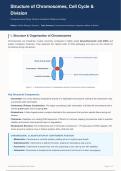
Telomeres (Protective Caps)
Short Arm (p arm)
Centromere / Kinetochore
Sister Chromatids (Identical Copies)
Long Arm (q arm)
Figure 1.1: Anatomical structure of a duplicated eukaryotic chromosome during metaphase.
Key Structural Components:
• Chromatid: One of two identical longitudinal strands of a replicated chromosome. Joined at the centromere, they
are termed sister chromatids.
• Centromere (Primary Constriction): The region connecting sister chromatids. It divides the chromosome into a
shorter p arm (petit) and a longer q arm.
• Kinetochore: A disk-shaped protein complex attached to the centromere that anchors spindle fibers during cell
division.
• Telomeres: Repetitive non-coding DNA sequences (TTAGGG in humans) capping chromosome ends to maintain
stability and prevent chromosomal fusion or degradation.
• Nucleosome Structure: The fundamental unit of chromatin consisting of ~147 base pairs of DNA wrapped 1.65
times around an octamer core of histone proteins (H2A, H2B, H3, H4).
CHROMOSOMAL CLASSIFICATION BY CENTROMERE POSITION
• Metacentric: Centromere is centrally located, yielding arms of roughly equal length.
• Submetacentric: Centromere is slightly off-center, leading to noticeable p and q arms.
• Acrocentric: Centromere is placed near one end, producing a very short p arm with satellites.
• Telocentric: Centromere is located at the extreme terminal end (not found in human karyotypes).
Comprehensive Biology Study Guide Page 1 of 3
Division
Comprehensive Study Guide & Academic Reference Notes
Subject: Cellular Biology & Genetics | Topic Summary: Chromosome Architecture, Interphase, Mitosis, & Meiosis
1. Structure & Organization of Chromosomes
Chromosomes are thread-like nuclear structures composed of tightly coiled deoxyribonucleic acid (DNA) and
protein complexes (histones). They represent the highest order of DNA packaging and serve as the vehicle for
inheritance during cell division.
Telomeres (Protective Caps)
Short Arm (p arm)
Centromere / Kinetochore
Sister Chromatids (Identical Copies)
Long Arm (q arm)
Figure 1.1: Anatomical structure of a duplicated eukaryotic chromosome during metaphase.
Key Structural Components:
• Chromatid: One of two identical longitudinal strands of a replicated chromosome. Joined at the centromere, they
are termed sister chromatids.
• Centromere (Primary Constriction): The region connecting sister chromatids. It divides the chromosome into a
shorter p arm (petit) and a longer q arm.
• Kinetochore: A disk-shaped protein complex attached to the centromere that anchors spindle fibers during cell
division.
• Telomeres: Repetitive non-coding DNA sequences (TTAGGG in humans) capping chromosome ends to maintain
stability and prevent chromosomal fusion or degradation.
• Nucleosome Structure: The fundamental unit of chromatin consisting of ~147 base pairs of DNA wrapped 1.65
times around an octamer core of histone proteins (H2A, H2B, H3, H4).
CHROMOSOMAL CLASSIFICATION BY CENTROMERE POSITION
• Metacentric: Centromere is centrally located, yielding arms of roughly equal length.
• Submetacentric: Centromere is slightly off-center, leading to noticeable p and q arms.
• Acrocentric: Centromere is placed near one end, producing a very short p arm with satellites.
• Telocentric: Centromere is located at the extreme terminal end (not found in human karyotypes).
Comprehensive Biology Study Guide Page 1 of 3


