NURS 6521N Advanced Pharmacology Midterm Exam Prep
Document | 2026/2027 Edition | 250 Verified Questions
NURS 6521N Advanced Pharmacology Midterm Exam 2026-2027 QUESTIONS AND ANSWERS ALREADY
GRADED A+. 100% Verified Solutions | Updated Per Latest Guidelines | Graded A+
This comprehensive document provides 250 verified questions and answers for the NURS 6521N
Advanced Pharmacology midterm exam. It covers key pharmacological concepts essential for
advanced practice nursing, including pharmacokinetics, pharmacodynamics, drug classifications, and
therapeutic management. The content is aligned with the 2026/2027 academic year curriculum and
incorporates the latest evidence-based guidelines. Ideal for graduate nursing students seeking to excel
in their pharmacology course and prepare for advanced clinical roles.
Abstract:
The NURS 6521N Advanced Pharmacology Midterm Exam V2 Actual Exam document is a rigorous preparatory
resource for graduate nursing students. It comprises 250 meticulously verified questions that span the core
domains of advanced pharmacology. The questions are designed to test higher-order thinking, requiring students
to apply pharmacokinetic principles, evaluate drug interactions, and make evidence-based prescribing decisions.
Each answer is accompanied by a detailed rationale that explains the underlying pharmacological mechanisms
and clinical reasoning. Reflecting the 2026/2027 curriculum, the content incorporates recent advances in
pharmacotherapy and safety standards. This document serves as both a study guide and a simulation of the actual
exam format, ensuring students are well-prepared for both the test and real-world practice.
Content Area Overview:
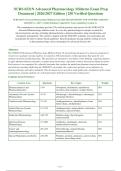
Content Area Questions Key Topics Weight
Pharmacokinetics and 1-40 Absorption, distribution, metabolism, 16%
Pharmacodynamics excretion, dose-response, receptor theory
Autonomic Nervous System 41-70 Cholinergics, anticholinergics, adrenergics, 12%
Pharmacology adrenergic blockers
Cardiovascular Pharmacology 71-110 Antihypertensives, antiarrhythmics, heart 16%
failure drugs, antilipidemics
Central Nervous System 111-145 Antidepressants, antipsychotics, anxiolytics, 14%
Pharmacology stimulants, anticonvulsants
Endocrine Pharmacology 146-170 Diabetes drugs, thyroid agents, 10%
corticosteroids
Infectious Disease 171-200 Antibiotics, antifungals, antivirals, 12%
Pharmacology antimicrobial resistance
Cancer and 201-225 Chemotherapy, targeted therapy, 10%
Immunopharmacology immunomodulators
Special Populations and Safety 226-250 Pediatric, geriatric, pregnancy, adverse drug 10%
reactions, prescribing errors
Page 1
,Q1. A drug exhibits a volume of distribution (Vd) of 500 L and a clearance of 5 L/hr. Which of the
following best approximates its elimination half-life?
A. 25 hours
B. 50 hours
C. 69 hours
D. 100 hours
Correct Answer: C. 69 hours
Rationale: Half-life (t1/2) = (0.693 × Vd) / Cl = (0.693 × 500 L) / 5 L/hr = 69.3 hours. Option A (25 hr)
results from miscalculating using 0.5 instead of 0.693; B (50 hr) uses Vd/Cl without 0.693; D (100 hr)
doubles Vd or halves Cl incorrectly.
Why Wrong:
A - This value arises from using a factor of 0.5 instead of 0.693 in the half-life calculation.
B - This value is simply Vd/Cl without the 0.693 conversion factor.
D - This value results from doubling the Vd or halving the Cl in the calculation.
Reference: Lehne, R.A. (2026). Pharmacology for Nursing Care, 12th Ed., Ch. 4, p. 62.
Q2. A patient with treatment-resistant hypertension is prescribed a direct renin inhibitor. Which of
the following best describes the mechanism of action of this drug class?
A. Blocks angiotensin I conversion to angiotensin II
B. Inhibits renin release from juxtaglomerular cells
C. Binds to renin and prevents angiotensinogen cleavage
D. Antagonizes angiotensin II at AT1 receptors
Correct Answer: C. Binds to renin and prevents angiotensinogen cleavage
Rationale: Direct renin inhibitors (e.g., aliskiren) bind to the active site of renin, inhibiting the
conversion of angiotensinogen to angiotensin I. Option A describes ACE inhibitors, B is not a drug effect
(renin release is regulated by baroreceptors, etc.), D describes ARBs.
Why Wrong:
A - This describes the action of ACE inhibitors, not renin inhibitors.
B - Renin release is not directly inhibited by these drugs; they inhibit renin's enzymatic activity.
D - This describes angiotensin receptor blockers (ARBs), not direct renin inhibitors.
Reference: Lehne, R.A. (2026). Pharmacology for Nursing Care, 12th Ed., Ch. 30.
Page 2
,Q3. A patient is receiving an aminoglycoside antibiotic and develops acute kidney injury. Which of
the following best explains the mechanism of nephrotoxicity associated with this drug class?
A. Intratubular precipitation of drug crystals causing obstruction
B. Direct tubular necrosis due to accumulation in proximal tubule cells
C. Allergic interstitial nephritis mediated by IgE antibodies
D. Vasoconstriction of afferent arterioles reducing glomerular filtration
Correct Answer: B. Direct tubular necrosis due to accumulation in proximal tubule cells
Rationale: Aminoglycosides are taken up by proximal tubular cells via endocytosis, accumulate in
lysosomes, and cause cell necrosis. Option A is seen with sulfonamides, C is a hypersensitivity reaction
(not typical for aminoglycosides), D occurs with NSAIDs or contrast media.
Why Wrong:
A - Crystal nephropathy is associated with sulfonamides or acyclovir, not aminoglycosides.
C - Allergic interstitial nephritis is more common with penicillins or NSAIDs, not aminoglycosides.
D - Afferent arteriolar vasoconstriction is characteristic of NSAIDs or calcineurin inhibitors, not
aminoglycosides.
Reference: Katzung, B.G. (2025). Basic & Clinical Pharmacology, 16th Ed., Ch. 47.
Q4. A patient with major depressive disorder has been on a selective serotonin reuptake inhibitor
(SSRI) for 6 weeks with minimal response. The prescriber plans to augment with a second agent.
Which of the following combinations is MOST likely to precipitate serotonin syndrome?
A. SSRI + bupropion
B. SSRI + mirtazapine
C. SSRI + buspirone
D. SSRI + phenelzine
Correct Answer: D. SSRI + phenelzine
Rationale: Phenelzine is a monoamine oxidase inhibitor (MAOI) that irreversibly inhibits MAO, leading
to excessive serotonin accumulation when combined with an SSRI. This combination is contraindicated
due to high risk of serotonin syndrome. Options A, B, and C have lower risk; bupropion primarily affects
norepinephrine/dopamine, mirtazapine is a noradrenergic and specific serotonergic antidepressant (less
serotonergic), buspirone is a 5-HT1A partial agonist with low synergy risk.
Why Wrong:
A - Bupropion primarily inhibits reuptake of norepinephrine and dopamine, not serotonin; risk is
low.
B - Mirtazapine blocks presynaptic 2 receptors and certain serotonin receptors; risk is low.
C - Buspirone is a partial agonist at 5-HT1A receptors and has minimal serotonergic excess risk with
SSRIs.
Reference: Stahl, S.M. (2025). Stahl's Essential Psychopharmacology, 6th Ed., Ch. 7.
Page 3
, Q5. Which of the following pharmacokinetic parameter changes is most likely to be observed in a
patient with severe cirrhosis, and how does it affect drug dosing?
A. Increased first-pass metabolism requiring lower oral doses
B. Decreased protein binding requiring higher initial doses
C. Reduced hepatic clearance of high-extraction drugs necessitating dose reduction
D. Increased volume of distribution for hydrophilic drugs needing loading dose adjustment
Correct Answer: C. Reduced hepatic clearance of high-extraction drugs necessitating dose reduction
Rationale: Severe cirrhosis decreases intrinsic clearance and blood flow; for high-extraction drugs (e.g.,
lidocaine, morphine), clearance is primarily dependent on hepatic blood flow, which is reduced, leading
to increased bioavailability and requiring dose reduction. Option A is opposite (first-pass metabolism is
decreased). B is true but should lead to lower doses due to more free drug, not higher. D is not typical; Vd
changes more for lipophilic drugs.
Why Wrong:
A - First-pass metabolism is reduced in cirrhosis, leading to increased oral bioavailability and need
for lower doses, not higher.
B - Decreased protein binding increases free fraction, so initial doses should be reduced, not
increased.
D - Volume of distribution changes are more prominent for lipophilic drugs, not hydrophilic; loading
dose adjustments may be needed but not specifically for hydrophilic drugs.
Reference: Lehne, R.A. (2026). Pharmacology for Nursing Care, 12th Ed., Ch. 5.
Q6. A patient with type 2 diabetes is started on metformin and a sulfonylurea. Which of the
following best describes the pharmacodynamic interaction between these two drug classes?
A. Additive effect on insulin secretion from pancreatic beta cells
B. Synergistic effect on hepatic glucose output reduction
C. Additive effect on peripheral glucose uptake
D. Potentiated effect due to reduced renal clearance of metformin
Correct Answer: A. Additive effect on insulin secretion from pancreatic beta cells
Rationale: Sulfonylureas stimulate insulin secretion, while metformin primarily reduces hepatic glucose
output and improves insulin sensitivity. The combination produces additive glucose-lowering effects
because they act via different mechanisms. Option B is incorrect because metformin reduces hepatic
output, but sulfonylureas do not directly affect hepatic output; C is mostly metformin's effect; D is not a
pharmacodynamic interaction.
Why Wrong:
B - Sulfonylureas do not directly reduce hepatic glucose output; the synergistic effect is not
primarily on hepatic output.
C - Sulfonylureas do not directly increase peripheral glucose uptake; this is more characteristic of
metformin and thiazolidinediones.
D - There is no known renal clearance interaction between metformin and sulfonylureas; this would
be pharmacokinetic, not pharmacodynamic.
Reference: American Diabetes Association. (2026). Standards of Medical Care in Diabetes-2026.
Diabetes Care, 49(Suppl 1).
Page 4
Document | 2026/2027 Edition | 250 Verified Questions
NURS 6521N Advanced Pharmacology Midterm Exam 2026-2027 QUESTIONS AND ANSWERS ALREADY
GRADED A+. 100% Verified Solutions | Updated Per Latest Guidelines | Graded A+
This comprehensive document provides 250 verified questions and answers for the NURS 6521N
Advanced Pharmacology midterm exam. It covers key pharmacological concepts essential for
advanced practice nursing, including pharmacokinetics, pharmacodynamics, drug classifications, and
therapeutic management. The content is aligned with the 2026/2027 academic year curriculum and
incorporates the latest evidence-based guidelines. Ideal for graduate nursing students seeking to excel
in their pharmacology course and prepare for advanced clinical roles.
Abstract:
The NURS 6521N Advanced Pharmacology Midterm Exam V2 Actual Exam document is a rigorous preparatory
resource for graduate nursing students. It comprises 250 meticulously verified questions that span the core
domains of advanced pharmacology. The questions are designed to test higher-order thinking, requiring students
to apply pharmacokinetic principles, evaluate drug interactions, and make evidence-based prescribing decisions.
Each answer is accompanied by a detailed rationale that explains the underlying pharmacological mechanisms
and clinical reasoning. Reflecting the 2026/2027 curriculum, the content incorporates recent advances in
pharmacotherapy and safety standards. This document serves as both a study guide and a simulation of the actual
exam format, ensuring students are well-prepared for both the test and real-world practice.
Content Area Overview:
Content Area Questions Key Topics Weight
Pharmacokinetics and 1-40 Absorption, distribution, metabolism, 16%
Pharmacodynamics excretion, dose-response, receptor theory
Autonomic Nervous System 41-70 Cholinergics, anticholinergics, adrenergics, 12%
Pharmacology adrenergic blockers
Cardiovascular Pharmacology 71-110 Antihypertensives, antiarrhythmics, heart 16%
failure drugs, antilipidemics
Central Nervous System 111-145 Antidepressants, antipsychotics, anxiolytics, 14%
Pharmacology stimulants, anticonvulsants
Endocrine Pharmacology 146-170 Diabetes drugs, thyroid agents, 10%
corticosteroids
Infectious Disease 171-200 Antibiotics, antifungals, antivirals, 12%
Pharmacology antimicrobial resistance
Cancer and 201-225 Chemotherapy, targeted therapy, 10%
Immunopharmacology immunomodulators
Special Populations and Safety 226-250 Pediatric, geriatric, pregnancy, adverse drug 10%
reactions, prescribing errors
Page 1
,Q1. A drug exhibits a volume of distribution (Vd) of 500 L and a clearance of 5 L/hr. Which of the
following best approximates its elimination half-life?
A. 25 hours
B. 50 hours
C. 69 hours
D. 100 hours
Correct Answer: C. 69 hours
Rationale: Half-life (t1/2) = (0.693 × Vd) / Cl = (0.693 × 500 L) / 5 L/hr = 69.3 hours. Option A (25 hr)
results from miscalculating using 0.5 instead of 0.693; B (50 hr) uses Vd/Cl without 0.693; D (100 hr)
doubles Vd or halves Cl incorrectly.
Why Wrong:
A - This value arises from using a factor of 0.5 instead of 0.693 in the half-life calculation.
B - This value is simply Vd/Cl without the 0.693 conversion factor.
D - This value results from doubling the Vd or halving the Cl in the calculation.
Reference: Lehne, R.A. (2026). Pharmacology for Nursing Care, 12th Ed., Ch. 4, p. 62.
Q2. A patient with treatment-resistant hypertension is prescribed a direct renin inhibitor. Which of
the following best describes the mechanism of action of this drug class?
A. Blocks angiotensin I conversion to angiotensin II
B. Inhibits renin release from juxtaglomerular cells
C. Binds to renin and prevents angiotensinogen cleavage
D. Antagonizes angiotensin II at AT1 receptors
Correct Answer: C. Binds to renin and prevents angiotensinogen cleavage
Rationale: Direct renin inhibitors (e.g., aliskiren) bind to the active site of renin, inhibiting the
conversion of angiotensinogen to angiotensin I. Option A describes ACE inhibitors, B is not a drug effect
(renin release is regulated by baroreceptors, etc.), D describes ARBs.
Why Wrong:
A - This describes the action of ACE inhibitors, not renin inhibitors.
B - Renin release is not directly inhibited by these drugs; they inhibit renin's enzymatic activity.
D - This describes angiotensin receptor blockers (ARBs), not direct renin inhibitors.
Reference: Lehne, R.A. (2026). Pharmacology for Nursing Care, 12th Ed., Ch. 30.
Page 2
,Q3. A patient is receiving an aminoglycoside antibiotic and develops acute kidney injury. Which of
the following best explains the mechanism of nephrotoxicity associated with this drug class?
A. Intratubular precipitation of drug crystals causing obstruction
B. Direct tubular necrosis due to accumulation in proximal tubule cells
C. Allergic interstitial nephritis mediated by IgE antibodies
D. Vasoconstriction of afferent arterioles reducing glomerular filtration
Correct Answer: B. Direct tubular necrosis due to accumulation in proximal tubule cells
Rationale: Aminoglycosides are taken up by proximal tubular cells via endocytosis, accumulate in
lysosomes, and cause cell necrosis. Option A is seen with sulfonamides, C is a hypersensitivity reaction
(not typical for aminoglycosides), D occurs with NSAIDs or contrast media.
Why Wrong:
A - Crystal nephropathy is associated with sulfonamides or acyclovir, not aminoglycosides.
C - Allergic interstitial nephritis is more common with penicillins or NSAIDs, not aminoglycosides.
D - Afferent arteriolar vasoconstriction is characteristic of NSAIDs or calcineurin inhibitors, not
aminoglycosides.
Reference: Katzung, B.G. (2025). Basic & Clinical Pharmacology, 16th Ed., Ch. 47.
Q4. A patient with major depressive disorder has been on a selective serotonin reuptake inhibitor
(SSRI) for 6 weeks with minimal response. The prescriber plans to augment with a second agent.
Which of the following combinations is MOST likely to precipitate serotonin syndrome?
A. SSRI + bupropion
B. SSRI + mirtazapine
C. SSRI + buspirone
D. SSRI + phenelzine
Correct Answer: D. SSRI + phenelzine
Rationale: Phenelzine is a monoamine oxidase inhibitor (MAOI) that irreversibly inhibits MAO, leading
to excessive serotonin accumulation when combined with an SSRI. This combination is contraindicated
due to high risk of serotonin syndrome. Options A, B, and C have lower risk; bupropion primarily affects
norepinephrine/dopamine, mirtazapine is a noradrenergic and specific serotonergic antidepressant (less
serotonergic), buspirone is a 5-HT1A partial agonist with low synergy risk.
Why Wrong:
A - Bupropion primarily inhibits reuptake of norepinephrine and dopamine, not serotonin; risk is
low.
B - Mirtazapine blocks presynaptic 2 receptors and certain serotonin receptors; risk is low.
C - Buspirone is a partial agonist at 5-HT1A receptors and has minimal serotonergic excess risk with
SSRIs.
Reference: Stahl, S.M. (2025). Stahl's Essential Psychopharmacology, 6th Ed., Ch. 7.
Page 3
, Q5. Which of the following pharmacokinetic parameter changes is most likely to be observed in a
patient with severe cirrhosis, and how does it affect drug dosing?
A. Increased first-pass metabolism requiring lower oral doses
B. Decreased protein binding requiring higher initial doses
C. Reduced hepatic clearance of high-extraction drugs necessitating dose reduction
D. Increased volume of distribution for hydrophilic drugs needing loading dose adjustment
Correct Answer: C. Reduced hepatic clearance of high-extraction drugs necessitating dose reduction
Rationale: Severe cirrhosis decreases intrinsic clearance and blood flow; for high-extraction drugs (e.g.,
lidocaine, morphine), clearance is primarily dependent on hepatic blood flow, which is reduced, leading
to increased bioavailability and requiring dose reduction. Option A is opposite (first-pass metabolism is
decreased). B is true but should lead to lower doses due to more free drug, not higher. D is not typical; Vd
changes more for lipophilic drugs.
Why Wrong:
A - First-pass metabolism is reduced in cirrhosis, leading to increased oral bioavailability and need
for lower doses, not higher.
B - Decreased protein binding increases free fraction, so initial doses should be reduced, not
increased.
D - Volume of distribution changes are more prominent for lipophilic drugs, not hydrophilic; loading
dose adjustments may be needed but not specifically for hydrophilic drugs.
Reference: Lehne, R.A. (2026). Pharmacology for Nursing Care, 12th Ed., Ch. 5.
Q6. A patient with type 2 diabetes is started on metformin and a sulfonylurea. Which of the
following best describes the pharmacodynamic interaction between these two drug classes?
A. Additive effect on insulin secretion from pancreatic beta cells
B. Synergistic effect on hepatic glucose output reduction
C. Additive effect on peripheral glucose uptake
D. Potentiated effect due to reduced renal clearance of metformin
Correct Answer: A. Additive effect on insulin secretion from pancreatic beta cells
Rationale: Sulfonylureas stimulate insulin secretion, while metformin primarily reduces hepatic glucose
output and improves insulin sensitivity. The combination produces additive glucose-lowering effects
because they act via different mechanisms. Option B is incorrect because metformin reduces hepatic
output, but sulfonylureas do not directly affect hepatic output; C is mostly metformin's effect; D is not a
pharmacodynamic interaction.
Why Wrong:
B - Sulfonylureas do not directly reduce hepatic glucose output; the synergistic effect is not
primarily on hepatic output.
C - Sulfonylureas do not directly increase peripheral glucose uptake; this is more characteristic of
metformin and thiazolidinediones.
D - There is no known renal clearance interaction between metformin and sulfonylureas; this would
be pharmacokinetic, not pharmacodynamic.
Reference: American Diabetes Association. (2026). Standards of Medical Care in Diabetes-2026.
Diabetes Care, 49(Suppl 1).
Page 4