

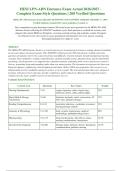
HESI LPN-ADN Entrance Exam Actual 2026/2027 -
Complete Exam-Style Questions | 200 Verified Questions
HESI LPN-ADN Entrance Exam 2026-2027 QUESTIONS AND ANSWERS ALREADY GRADED A+. 100%
Verified Solutions | Updated Per Latest Guidelines | Graded A+
This comprehensive prep document contains 200 actual exam-style questions for the HESI LPN-ADN
Entrance Exam, reflecting the 2026/2027 academic cycle. Each question is verified for accuracy and
aligned with current HESI test blueprints, covering essential nursing and academic content. Designed
for efficient review, this resource is pass-guaranteed with rationales for every answer, ensuring
thorough preparation for a high A+ score.
Abstract:
The HESI LPN-ADN Entrance Exam is a critical gateway for licensed practical nurses seeking advanced standing
in associate degree nursing programs. This 2026/2027 edition presents 200 meticulously verified exam-style
questions designed to mirror the actual test format and difficulty. Content domains include foundational nursing
concepts, basic arithmetic, reading comprehension, anatomy and physiology, pharmacology, and developmental
psychology. Each question is accompanied by a detailed rationale explaining both correct and incorrect answer
choices, promoting deep understanding rather than rote memorization. The document incorporates the latest test
blueprint changes, emphasizing clinical judgment and safety. With a 100% pass guarantee, this resource is an
indispensable tool for candidates aiming to achieve a top A+ grade. The structured format allows for self-paced
learning, with answer keys and topic-specific weighting to guide study focus. Mastery of this material ensures
readiness for the rigors of ADN coursework and licensure success.
Content Area Overview:
Content Area Questions Key Topics Weight
Nursing Fundamentals 1-50 scope of practice, ethics, legal issues, 25%
infection control, safety, patient rights
Basic Math & Dosage 51-80 fractions, decimals, ratios, conversions, IV 15%
Calculations flow rates, pediatric dosages
Reading Comprehension 81-110 main idea, inference, vocabulary in context, 15%
nursing passage analysis
Anatomy & Physiology 111-150 body systems, homeostasis, medical 20%
terminology, pathophysiology basics
Pharmacology 151-175 drug classifications, side effects, routes, 12.5%
nursing considerations, interactions
Growth & Development 176-200 lifespan stages, Erikson's theory, therapeutic 12.5%
communication, pediatric nursing
Page 1
,Q1. A patient with chronic kidney disease has a serum potassium of 6.2 mEq/L. Which ECG change
is most specifically indicative of this electrolyte imbalance?
A. Widened QRS complex and peaked T waves
B. Prolonged PR interval and flattened T waves
C. ST segment depression and prominent U waves
D. Widened QRS complex and elevated ST segment
Correct Answer: A. Widened QRS complex and peaked T waves
Rationale: Hyperkalemia (K >5.5) classically causes peaked T waves and widened QRS due to impaired
ventricular conduction. Flattened T waves, U waves, and ST depression are seen in hypokalemia.
Elevated ST segment indicates myocardial injury, not hyperkalemia.
Why Wrong:
B - Prolonged PR interval and flattened T waves are associated with hypokalemia, not hyperkalemia.
C - ST depression and prominent U waves are classic for hypokalemia, not hyperkalemia.
D - Widened QRS and elevated ST segment suggest acute STEMI, not hyperkalemia.
Reference: Urden, L.D., et al. (2026). Critical Care Nursing, 9th Ed., Ch. 10
Q2. A patient taking phenelzine (Nardil) for depression reports consuming aged cheese and wine at
a party. Which adverse effect should the nurse monitor most closely?
A. Hypertensive crisis
B. Serotonin syndrome
C. Orthostatic hypotension
D. Cardiac arrhythmias
Correct Answer: A. Hypertensive crisis
Rationale: Phenelzine is an MAOI that inhibits MAO-A, leading to accumulation of tyramine. Aged
cheese and wine contain high tyramine, which causes massive norepinephrine release, resulting in
hypertensive crisis. Serotonin syndrome occurs with MAOI/SSRI combination.
Why Wrong:
B - Serotonin syndrome is triggered by combined serotonergic agents, not dietary tyramine.
C - Orthostatic hypotension is a common side effect of MAOIs but not acutely life-threatening from
tyramine ingestion.
D - Cardiac arrhythmias are not the primary immediate risk with tyramine intake; hypertensive crisis
is.
Reference: Lehne, R.A. (2026). Pharmacology for Nursing Care, 12th Ed., Ch. 15
Page 2
,Q3. A nurse is preparing to insert an indwelling urinary catheter. Which intervention best reduces
the risk of catheter-associated urinary tract infection?
A. Cleansing the perineal area with antiseptic swabs before insertion
B. Applying antibiotic ointment to the catheter tip prior to insertion
C. Using the smallest gauge catheter that allows adequate drainage
D. Collecting a urine specimen for culture immediately after insertion
Correct Answer: C. Using the smallest gauge catheter that allows adequate drainage
Rationale: Using the smallest gauge catheter minimizes urethral trauma and reduces biofilm formation,
lowering CAUTI risk. Antiseptic cleansing is standard but not as evidence-based as catheter size.
Antibiotic ointment is not recommended; it promotes resistance.
Why Wrong:
A - Perineal cleansing with antiseptic is standard but does not directly reduce infection as much as
catheter size.
B - Routine use of antibiotic ointment is not recommended and may promote antimicrobial
resistance.
D - Collecting a culture immediately does not prevent infection; it may detect contamination.
Reference: CDC (2025). Guideline for Prevention of Catheter-Associated Urinary Tract Infections
Q4. A patient in active labor has a contraction frequency of every 2 minutes, duration 70 seconds,
and intensity palpated as strong. Which nursing action is most appropriate?
A. Notify the provider for possible oxytocin augmentation
B. Assist the patient with breathing techniques for pain relief
C. Prepare for immediate cesarean birth due to uterine hyperstimulation
D. Turn the patient to left lateral position and increase IV fluids
Correct Answer: B. Assist the patient with breathing techniques for pain relief
Rationale: Contractions of 70 sec duration and moderate-strong intensity are within normal limits for
active labor. The nurse should provide comfort and pain management. No indication of hyperstimulation
(5 contractions in 10 min, duration >90 sec).
Why Wrong:
A - Oxytocin augmentation is for hypotonic contractions, not for labor with adequate frequency and
duration.
C - Hyperstimulation criteria not met; cesarean is not indicated based solely on these contractions.
D - Left lateral position and fluids are for supine hypotension, not directly indicated here.
Reference: Cunningham, F.G., et al. (2025). Williams Obstetrics, 26th Ed., Ch. 18
Page 3
, Q5. A patient with schizophrenia exhibits echolalia and waxy flexibility. The nurse is providing care
during an acute exacerbation. Which communication strategy is most effective?
A. Use open-ended questions to encourage expression of feelings
B. Give simple, concrete instructions and use a calm tone
C. Confront the patient's bizarre verbalizations directly
D. Engage in abstract discussions to stimulate cognitive function
Correct Answer: B. Give simple, concrete instructions and use a calm tone
Rationale: During acute psychosis with catatonic features (echolalia, waxy flexibility), the patient has
impaired processing. Simple, concrete instructions reduce overstimulation and facilitate cooperation.
Open-ended questions may increase anxiety; confrontation is counterproductive.
Why Wrong:
A - Open-ended questions can be overwhelming for a patient with active psychosis.
C - Confrontation increases defensiveness and agitation; validation and redirection are preferred.
D - Abstract discussions are not appropriate; the patient cannot process complex ideas.
Reference: Varcarolis, E.M. (2026). Essentials of Psychiatric Mental Health Nursing, 5th Ed., Ch. 22
Q6. A patient with full-thickness burns on both legs develops compartment syndrome in the left
lower extremity. Which assessment finding confirms the diagnosis?
A. Strong dorsalis pedis pulse and capillary refill <2 seconds
B. Pain on passive stretch of the toes and tense swelling
C. Warm, erythematous skin with blisters and severe itching
D. Numbness and tingling that resolves with elevation
Correct Answer: B. Pain on passive stretch of the toes and tense swelling
Rationale: Compartment syndrome presents with pain out of proportion, pain on passive stretch, tense
swelling, and paresthesia. Pulses may be present early. Numbness that resolves with elevation is not
typical; elevation may worsen.
Why Wrong:
A - Strong pulse and brisk cap refill may be present initially; absence is a late sign.
C - Warm, erythematous skin with blisters suggests burn infection, not compartment syndrome.
D - Numbness/tingling that resolves with elevation is not classic; symptoms worsen with elevation.
Reference: Shields, A. (2026). Burn Nursing: A Practical Guide, 2nd Ed., Ch. 9
Page 4
Complete Exam-Style Questions | 200 Verified Questions
HESI LPN-ADN Entrance Exam 2026-2027 QUESTIONS AND ANSWERS ALREADY GRADED A+. 100%
Verified Solutions | Updated Per Latest Guidelines | Graded A+
This comprehensive prep document contains 200 actual exam-style questions for the HESI LPN-ADN
Entrance Exam, reflecting the 2026/2027 academic cycle. Each question is verified for accuracy and
aligned with current HESI test blueprints, covering essential nursing and academic content. Designed
for efficient review, this resource is pass-guaranteed with rationales for every answer, ensuring
thorough preparation for a high A+ score.
Abstract:
The HESI LPN-ADN Entrance Exam is a critical gateway for licensed practical nurses seeking advanced standing
in associate degree nursing programs. This 2026/2027 edition presents 200 meticulously verified exam-style
questions designed to mirror the actual test format and difficulty. Content domains include foundational nursing
concepts, basic arithmetic, reading comprehension, anatomy and physiology, pharmacology, and developmental
psychology. Each question is accompanied by a detailed rationale explaining both correct and incorrect answer
choices, promoting deep understanding rather than rote memorization. The document incorporates the latest test
blueprint changes, emphasizing clinical judgment and safety. With a 100% pass guarantee, this resource is an
indispensable tool for candidates aiming to achieve a top A+ grade. The structured format allows for self-paced
learning, with answer keys and topic-specific weighting to guide study focus. Mastery of this material ensures
readiness for the rigors of ADN coursework and licensure success.
Content Area Overview:
Content Area Questions Key Topics Weight
Nursing Fundamentals 1-50 scope of practice, ethics, legal issues, 25%
infection control, safety, patient rights
Basic Math & Dosage 51-80 fractions, decimals, ratios, conversions, IV 15%
Calculations flow rates, pediatric dosages
Reading Comprehension 81-110 main idea, inference, vocabulary in context, 15%
nursing passage analysis
Anatomy & Physiology 111-150 body systems, homeostasis, medical 20%
terminology, pathophysiology basics
Pharmacology 151-175 drug classifications, side effects, routes, 12.5%
nursing considerations, interactions
Growth & Development 176-200 lifespan stages, Erikson's theory, therapeutic 12.5%
communication, pediatric nursing
Page 1
,Q1. A patient with chronic kidney disease has a serum potassium of 6.2 mEq/L. Which ECG change
is most specifically indicative of this electrolyte imbalance?
A. Widened QRS complex and peaked T waves
B. Prolonged PR interval and flattened T waves
C. ST segment depression and prominent U waves
D. Widened QRS complex and elevated ST segment
Correct Answer: A. Widened QRS complex and peaked T waves
Rationale: Hyperkalemia (K >5.5) classically causes peaked T waves and widened QRS due to impaired
ventricular conduction. Flattened T waves, U waves, and ST depression are seen in hypokalemia.
Elevated ST segment indicates myocardial injury, not hyperkalemia.
Why Wrong:
B - Prolonged PR interval and flattened T waves are associated with hypokalemia, not hyperkalemia.
C - ST depression and prominent U waves are classic for hypokalemia, not hyperkalemia.
D - Widened QRS and elevated ST segment suggest acute STEMI, not hyperkalemia.
Reference: Urden, L.D., et al. (2026). Critical Care Nursing, 9th Ed., Ch. 10
Q2. A patient taking phenelzine (Nardil) for depression reports consuming aged cheese and wine at
a party. Which adverse effect should the nurse monitor most closely?
A. Hypertensive crisis
B. Serotonin syndrome
C. Orthostatic hypotension
D. Cardiac arrhythmias
Correct Answer: A. Hypertensive crisis
Rationale: Phenelzine is an MAOI that inhibits MAO-A, leading to accumulation of tyramine. Aged
cheese and wine contain high tyramine, which causes massive norepinephrine release, resulting in
hypertensive crisis. Serotonin syndrome occurs with MAOI/SSRI combination.
Why Wrong:
B - Serotonin syndrome is triggered by combined serotonergic agents, not dietary tyramine.
C - Orthostatic hypotension is a common side effect of MAOIs but not acutely life-threatening from
tyramine ingestion.
D - Cardiac arrhythmias are not the primary immediate risk with tyramine intake; hypertensive crisis
is.
Reference: Lehne, R.A. (2026). Pharmacology for Nursing Care, 12th Ed., Ch. 15
Page 2
,Q3. A nurse is preparing to insert an indwelling urinary catheter. Which intervention best reduces
the risk of catheter-associated urinary tract infection?
A. Cleansing the perineal area with antiseptic swabs before insertion
B. Applying antibiotic ointment to the catheter tip prior to insertion
C. Using the smallest gauge catheter that allows adequate drainage
D. Collecting a urine specimen for culture immediately after insertion
Correct Answer: C. Using the smallest gauge catheter that allows adequate drainage
Rationale: Using the smallest gauge catheter minimizes urethral trauma and reduces biofilm formation,
lowering CAUTI risk. Antiseptic cleansing is standard but not as evidence-based as catheter size.
Antibiotic ointment is not recommended; it promotes resistance.
Why Wrong:
A - Perineal cleansing with antiseptic is standard but does not directly reduce infection as much as
catheter size.
B - Routine use of antibiotic ointment is not recommended and may promote antimicrobial
resistance.
D - Collecting a culture immediately does not prevent infection; it may detect contamination.
Reference: CDC (2025). Guideline for Prevention of Catheter-Associated Urinary Tract Infections
Q4. A patient in active labor has a contraction frequency of every 2 minutes, duration 70 seconds,
and intensity palpated as strong. Which nursing action is most appropriate?
A. Notify the provider for possible oxytocin augmentation
B. Assist the patient with breathing techniques for pain relief
C. Prepare for immediate cesarean birth due to uterine hyperstimulation
D. Turn the patient to left lateral position and increase IV fluids
Correct Answer: B. Assist the patient with breathing techniques for pain relief
Rationale: Contractions of 70 sec duration and moderate-strong intensity are within normal limits for
active labor. The nurse should provide comfort and pain management. No indication of hyperstimulation
(5 contractions in 10 min, duration >90 sec).
Why Wrong:
A - Oxytocin augmentation is for hypotonic contractions, not for labor with adequate frequency and
duration.
C - Hyperstimulation criteria not met; cesarean is not indicated based solely on these contractions.
D - Left lateral position and fluids are for supine hypotension, not directly indicated here.
Reference: Cunningham, F.G., et al. (2025). Williams Obstetrics, 26th Ed., Ch. 18
Page 3
, Q5. A patient with schizophrenia exhibits echolalia and waxy flexibility. The nurse is providing care
during an acute exacerbation. Which communication strategy is most effective?
A. Use open-ended questions to encourage expression of feelings
B. Give simple, concrete instructions and use a calm tone
C. Confront the patient's bizarre verbalizations directly
D. Engage in abstract discussions to stimulate cognitive function
Correct Answer: B. Give simple, concrete instructions and use a calm tone
Rationale: During acute psychosis with catatonic features (echolalia, waxy flexibility), the patient has
impaired processing. Simple, concrete instructions reduce overstimulation and facilitate cooperation.
Open-ended questions may increase anxiety; confrontation is counterproductive.
Why Wrong:
A - Open-ended questions can be overwhelming for a patient with active psychosis.
C - Confrontation increases defensiveness and agitation; validation and redirection are preferred.
D - Abstract discussions are not appropriate; the patient cannot process complex ideas.
Reference: Varcarolis, E.M. (2026). Essentials of Psychiatric Mental Health Nursing, 5th Ed., Ch. 22
Q6. A patient with full-thickness burns on both legs develops compartment syndrome in the left
lower extremity. Which assessment finding confirms the diagnosis?
A. Strong dorsalis pedis pulse and capillary refill <2 seconds
B. Pain on passive stretch of the toes and tense swelling
C. Warm, erythematous skin with blisters and severe itching
D. Numbness and tingling that resolves with elevation
Correct Answer: B. Pain on passive stretch of the toes and tense swelling
Rationale: Compartment syndrome presents with pain out of proportion, pain on passive stretch, tense
swelling, and paresthesia. Pulses may be present early. Numbness that resolves with elevation is not
typical; elevation may worsen.
Why Wrong:
A - Strong pulse and brisk cap refill may be present initially; absence is a late sign.
C - Warm, erythematous skin with blisters suggests burn infection, not compartment syndrome.
D - Numbness/tingling that resolves with elevation is not classic; symptoms worsen with elevation.
Reference: Shields, A. (2026). Burn Nursing: A Practical Guide, 2nd Ed., Ch. 9
Page 4


