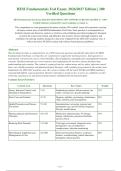
HESI Fundamentals Exit Exam: 2026/2027 Edition | 200
Verified Questions
HESI Fundamentals Exit Exam 2026-2027 QUESTIONS AND ANSWERS ALREADY GRADED A+. 100%
Verified Solutions | Updated Per Latest Guidelines | Graded A+
This comprehensive exam preparation document contains 200 verified, exam-style questions covering
all major content areas of the HESI Fundamentals Exit Exam. Each question is accompanied by a
detailed rationale and distractor analysis to reinforce critical thinking and clinical judgment. Designed
to mirror the actual exam format and difficulty, this resource ensures thorough readiness and
confidence for nursing students aiming for a top score. Updated for the 2026-2027 academic year, it
reflects the latest NCLEX test plan and evidence-based practice guidelines.
Abstract:
This document provides a comprehensive set of 200 exam-style questions specifically tailored for the HESI
Fundamentals Exit Exam, covering the core competencies required for nursing practice. Each question is
meticulously constructed to assess critical thinking, clinical judgment, and application of fundamental nursing
concepts. Detailed rationales for correct answers and explanations for incorrect options facilitate deep
understanding and retention. The content is organized into key content areas such as safety, infection control,
basic care, health promotion, and pharmacological therapies, with weighting proportional to the actual exam.
Updated for the 2026-2027 academic year, this resource aligns with the latest NCLEX and HESI guidelines,
ensuring high-fidelity exam preparation. Ideal for self-study or group review, it serves as a definitive tool for
achieving a passing score and demonstrating mastery of fundamental nursing principles.
Content Area Overview:
Content Area Questions Key Topics Weight
Safety, Infection Control, and 1-30 Standard precautions, fall prevention, fire 15%
Emergency Preparedness safety, restraint use, disaster planning
Basic Care and Comfort 31-70 Hygiene, mobility, positioning, elimination, 20%
sleep, nutrition, pain management
Health Promotion and Disease 71-100 Immunizations, screening, prenatal and 15%
Prevention postpartum care, growth and development,
lifestyle modifications
Pharmacological and Parenteral 101-130 Medication administration, IV therapy, 15%
Therapies dosage calculations, parenteral nutrition,
adverse effects
Reducing Risk Potential 131-160 Vital signs assessment, diagnostic tests, 15%
preoperative care, postoperative
complications, infection monitoring
Physiological Adaptation and 161-200 Fluid and electrolyte balance, acid-base 20%
Management of Care balance, wound healing, patient education,
delegation, ethical practice
Page 1
,Q1. A patient admitted with active pulmonary tuberculosis develops Clostridioides
difficile-associated diarrhea. Which transmission-based precautions should the nurse implement?
A. Airborne precautions only
B. Contact precautions only
C. Airborne and Contact precautions simultaneously
D. Standard precautions only
Correct Answer: C. Airborne and Contact precautions simultaneously
Rationale: Pulmonary tuberculosis requires airborne precautions (N95 respirator, negative pressure). C.
difficile requires contact precautions (gown and gloves for all interactions). Both must be applied
concurrently because the patient has two transmissible infections, each requiring different precautions.
Why Wrong:
A - Airborne precautions address TB but not C. diff, which requires contact precautions.
B - Contact precautions address C. diff but not TB, which requires airborne precautions.
D - Standard precautions are insufficient for either TB or C. diff as they do not prevent airborne
transmission or spore contamination.
Reference: CDC (2024). Guideline for Isolation Precautions. HESI Fundamentals, Ch. 29.
Q2. A patient with a severe head injury has a blood pressure of 180/110 mm Hg, heart rate of 48
bpm, and irregular respirations. What is the most likely cause of these findings?
A. Hypovolemic shock
B. Increased intracranial pressure
C. Sepsis
D. Spinal shock
Correct Answer: B. Increased intracranial pressure
Rationale: Cushing's triad (hypertension, bradycardia, irregular respirations) is a classic late sign of
increased intracranial pressure. Hypertension stimulates baroreceptors, causing bradycardia, while
brainstem compression disrupts respiratory patterns.
Why Wrong:
A - Hypovolemic shock typically presents with hypotension, tachycardia, and tachypnea.
C - Sepsis usually includes fever, hypotension, and tachycardia; not the triad seen here.
D - Spinal shock causes hypotension and bradycardia but not hypertension or irregular respirations.
Reference: Jarvis, C. (2025). Physical Examination and Health Assessment, 9th Ed., Ch. 14. HESI
Fundamentals, Ch. 31.
Page 2
,Q3. A patient receiving anticoagulation therapy has orthostatic hypotension and a history of two
falls in the past month. Which nursing intervention is most effective in preventing falls?
A. Keep all four side rails raised when the patient is in bed.
B. Implement a scheduled toileting program every 2 hours.
C. Place a yellow fall risk sign above the patient's bed.
D. Administer a sedative at bedtime to promote uninterrupted sleep.
Correct Answer: B. Implement a scheduled toileting program every 2 hours.
Rationale: A scheduled toileting program reduces the risk of falls related to urgency and orthostatic
hypotension by providing regular assistance. Raised side rails can lead to entrapment or attempts to
climb over, increasing fall risk. Visual signs alone do not prevent falls. Sedatives increase drowsiness and
fall risk.
Why Wrong:
A - Raised side rails are restrictive and associated with increased risk of injury from climbing over.
C - Fall risk signage is a passive intervention that does not directly prevent falls.
D - Sedatives cause drowsiness and impair balance, thereby increasing fall risk.
Reference: AHRQ (2025). Preventing Falls in Hospitals. HESI Fundamentals, Ch. 28.
Q4. A patient scheduled for elective surgery has signed the informed consent form but later confides
to the nurse, 'I don't really understand what the doctor said about the risks.' What is the nurse's
best action?
A. Have the patient sign a new consent form acknowledging understanding.
B. Notify the surgeon that the patient lacks understanding of the risks.
C. Explain the risks of surgery to the patient in simpler terms.
D. Proceed with the surgery as the signed consent is legally valid.
Correct Answer: B. Notify the surgeon that the patient lacks understanding of the risks.
Rationale: The nurse's role is to witness the signature and verify that the patient understands. If
understanding is lacking, the nurse must notify the surgeon, who is responsible for providing the
information. The nurse should not explain risks because that falls outside the nursing scope and may
cause confusion. Proceeding without understanding violates patient autonomy.
Why Wrong:
A - Having the patient sign another form does not address the lack of understanding.
C - Explaining risks is the responsibility of the surgeon, not the nurse.
D - Legal validity does not equate to ethical informed consent if understanding is absent.
Reference: American Nurses Association (2025). Code of Ethics. HESI Fundamentals, Ch. 7.
Page 3
, Q5. A patient is NPO for surgery scheduled at 0800. At 0600, the patient inadvertently drinks 120
mL of water. What should the nurse do first?
A. Cancel the surgery immediately.
B. Allow the patient to proceed as the amount is small.
C. Notify the anesthesiologist of the ingestion.
D. Administer metoclopramide to accelerate gastric emptying.
Correct Answer: C. Notify the anesthesiologist of the ingestion.
Rationale: The anesthesiologist must evaluate the risk of aspiration; clear liquids may be safe if
consumed 2-4 hours prior, but the decision should be made by the anesthesia provider. Canceling without
consultation is premature. The nurse cannot independently decide to proceed or administer medication to
alter gastric emptying.
Why Wrong:
A - Cancellation is a medical decision; the nurse should communicate first.
B - Although small, any ingestion violates NPO order; only anesthesia can decide.
D - Metoclopramide is not standard for this purpose and requires a prescription.
Reference: AORN (2026). Guidelines for Perioperative Practice. HESI Fundamentals, Ch. 41.
Q6. A patient has a sacral wound with full-thickness skin loss, visible subcutaneous tissue, but no
exposed bone or tendon. How should this pressure injury be staged?
A. Stage 2
B. Stage 3
C. Stage 4
D. Unstageable
Correct Answer: B. Stage 3
Rationale: Stage 3 pressure injury involves full-thickness skin loss with visible subcutaneous tissue; bone,
tendon, or muscle is not exposed. Stage 2 is partial-thickness. Stage 4 exposes bone/tendon. Unstageable
occurs when the wound base is obscured by slough or eschar.
Why Wrong:
A - Stage 2 is partial-thickness with exposed dermis, not subcutaneous tissue.
C - Stage 4 involves exposed bone, tendon, or muscle, which is absent here.
D - Unstageable is used when tissue depth cannot be assessed due to slough, not when base is
visible.
Reference: NPUAP/EPUAP (2024). Pressure Injury Staging Guidelines. HESI Fundamentals, Ch. 36.
Page 4
Verified Questions
HESI Fundamentals Exit Exam 2026-2027 QUESTIONS AND ANSWERS ALREADY GRADED A+. 100%
Verified Solutions | Updated Per Latest Guidelines | Graded A+
This comprehensive exam preparation document contains 200 verified, exam-style questions covering
all major content areas of the HESI Fundamentals Exit Exam. Each question is accompanied by a
detailed rationale and distractor analysis to reinforce critical thinking and clinical judgment. Designed
to mirror the actual exam format and difficulty, this resource ensures thorough readiness and
confidence for nursing students aiming for a top score. Updated for the 2026-2027 academic year, it
reflects the latest NCLEX test plan and evidence-based practice guidelines.
Abstract:
This document provides a comprehensive set of 200 exam-style questions specifically tailored for the HESI
Fundamentals Exit Exam, covering the core competencies required for nursing practice. Each question is
meticulously constructed to assess critical thinking, clinical judgment, and application of fundamental nursing
concepts. Detailed rationales for correct answers and explanations for incorrect options facilitate deep
understanding and retention. The content is organized into key content areas such as safety, infection control,
basic care, health promotion, and pharmacological therapies, with weighting proportional to the actual exam.
Updated for the 2026-2027 academic year, this resource aligns with the latest NCLEX and HESI guidelines,
ensuring high-fidelity exam preparation. Ideal for self-study or group review, it serves as a definitive tool for
achieving a passing score and demonstrating mastery of fundamental nursing principles.
Content Area Overview:
Content Area Questions Key Topics Weight
Safety, Infection Control, and 1-30 Standard precautions, fall prevention, fire 15%
Emergency Preparedness safety, restraint use, disaster planning
Basic Care and Comfort 31-70 Hygiene, mobility, positioning, elimination, 20%
sleep, nutrition, pain management
Health Promotion and Disease 71-100 Immunizations, screening, prenatal and 15%
Prevention postpartum care, growth and development,
lifestyle modifications
Pharmacological and Parenteral 101-130 Medication administration, IV therapy, 15%
Therapies dosage calculations, parenteral nutrition,
adverse effects
Reducing Risk Potential 131-160 Vital signs assessment, diagnostic tests, 15%
preoperative care, postoperative
complications, infection monitoring
Physiological Adaptation and 161-200 Fluid and electrolyte balance, acid-base 20%
Management of Care balance, wound healing, patient education,
delegation, ethical practice
Page 1
,Q1. A patient admitted with active pulmonary tuberculosis develops Clostridioides
difficile-associated diarrhea. Which transmission-based precautions should the nurse implement?
A. Airborne precautions only
B. Contact precautions only
C. Airborne and Contact precautions simultaneously
D. Standard precautions only
Correct Answer: C. Airborne and Contact precautions simultaneously
Rationale: Pulmonary tuberculosis requires airborne precautions (N95 respirator, negative pressure). C.
difficile requires contact precautions (gown and gloves for all interactions). Both must be applied
concurrently because the patient has two transmissible infections, each requiring different precautions.
Why Wrong:
A - Airborne precautions address TB but not C. diff, which requires contact precautions.
B - Contact precautions address C. diff but not TB, which requires airborne precautions.
D - Standard precautions are insufficient for either TB or C. diff as they do not prevent airborne
transmission or spore contamination.
Reference: CDC (2024). Guideline for Isolation Precautions. HESI Fundamentals, Ch. 29.
Q2. A patient with a severe head injury has a blood pressure of 180/110 mm Hg, heart rate of 48
bpm, and irregular respirations. What is the most likely cause of these findings?
A. Hypovolemic shock
B. Increased intracranial pressure
C. Sepsis
D. Spinal shock
Correct Answer: B. Increased intracranial pressure
Rationale: Cushing's triad (hypertension, bradycardia, irregular respirations) is a classic late sign of
increased intracranial pressure. Hypertension stimulates baroreceptors, causing bradycardia, while
brainstem compression disrupts respiratory patterns.
Why Wrong:
A - Hypovolemic shock typically presents with hypotension, tachycardia, and tachypnea.
C - Sepsis usually includes fever, hypotension, and tachycardia; not the triad seen here.
D - Spinal shock causes hypotension and bradycardia but not hypertension or irregular respirations.
Reference: Jarvis, C. (2025). Physical Examination and Health Assessment, 9th Ed., Ch. 14. HESI
Fundamentals, Ch. 31.
Page 2
,Q3. A patient receiving anticoagulation therapy has orthostatic hypotension and a history of two
falls in the past month. Which nursing intervention is most effective in preventing falls?
A. Keep all four side rails raised when the patient is in bed.
B. Implement a scheduled toileting program every 2 hours.
C. Place a yellow fall risk sign above the patient's bed.
D. Administer a sedative at bedtime to promote uninterrupted sleep.
Correct Answer: B. Implement a scheduled toileting program every 2 hours.
Rationale: A scheduled toileting program reduces the risk of falls related to urgency and orthostatic
hypotension by providing regular assistance. Raised side rails can lead to entrapment or attempts to
climb over, increasing fall risk. Visual signs alone do not prevent falls. Sedatives increase drowsiness and
fall risk.
Why Wrong:
A - Raised side rails are restrictive and associated with increased risk of injury from climbing over.
C - Fall risk signage is a passive intervention that does not directly prevent falls.
D - Sedatives cause drowsiness and impair balance, thereby increasing fall risk.
Reference: AHRQ (2025). Preventing Falls in Hospitals. HESI Fundamentals, Ch. 28.
Q4. A patient scheduled for elective surgery has signed the informed consent form but later confides
to the nurse, 'I don't really understand what the doctor said about the risks.' What is the nurse's
best action?
A. Have the patient sign a new consent form acknowledging understanding.
B. Notify the surgeon that the patient lacks understanding of the risks.
C. Explain the risks of surgery to the patient in simpler terms.
D. Proceed with the surgery as the signed consent is legally valid.
Correct Answer: B. Notify the surgeon that the patient lacks understanding of the risks.
Rationale: The nurse's role is to witness the signature and verify that the patient understands. If
understanding is lacking, the nurse must notify the surgeon, who is responsible for providing the
information. The nurse should not explain risks because that falls outside the nursing scope and may
cause confusion. Proceeding without understanding violates patient autonomy.
Why Wrong:
A - Having the patient sign another form does not address the lack of understanding.
C - Explaining risks is the responsibility of the surgeon, not the nurse.
D - Legal validity does not equate to ethical informed consent if understanding is absent.
Reference: American Nurses Association (2025). Code of Ethics. HESI Fundamentals, Ch. 7.
Page 3
, Q5. A patient is NPO for surgery scheduled at 0800. At 0600, the patient inadvertently drinks 120
mL of water. What should the nurse do first?
A. Cancel the surgery immediately.
B. Allow the patient to proceed as the amount is small.
C. Notify the anesthesiologist of the ingestion.
D. Administer metoclopramide to accelerate gastric emptying.
Correct Answer: C. Notify the anesthesiologist of the ingestion.
Rationale: The anesthesiologist must evaluate the risk of aspiration; clear liquids may be safe if
consumed 2-4 hours prior, but the decision should be made by the anesthesia provider. Canceling without
consultation is premature. The nurse cannot independently decide to proceed or administer medication to
alter gastric emptying.
Why Wrong:
A - Cancellation is a medical decision; the nurse should communicate first.
B - Although small, any ingestion violates NPO order; only anesthesia can decide.
D - Metoclopramide is not standard for this purpose and requires a prescription.
Reference: AORN (2026). Guidelines for Perioperative Practice. HESI Fundamentals, Ch. 41.
Q6. A patient has a sacral wound with full-thickness skin loss, visible subcutaneous tissue, but no
exposed bone or tendon. How should this pressure injury be staged?
A. Stage 2
B. Stage 3
C. Stage 4
D. Unstageable
Correct Answer: B. Stage 3
Rationale: Stage 3 pressure injury involves full-thickness skin loss with visible subcutaneous tissue; bone,
tendon, or muscle is not exposed. Stage 2 is partial-thickness. Stage 4 exposes bone/tendon. Unstageable
occurs when the wound base is obscured by slough or eschar.
Why Wrong:
A - Stage 2 is partial-thickness with exposed dermis, not subcutaneous tissue.
C - Stage 4 involves exposed bone, tendon, or muscle, which is absent here.
D - Unstageable is used when tissue depth cannot be assessed due to slough, not when base is
visible.
Reference: NPUAP/EPUAP (2024). Pressure Injury Staging Guidelines. HESI Fundamentals, Ch. 36.
Page 4