Started on Thursday, August 8, 2024, 6:22 PM
State Finished
Completed on Thursday, August 8, 2024, 7:03 PM
Time taken 40 mins 57 secs
Grade 37.00 out of 40.00 (92.5%)
Question 1 The opportunity cost of capital owned by the firm should reflect
Complete
Mark 1.00 out of a. the return foregone by using the capital rather than renting it to another firm.
1.00
b. acquisition cost.
c. both "acquisition cost" and "the return foregone by using the capital rather than renting it to
another firm".
d. wage rate differences.
Question 2
Complete
Mark 1.00 out of
1.00
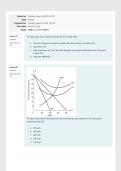
The figure above shows the demand and cost curves facing a price-setting firm. At what output is
marginal revenue $20?
a. 300 units
b. 200 units
c. 400 units
d. 500 units
e. 100 units
, Question 3 Which of the following is anestimable form of a production function?
Complete
Mark 1.00 out of a. Q = aK3L3 + bK2L2
1.00
b. Q = f(L, K̅)
c. All of the choices are correct.
d. Q = f(L,K)
Question 4 Which of the following is not a characteristic of a constant cost competitive industry? As the industry
Complete expands output in the long run,
Mark 1.00 out of
1.00
a. the number of firms remain constant.
b. the equilibrium price of the product remains constant in the long run.
c. None of the choices are correct.
d. input prices remain constant.
e. the cost of production remains constant.
Question 5 The marginal rate of technical substitution is
Complete
Mark 1.00 out of a. None of the choices are correct.
1.00
b. the slope of the isocost curve.
c. the rate at which the firm can substitute labor for capital while holding total cost constant.
d. both "the rate at which the firm can substitute labor for capital while holding total cost
constant" and "the slope of the isocost curve".
e. the rate at which the firm can substitute labor for capital while holding output constant.
Question 6 Which of the following is false?
Complete
Mark 0.00 out of a. None of the choices are correct.
1.00
b. A change in total cost shifts the isocost curve.
c. Convex isoquants mean that the marginal rate of technical substitution decreases as the firm
substitutes labor for capital.
d. At the optimal input choice, the rate at which the firm can substitute labor for capital in
production is equal to the rate at which the firm can substitute labor for capital in the market.
e. A change in input prices shifts the isoquant map.
State Finished
Completed on Thursday, August 8, 2024, 7:03 PM
Time taken 40 mins 57 secs
Grade 37.00 out of 40.00 (92.5%)
Question 1 The opportunity cost of capital owned by the firm should reflect
Complete
Mark 1.00 out of a. the return foregone by using the capital rather than renting it to another firm.
1.00
b. acquisition cost.
c. both "acquisition cost" and "the return foregone by using the capital rather than renting it to
another firm".
d. wage rate differences.
Question 2
Complete
Mark 1.00 out of
1.00
The figure above shows the demand and cost curves facing a price-setting firm. At what output is
marginal revenue $20?
a. 300 units
b. 200 units
c. 400 units
d. 500 units
e. 100 units
, Question 3 Which of the following is anestimable form of a production function?
Complete
Mark 1.00 out of a. Q = aK3L3 + bK2L2
1.00
b. Q = f(L, K̅)
c. All of the choices are correct.
d. Q = f(L,K)
Question 4 Which of the following is not a characteristic of a constant cost competitive industry? As the industry
Complete expands output in the long run,
Mark 1.00 out of
1.00
a. the number of firms remain constant.
b. the equilibrium price of the product remains constant in the long run.
c. None of the choices are correct.
d. input prices remain constant.
e. the cost of production remains constant.
Question 5 The marginal rate of technical substitution is
Complete
Mark 1.00 out of a. None of the choices are correct.
1.00
b. the slope of the isocost curve.
c. the rate at which the firm can substitute labor for capital while holding total cost constant.
d. both "the rate at which the firm can substitute labor for capital while holding total cost
constant" and "the slope of the isocost curve".
e. the rate at which the firm can substitute labor for capital while holding output constant.
Question 6 Which of the following is false?
Complete
Mark 0.00 out of a. None of the choices are correct.
1.00
b. A change in total cost shifts the isocost curve.
c. Convex isoquants mean that the marginal rate of technical substitution decreases as the firm
substitutes labor for capital.
d. At the optimal input choice, the rate at which the firm can substitute labor for capital in
production is equal to the rate at which the firm can substitute labor for capital in the market.
e. A change in input prices shifts the isoquant map.