

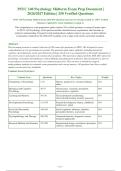
PSYC 140 Psychology Midterm Exam Prep Document |
2026/2027 Edition | 250 Verified Questions
PSYC 140 Psychology Midterm Exam 2026-2027 Questions and Answers Already Graded A+. 100% Verified
Solutions | Updated Per Latest Guidelines | Graded A+
This comprehensive exam preparation guide contains 250 verified questions covering all major topics
in PSYC 140 Psychology. Each question includes detailed answer explanations and rationales to
reinforce understanding. Designed to help undergraduate students achieve top scores on their midterm
examination. Updated for the 2026-2027 academic year to align with current curriculum standards.
Abstract:
This document presents a curated collection of 250 exam-style questions for PSYC 140, designed to assess
comprehension of core psychological concepts. The questions span major subfields, including biological,
cognitive, developmental, social, and clinical psychology. Each item is accompanied by a thorough explanation of
the correct answer and analysis of common misconceptions. The material is aligned with the 2026-2027 university
psychology curriculum and emphasizes critical thinking and application of theories. Special attention is given to
recent advances in neuroscience and cross-cultural perspectives. This resource is intended to support
undergraduate students in systematic exam preparation and concept mastery. All questions have been verified
against current university standards.
Content Area Overview:
Content Area Questions Key Topics Weight
Foundations of Psychology 1-35 History, perspectives, research methods, 14%
ethics
Biological and Cognitive 36-75 Neuroscience, sensation, perception, 16%
Psychology consciousness, cognition
Learning and Memory 76-110 Classical/operant conditioning, 14%
observational learning, memory processes
Developmental Psychology 111-145 Prenatal development, infancy, childhood, 14%
adolescence, aging
Social and Personality 146-185 Social cognition, influence, attitudes, 16%
Psychology personality theories, assessment
Psychopathology and Therapy 186-220 Abnormal behavior, diagnostic criteria, 14%
treatment approaches
Research Methods and Statistics 221-250 Experimental design, correlation, descriptive 12%
statistics, inferential statistics
Page 1
,Q1. A patient with Broca's aphasia following a left hemisphere stroke shows substantial language
recovery over months. Which neural mechanism best accounts for this?
A. Synaptic pruning in the right hemisphere
B. Reorganization of function through perilesional tissue and contralateral homotopic areas
C. Increased myelination of spared pathways
D. Neurogenesis in the hippocampus
Correct Answer: B. Reorganization of function through perilesional tissue and contralateral
homotopic areas
Rationale: Recovery from aphasia largely involves functional reorganization, with perilesional areas and
contralateral regions (e.g., right hemisphere) assuming language functions. Synaptic pruning is a
developmental process, not a recovery mechanism; myelination is too slow; neurogenesis in hippocampus
does not directly support language recovery.
Why Wrong:
A - Synaptic pruning is a developmental process that reduces synapses, not a mechanism for
recovery after stroke.
C - While myelination can enhance signal speed, it does not account for the significant
reorganization of function observed in aphasia recovery.
D - Neurogenesis in the hippocampus is associated with memory, not language recovery, and is
limited in adults.
Reference: Kolb, B., & Whishaw, I. Q. (2025). Fundamentals of Human Neuropsychology (8th ed.). Worth
Publishers.
Q2. In a negotiation, a salesperson starts with an inflated price, and the final agreed price seems
reasonable to the buyer. Which cognitive heuristic primarily drives this perception?
A. Availability heuristic
B. Representativeness heuristic
C. Anchoring and adjustment
D. Confirmation bias
Correct Answer: C. Anchoring and adjustment
Rationale: The anchoring effect occurs when an initial value (anchor) influences subsequent judgments;
the buyer adjusts insufficiently from the inflated price. Availability relies on ease of recall,
representativeness on similarity, and confirmation bias on seeking evidence that supports pre-existing
beliefs.
Why Wrong:
A - Availability heuristic depends on how easily examples come to mind, not on an initial anchor.
B - Representativeness heuristic involves assessing similarity to a prototype, not adjustment from a
starting point.
D - Confirmation bias is the tendency to search for information that confirms one's own
preconceptions, not relevant to the effect of an initial offer.
Reference: Tversky, A., & Kahneman, D. (1974). Judgment under uncertainty: Heuristics and biases.
Science, 185(4157), 1124-1131.
Page 2
,Q3. A rat's lever pressing produces food on a schedule where a fixed number of presses is required,
but the number varies unpredictably. The rat shows a steady, moderate response rate with little
pause after reinforcement. What schedule is this?
A. Fixed ratio (FR)
B. Variable ratio (VR)
C. Fixed interval (FI)
D. Variable interval (VI)
Correct Answer: B. Variable ratio (VR)
Rationale: Variable ratio schedules require an unpredictable number of responses per reinforcement,
producing high and steady response rates with minimal post-reinforcement pauses. Fixed ratio shows
post-reinforcement pauses, interval schedules produce scalloped or steady patterns depending on
variability.
Why Wrong:
A - Fixed ratio schedules typically produce a post-reinforcement pause followed by a high response
rate, not a steady rate with no pause.
C - Fixed interval schedules produce a scalloped response pattern with increasing rate near the end of
the interval.
D - Variable interval schedules produce a steady but lower response rate than VR and are time-based,
not response-count based.
Reference: Staddon, J. E. R., & Cerutti, D. T. (2003). Operant behavior. Annual Review of Psychology,
54(1), 115-144.
Q4. According to the two-factor theory of emotion, emotional experience depends on which two
factors?
A. Physiological arousal and cognitive interpretation
B. Subjective feeling and behavioral response
C. Appraisal of stimulus and action tendency
D. Autonomic nervous system and limbic system activation
Correct Answer: A. Physiological arousal and cognitive interpretation
Rationale: Schachter and Singer's two-factor theory posits that emotion results from physiological
arousal followed by a cognitive label (interpretation) of that arousal. Option B describes components of
emotion but not the theory's unique mechanism; C is appraisal theory; D is biological substrate.
Why Wrong:
B - Subjective feeling and behavioral response are components of emotion, but the two-factor theory
specifically emphasizes the sequence of arousal and cognition.
C - Appraisal and action tendency are central to cognitive appraisal theories (e.g., Lazarus), not the
two-factor theory.
D - Autonomic and limbic activation are involved but are not the two factors proposed by Schachter
and Singer.
Reference: Schachter, S., & Singer, J. (1962). Cognitive, social, and physiological determinants of
emotional state. Psychological Review, 69(5), 379-399.
Page 3
, Q5. Which statement best reflects current understanding of the role of sleep in memory
consolidation?
A. REM sleep exclusively consolidates procedural memories, while NREM consolidates declarative
memories.
B. NREM sleep, particularly slow-wave sleep, facilitates hippocampal-neocortical dialogue for
systems consolidation.
C. Sleep only benefits memory if the material is emotionally charged.
D. Memory consolidation occurs solely during REM sleep.
Correct Answer: B. NREM sleep, particularly slow-wave sleep, facilitates hippocampal-neocortical
dialogue for systems consolidation.
Rationale: Current evidence highlights NREM slow-wave sleep as critical for declarative memory
consolidation through hippocampal-neocortical interactions. REM is more important for procedural and
emotional memories, but not exclusive. Sleep benefits both emotional and neutral memories.
Why Wrong:
A - The dichotomy is not strict; NREM also contributes to procedural memory, and REM
contributes to declarative memory.
C - Sleep benefits both emotional and non-emotional memories, though emotional memories may
show greater consolidation.
D - Both NREM and REM sleep contribute to different aspects of memory consolidation.
Reference: Rasch, B., & Born, J. (2013). About sleep's role in memory. Nature Reviews Neuroscience,
14(4), 221-236.
Q6. In minimal group paradigm studies, participants allocated more resources to ingroup than
outgroup members. This effect is best explained by:
A. Realistic conflict theory
B. Social identity theory
C. System justification theory
D. Scapegoat theory
Correct Answer: B. Social identity theory
Rationale: Social identity theory proposes that individuals strive for positive social identity, leading to
ingroup favoritism even in arbitrary groups. Realistic conflict theory requires actual resource
competition; system justification explains defense of the status quo; scapegoat theory involves blaming
outgroups for problems.
Why Wrong:
A - Realistic conflict theory requires actual conflict over scarce resources, which is absent in
minimal group paradigms.
C - System justification theory focuses on justifying existing social systems, not ingroup favoritism
in minimal groups.
D - Scapegoat theory involves displacing aggression onto outgroups, not resource allocation in the
absence of threat.
Reference: Tajfel, H., & Turner, J. C. (1979). An integrative theory of intergroup conflict. In W. G. Austin
& S. Worchel (Eds.), The social psychology of intergroup relations (pp. 33-47). Brooks/Cole.
Page 4
2026/2027 Edition | 250 Verified Questions
PSYC 140 Psychology Midterm Exam 2026-2027 Questions and Answers Already Graded A+. 100% Verified
Solutions | Updated Per Latest Guidelines | Graded A+
This comprehensive exam preparation guide contains 250 verified questions covering all major topics
in PSYC 140 Psychology. Each question includes detailed answer explanations and rationales to
reinforce understanding. Designed to help undergraduate students achieve top scores on their midterm
examination. Updated for the 2026-2027 academic year to align with current curriculum standards.
Abstract:
This document presents a curated collection of 250 exam-style questions for PSYC 140, designed to assess
comprehension of core psychological concepts. The questions span major subfields, including biological,
cognitive, developmental, social, and clinical psychology. Each item is accompanied by a thorough explanation of
the correct answer and analysis of common misconceptions. The material is aligned with the 2026-2027 university
psychology curriculum and emphasizes critical thinking and application of theories. Special attention is given to
recent advances in neuroscience and cross-cultural perspectives. This resource is intended to support
undergraduate students in systematic exam preparation and concept mastery. All questions have been verified
against current university standards.
Content Area Overview:
Content Area Questions Key Topics Weight
Foundations of Psychology 1-35 History, perspectives, research methods, 14%
ethics
Biological and Cognitive 36-75 Neuroscience, sensation, perception, 16%
Psychology consciousness, cognition
Learning and Memory 76-110 Classical/operant conditioning, 14%
observational learning, memory processes
Developmental Psychology 111-145 Prenatal development, infancy, childhood, 14%
adolescence, aging
Social and Personality 146-185 Social cognition, influence, attitudes, 16%
Psychology personality theories, assessment
Psychopathology and Therapy 186-220 Abnormal behavior, diagnostic criteria, 14%
treatment approaches
Research Methods and Statistics 221-250 Experimental design, correlation, descriptive 12%
statistics, inferential statistics
Page 1
,Q1. A patient with Broca's aphasia following a left hemisphere stroke shows substantial language
recovery over months. Which neural mechanism best accounts for this?
A. Synaptic pruning in the right hemisphere
B. Reorganization of function through perilesional tissue and contralateral homotopic areas
C. Increased myelination of spared pathways
D. Neurogenesis in the hippocampus
Correct Answer: B. Reorganization of function through perilesional tissue and contralateral
homotopic areas
Rationale: Recovery from aphasia largely involves functional reorganization, with perilesional areas and
contralateral regions (e.g., right hemisphere) assuming language functions. Synaptic pruning is a
developmental process, not a recovery mechanism; myelination is too slow; neurogenesis in hippocampus
does not directly support language recovery.
Why Wrong:
A - Synaptic pruning is a developmental process that reduces synapses, not a mechanism for
recovery after stroke.
C - While myelination can enhance signal speed, it does not account for the significant
reorganization of function observed in aphasia recovery.
D - Neurogenesis in the hippocampus is associated with memory, not language recovery, and is
limited in adults.
Reference: Kolb, B., & Whishaw, I. Q. (2025). Fundamentals of Human Neuropsychology (8th ed.). Worth
Publishers.
Q2. In a negotiation, a salesperson starts with an inflated price, and the final agreed price seems
reasonable to the buyer. Which cognitive heuristic primarily drives this perception?
A. Availability heuristic
B. Representativeness heuristic
C. Anchoring and adjustment
D. Confirmation bias
Correct Answer: C. Anchoring and adjustment
Rationale: The anchoring effect occurs when an initial value (anchor) influences subsequent judgments;
the buyer adjusts insufficiently from the inflated price. Availability relies on ease of recall,
representativeness on similarity, and confirmation bias on seeking evidence that supports pre-existing
beliefs.
Why Wrong:
A - Availability heuristic depends on how easily examples come to mind, not on an initial anchor.
B - Representativeness heuristic involves assessing similarity to a prototype, not adjustment from a
starting point.
D - Confirmation bias is the tendency to search for information that confirms one's own
preconceptions, not relevant to the effect of an initial offer.
Reference: Tversky, A., & Kahneman, D. (1974). Judgment under uncertainty: Heuristics and biases.
Science, 185(4157), 1124-1131.
Page 2
,Q3. A rat's lever pressing produces food on a schedule where a fixed number of presses is required,
but the number varies unpredictably. The rat shows a steady, moderate response rate with little
pause after reinforcement. What schedule is this?
A. Fixed ratio (FR)
B. Variable ratio (VR)
C. Fixed interval (FI)
D. Variable interval (VI)
Correct Answer: B. Variable ratio (VR)
Rationale: Variable ratio schedules require an unpredictable number of responses per reinforcement,
producing high and steady response rates with minimal post-reinforcement pauses. Fixed ratio shows
post-reinforcement pauses, interval schedules produce scalloped or steady patterns depending on
variability.
Why Wrong:
A - Fixed ratio schedules typically produce a post-reinforcement pause followed by a high response
rate, not a steady rate with no pause.
C - Fixed interval schedules produce a scalloped response pattern with increasing rate near the end of
the interval.
D - Variable interval schedules produce a steady but lower response rate than VR and are time-based,
not response-count based.
Reference: Staddon, J. E. R., & Cerutti, D. T. (2003). Operant behavior. Annual Review of Psychology,
54(1), 115-144.
Q4. According to the two-factor theory of emotion, emotional experience depends on which two
factors?
A. Physiological arousal and cognitive interpretation
B. Subjective feeling and behavioral response
C. Appraisal of stimulus and action tendency
D. Autonomic nervous system and limbic system activation
Correct Answer: A. Physiological arousal and cognitive interpretation
Rationale: Schachter and Singer's two-factor theory posits that emotion results from physiological
arousal followed by a cognitive label (interpretation) of that arousal. Option B describes components of
emotion but not the theory's unique mechanism; C is appraisal theory; D is biological substrate.
Why Wrong:
B - Subjective feeling and behavioral response are components of emotion, but the two-factor theory
specifically emphasizes the sequence of arousal and cognition.
C - Appraisal and action tendency are central to cognitive appraisal theories (e.g., Lazarus), not the
two-factor theory.
D - Autonomic and limbic activation are involved but are not the two factors proposed by Schachter
and Singer.
Reference: Schachter, S., & Singer, J. (1962). Cognitive, social, and physiological determinants of
emotional state. Psychological Review, 69(5), 379-399.
Page 3
, Q5. Which statement best reflects current understanding of the role of sleep in memory
consolidation?
A. REM sleep exclusively consolidates procedural memories, while NREM consolidates declarative
memories.
B. NREM sleep, particularly slow-wave sleep, facilitates hippocampal-neocortical dialogue for
systems consolidation.
C. Sleep only benefits memory if the material is emotionally charged.
D. Memory consolidation occurs solely during REM sleep.
Correct Answer: B. NREM sleep, particularly slow-wave sleep, facilitates hippocampal-neocortical
dialogue for systems consolidation.
Rationale: Current evidence highlights NREM slow-wave sleep as critical for declarative memory
consolidation through hippocampal-neocortical interactions. REM is more important for procedural and
emotional memories, but not exclusive. Sleep benefits both emotional and neutral memories.
Why Wrong:
A - The dichotomy is not strict; NREM also contributes to procedural memory, and REM
contributes to declarative memory.
C - Sleep benefits both emotional and non-emotional memories, though emotional memories may
show greater consolidation.
D - Both NREM and REM sleep contribute to different aspects of memory consolidation.
Reference: Rasch, B., & Born, J. (2013). About sleep's role in memory. Nature Reviews Neuroscience,
14(4), 221-236.
Q6. In minimal group paradigm studies, participants allocated more resources to ingroup than
outgroup members. This effect is best explained by:
A. Realistic conflict theory
B. Social identity theory
C. System justification theory
D. Scapegoat theory
Correct Answer: B. Social identity theory
Rationale: Social identity theory proposes that individuals strive for positive social identity, leading to
ingroup favoritism even in arbitrary groups. Realistic conflict theory requires actual resource
competition; system justification explains defense of the status quo; scapegoat theory involves blaming
outgroups for problems.
Why Wrong:
A - Realistic conflict theory requires actual conflict over scarce resources, which is absent in
minimal group paradigms.
C - System justification theory focuses on justifying existing social systems, not ingroup favoritism
in minimal groups.
D - Scapegoat theory involves displacing aggression onto outgroups, not resource allocation in the
absence of threat.
Reference: Tajfel, H., & Turner, J. C. (1979). An integrative theory of intergroup conflict. In W. G. Austin
& S. Worchel (Eds.), The social psychology of intergroup relations (pp. 33-47). Brooks/Cole.
Page 4


