

L ATEST E XAM · VERIFIED ANSWERS · INSTANT DOWNLOAD
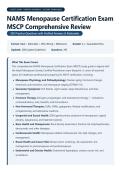
NAMS Menopause Certification Exam
MSCP Comprehensive Review
295 Practice Questions with Verified Answers & Rationales
Format: Q&A + Rationales + Why-Wrong + References Graded: A+ / Guaranteed Pass
Updated: 2026 (Latest Guidelines) Questions: 295
What This Exam Covers
This comprehensive NAMS Menopause Certification Exam (MSCP) study guide is aligned with
the latest Menopause Society Certified Practitioner exam blueprint. It covers all essential
topics for healthcare professionals preparing for MSCP certification, including:
Menopause Physiology and Pathophysiology: Ovarian aging, hormonal changes,
menstrual cycle transition, and menopause staging (STRAW+10).
Vasomotor Symptoms: Hot flashes, night sweats, sleep disturbances, and their
management.
Hormone Therapy: Estrogen, progestogen, and testosterone therapy — indications,
contraindications, risks, benefits, and formulations.
Non-Hormonal Therapies: SSRIs, SNRIs, gabapentin, lifestyle modifications, and
complementary and alternative medicine.
Urogenital and Sexual Health: GSM (genitourinary syndrome of menopause), vaginal
atrophy, dyspareunia, and treatment options.
Bone Health and Osteoporosis: Bone density assessment, fracture risk, bisphosphonates,
denosumab, and other therapies.
Cardiovascular Health: Menopause-related cardiovascular risk, lipid changes, and
management.
Breast Health and Cancer Risk: Breast cancer screening, risk assessment, and
management in perimenopause and postmenopause.
Endometrial and Ovarian Health: Endometrial hyperplasia, ovarian cancer risk, and
surveillance.
, Menopause Management in Special Populations: Premature ovarian insufficiency,
surgical menopause, cancer survivors, and transgender individuals.
Psychosocial and Cognitive Aspects: Mood disorders, cognitive changes, and quality of
life in menopause.
ABSTRACT
This NAMS Menopause Certification Exam (MSCP) study guide is a comprehensive resource
that consolidates the most frequently tested concepts from the Menopause Society Certified
Practitioner curriculum. It contains 295 practice questions that closely mirror the actual MSCP
exam in style, difficulty, and content distribution. Each question is accompanied by a detailed
rationale (in italics) that explains the clinical reasoning behind the correct answer, plus a
targeted "Why Wrong" section (in italics) that addresses only the incorrect options — helping
you understand exactly why each distractor is not the best choice. Additionally, each question
includes a reference (in italics) citing the specific source or guideline for further study. This
comprehensive approach reinforces clinical judgment, evidence-based practice, and test-
taking strategies, ensuring you are fully prepared for exam day.
Why Download This Exam?
Guaranteed Pass: Master the content tested on the MSCP exam with 295 carefully crafted
questions that cover every major topic.
Learn from Mistakes: Each incorrect option is explained in detail (in italics) so you
understand why it is wrong, not just why the correct answer is right.
Exam Readiness: Build confidence by practicing with questions that mirror the real exam
format and difficulty level.
Time-Saving: All the essential content is consolidated into one document — no need to
search through multiple resources.
Instant Download: Access the material immediately and start studying right away.
References Included: Each question includes a reference citation from Menopause Society
guidelines, ACOG, or peer-reviewed literature.
You will pass the NAMS Menopause Certification Exam on your first attempt with this
comprehensive review!
Menopause Physiology Vasomotor Symptoms Hormone Therapy
, Non-Hormonal Therapy GSM Osteoporosis Cardiovascular Health
Breast Health Endometrial Health Special Populations Psychosocial Aspects
Evidence-Based Practice
NAMS MSCP MENOPAUSECERTIFICATION VERIFIEDQANDA GRADEDA+ RATIONALES
WHYWRONG GUARANTEEDPASS LATEST2026
1.
According to the STRAW+10 staging system, which stage is characterized by persistent
amenorrhea for 12 months or more?
A. Stage -1 (Late Reproductive)
B. Stage 0 (Menopause Transition)
C. Stage +1 (Postmenopause)
D. Stage +2 (Late Postmenopause)
Correct Answer: C
Rationale: Stage +1 (Postmenopause) is defined by amenorrhea lasting 12 months or more,
marking the completion of the menopause transition. Stages +2 and +3 represent late and
advanced postmenopause.
Why the other options are wrong:
A. Stage -1 (Late Reproductive) — Stage -1 is the late reproductive stage, characterized by
declining fertility but regular cycles.
B. Stage 0 (Menopause Transition) — Stage 0 is the menopause transition, marked by increased
cycle variability and elevated FSH.
D. Stage +2 (Late Postmenopause) — Stage +2 is late postmenopause, typically 3-6 years after
menopause onset.
Reference: Harlow et al., 'STRAW+10 Staging System,' Menopause, 2012.
2.
Which of the following is the most common vasomotor symptom experienced during
menopause?
A. Night sweats
B. Hot flashes
, C. Sleep disturbances
D. Mood swings
Correct Answer: B
Rationale: Hot flashes are the most common vasomotor symptom, affecting up to 80% of women
during the menopause transition. They are characterized by sudden sensations of heat, flushing,
and sweating.
Why the other options are wrong:
A. Night sweats — Night sweats are a variant of hot flashes occurring during sleep, but hot
flashes overall are more prevalent.
C. Sleep disturbances — Sleep disturbances are common but are not classified as primary
vasomotor symptoms.
D. Mood swings — Mood swings are associated with menopause but are not vasomotor
symptoms.
Reference: NAMS, 'Menopause Practice: A Clinician's Guide,' 6th ed., 2023, Chapter 4.
3.
What is the first-line pharmacologic therapy for moderate-to-severe vasomotor symptoms in a
woman without contraindications?
A. SSRI
B. Gabapentin
C. Systemic estrogen therapy
D. Clonidine
Correct Answer: C
Rationale: Systemic estrogen therapy is the most effective treatment for moderate-to-severe
vasomotor symptoms and is recommended as first-line therapy for women without
contraindications.
Why the other options are wrong:
A. SSRI — SSRIs are effective for vasomotor symptoms but are second-line options, typically for
women with contraindications to estrogen.
B. Gabapentin — Gabapentin is effective but is also a second-line therapy.
D. Clonidine — Clonidine has limited efficacy and is not first-line therapy.
NAMS Menopause Certification Exam
MSCP Comprehensive Review
295 Practice Questions with Verified Answers & Rationales
Format: Q&A + Rationales + Why-Wrong + References Graded: A+ / Guaranteed Pass
Updated: 2026 (Latest Guidelines) Questions: 295
What This Exam Covers
This comprehensive NAMS Menopause Certification Exam (MSCP) study guide is aligned with
the latest Menopause Society Certified Practitioner exam blueprint. It covers all essential
topics for healthcare professionals preparing for MSCP certification, including:
Menopause Physiology and Pathophysiology: Ovarian aging, hormonal changes,
menstrual cycle transition, and menopause staging (STRAW+10).
Vasomotor Symptoms: Hot flashes, night sweats, sleep disturbances, and their
management.
Hormone Therapy: Estrogen, progestogen, and testosterone therapy — indications,
contraindications, risks, benefits, and formulations.
Non-Hormonal Therapies: SSRIs, SNRIs, gabapentin, lifestyle modifications, and
complementary and alternative medicine.
Urogenital and Sexual Health: GSM (genitourinary syndrome of menopause), vaginal
atrophy, dyspareunia, and treatment options.
Bone Health and Osteoporosis: Bone density assessment, fracture risk, bisphosphonates,
denosumab, and other therapies.
Cardiovascular Health: Menopause-related cardiovascular risk, lipid changes, and
management.
Breast Health and Cancer Risk: Breast cancer screening, risk assessment, and
management in perimenopause and postmenopause.
Endometrial and Ovarian Health: Endometrial hyperplasia, ovarian cancer risk, and
surveillance.
, Menopause Management in Special Populations: Premature ovarian insufficiency,
surgical menopause, cancer survivors, and transgender individuals.
Psychosocial and Cognitive Aspects: Mood disorders, cognitive changes, and quality of
life in menopause.
ABSTRACT
This NAMS Menopause Certification Exam (MSCP) study guide is a comprehensive resource
that consolidates the most frequently tested concepts from the Menopause Society Certified
Practitioner curriculum. It contains 295 practice questions that closely mirror the actual MSCP
exam in style, difficulty, and content distribution. Each question is accompanied by a detailed
rationale (in italics) that explains the clinical reasoning behind the correct answer, plus a
targeted "Why Wrong" section (in italics) that addresses only the incorrect options — helping
you understand exactly why each distractor is not the best choice. Additionally, each question
includes a reference (in italics) citing the specific source or guideline for further study. This
comprehensive approach reinforces clinical judgment, evidence-based practice, and test-
taking strategies, ensuring you are fully prepared for exam day.
Why Download This Exam?
Guaranteed Pass: Master the content tested on the MSCP exam with 295 carefully crafted
questions that cover every major topic.
Learn from Mistakes: Each incorrect option is explained in detail (in italics) so you
understand why it is wrong, not just why the correct answer is right.
Exam Readiness: Build confidence by practicing with questions that mirror the real exam
format and difficulty level.
Time-Saving: All the essential content is consolidated into one document — no need to
search through multiple resources.
Instant Download: Access the material immediately and start studying right away.
References Included: Each question includes a reference citation from Menopause Society
guidelines, ACOG, or peer-reviewed literature.
You will pass the NAMS Menopause Certification Exam on your first attempt with this
comprehensive review!
Menopause Physiology Vasomotor Symptoms Hormone Therapy
, Non-Hormonal Therapy GSM Osteoporosis Cardiovascular Health
Breast Health Endometrial Health Special Populations Psychosocial Aspects
Evidence-Based Practice
NAMS MSCP MENOPAUSECERTIFICATION VERIFIEDQANDA GRADEDA+ RATIONALES
WHYWRONG GUARANTEEDPASS LATEST2026
1.
According to the STRAW+10 staging system, which stage is characterized by persistent
amenorrhea for 12 months or more?
A. Stage -1 (Late Reproductive)
B. Stage 0 (Menopause Transition)
C. Stage +1 (Postmenopause)
D. Stage +2 (Late Postmenopause)
Correct Answer: C
Rationale: Stage +1 (Postmenopause) is defined by amenorrhea lasting 12 months or more,
marking the completion of the menopause transition. Stages +2 and +3 represent late and
advanced postmenopause.
Why the other options are wrong:
A. Stage -1 (Late Reproductive) — Stage -1 is the late reproductive stage, characterized by
declining fertility but regular cycles.
B. Stage 0 (Menopause Transition) — Stage 0 is the menopause transition, marked by increased
cycle variability and elevated FSH.
D. Stage +2 (Late Postmenopause) — Stage +2 is late postmenopause, typically 3-6 years after
menopause onset.
Reference: Harlow et al., 'STRAW+10 Staging System,' Menopause, 2012.
2.
Which of the following is the most common vasomotor symptom experienced during
menopause?
A. Night sweats
B. Hot flashes
, C. Sleep disturbances
D. Mood swings
Correct Answer: B
Rationale: Hot flashes are the most common vasomotor symptom, affecting up to 80% of women
during the menopause transition. They are characterized by sudden sensations of heat, flushing,
and sweating.
Why the other options are wrong:
A. Night sweats — Night sweats are a variant of hot flashes occurring during sleep, but hot
flashes overall are more prevalent.
C. Sleep disturbances — Sleep disturbances are common but are not classified as primary
vasomotor symptoms.
D. Mood swings — Mood swings are associated with menopause but are not vasomotor
symptoms.
Reference: NAMS, 'Menopause Practice: A Clinician's Guide,' 6th ed., 2023, Chapter 4.
3.
What is the first-line pharmacologic therapy for moderate-to-severe vasomotor symptoms in a
woman without contraindications?
A. SSRI
B. Gabapentin
C. Systemic estrogen therapy
D. Clonidine
Correct Answer: C
Rationale: Systemic estrogen therapy is the most effective treatment for moderate-to-severe
vasomotor symptoms and is recommended as first-line therapy for women without
contraindications.
Why the other options are wrong:
A. SSRI — SSRIs are effective for vasomotor symptoms but are second-line options, typically for
women with contraindications to estrogen.
B. Gabapentin — Gabapentin is effective but is also a second-line therapy.
D. Clonidine — Clonidine has limited efficacy and is not first-line therapy.


