HESI RN EXIT
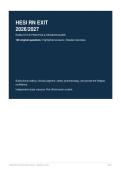
2026/2027
EXAM-STYLE PRACTICE & REVISION GUIDE
120 original questions | Highlighted answers | Detailed rationales
Build priority-setting, clinical judgment, safety, pharmacology, and across-the-lifespan
confidence.
Independent study resource. Not official exam content.
Independent exam-style practice resource - educational use only Page 1
, How to Use This Guide
Complete each item before revealing the answer. For every miss, identify whether the gap was content knowledge, priority
setting, medication safety, or misreading the stem. Rework missed questions after 24-48 hours, then again one week later.
Suggested scoring guide
Score Interpretation Next move
102-120 Strong practice performance Review rationales and target weak categories.
84-101 Developing readiness Use a focused content review, then retest.
Below 84 Foundational review advised Rebuild core concepts and seek faculty guidance.
Important Notice
This independent, original practice guide is not affiliated with, sponsored by, or endorsed by Elsevier, HESI, NCSBN, or
NCLEX. It contains no recalled, copied, or actual secure exam questions. It is educational material, not a substitute for faculty
guidance, current clinical references, institutional policy, or professional medical judgment.
The name HESI is used only to identify the type of readiness preparation learners may be seeking. NCLEX and Next
Generation NCLEX are registered marks of the National Council of State Boards of Nursing.
Independent exam-style practice resource - educational use only Page 2
, Contents
1. Fundamentals, Safety & Infection Control - 15 questions
2. Pharmacology & Medication Safety - 15 questions
3. Adult Health: Cardiovascular & Respiratory - 15 questions
4. Adult Health: Neurologic, Endocrine, Renal & GI - 15 questions
5. Maternity & Newborn - 12 questions
6. Pediatrics - 12 questions
7. Mental Health - 10 questions
8. Leadership, Prioritization & Delegation - 10 questions
9. Emergency & Critical Care - 10 questions
10. Gerontology & Community Health - 6 questions
Coverage reflects broad nursing licensure-readiness domains and emphasizes safety, clinical judgment, prioritization, and
delegation.
Independent exam-style practice resource - educational use only Page 3
, Fundamentals, Safety & Infection Control
1. A client has profuse watery diarrhea and a confirmed Clostridioides difficile infection. Which hand-hygiene
action is best after care?
A. Wash with soap and water before leaving the room.
B. Use alcohol rub only after removing gloves.
C. Wipe gloves with disinfectant and reuse them.
D. Wash only if visible soil is present.
ANSWER: A - Wash with soap and water before leaving the room.
Rationale: Soap-and-water washing physically removes spores; alcohol hand rub does not reliably kill C. difficile spores.
2. A nurse discovers smoke coming from a wastebasket in a client room. Which action comes first?
A. Remove anyone in immediate danger.
B. Activate the building fire alarm.
C. Close all doors in the corridor.
D. Use the nearest fire extinguisher.
ANSWER: A - Remove anyone in immediate danger.
Rationale: The RACE sequence begins with rescue or removal of people in immediate danger, followed by alarm, containment, and
extinguishing or evacuation.
3. Before giving medication through an enteral feeding tube, what should the nurse do first?
A. Verify tube placement according to policy.
B. Mix all prescribed drugs together.
C. Add each drug directly to the formula.
D. Place the client flat to prevent coughing.
ANSWER: A - Verify tube placement according to policy.
Rationale: Placement must be verified before using the tube. Drugs are generally given separately with appropriate flushing, and the head
is elevated.
4. A client with pulmonary tuberculosis is admitted. Which room and mask are appropriate?
A. Airborne-infection isolation room and a fit-tested N95 respirator.
B. Private room and a surgical mask for staff.
C. Positive-pressure room and sterile gloves.
D. Shared room and a face shield only.
ANSWER: A - Airborne-infection isolation room and a fit-tested N95 respirator.
Rationale: Tuberculosis requires airborne precautions, a negative-pressure airborne-infection isolation room, and an approved respirator
for staff.
Independent exam-style practice resource - educational use only Page 4
2026/2027
EXAM-STYLE PRACTICE & REVISION GUIDE
120 original questions | Highlighted answers | Detailed rationales
Build priority-setting, clinical judgment, safety, pharmacology, and across-the-lifespan
confidence.
Independent study resource. Not official exam content.
Independent exam-style practice resource - educational use only Page 1
, How to Use This Guide
Complete each item before revealing the answer. For every miss, identify whether the gap was content knowledge, priority
setting, medication safety, or misreading the stem. Rework missed questions after 24-48 hours, then again one week later.
Suggested scoring guide
Score Interpretation Next move
102-120 Strong practice performance Review rationales and target weak categories.
84-101 Developing readiness Use a focused content review, then retest.
Below 84 Foundational review advised Rebuild core concepts and seek faculty guidance.
Important Notice
This independent, original practice guide is not affiliated with, sponsored by, or endorsed by Elsevier, HESI, NCSBN, or
NCLEX. It contains no recalled, copied, or actual secure exam questions. It is educational material, not a substitute for faculty
guidance, current clinical references, institutional policy, or professional medical judgment.
The name HESI is used only to identify the type of readiness preparation learners may be seeking. NCLEX and Next
Generation NCLEX are registered marks of the National Council of State Boards of Nursing.
Independent exam-style practice resource - educational use only Page 2
, Contents
1. Fundamentals, Safety & Infection Control - 15 questions
2. Pharmacology & Medication Safety - 15 questions
3. Adult Health: Cardiovascular & Respiratory - 15 questions
4. Adult Health: Neurologic, Endocrine, Renal & GI - 15 questions
5. Maternity & Newborn - 12 questions
6. Pediatrics - 12 questions
7. Mental Health - 10 questions
8. Leadership, Prioritization & Delegation - 10 questions
9. Emergency & Critical Care - 10 questions
10. Gerontology & Community Health - 6 questions
Coverage reflects broad nursing licensure-readiness domains and emphasizes safety, clinical judgment, prioritization, and
delegation.
Independent exam-style practice resource - educational use only Page 3
, Fundamentals, Safety & Infection Control
1. A client has profuse watery diarrhea and a confirmed Clostridioides difficile infection. Which hand-hygiene
action is best after care?
A. Wash with soap and water before leaving the room.
B. Use alcohol rub only after removing gloves.
C. Wipe gloves with disinfectant and reuse them.
D. Wash only if visible soil is present.
ANSWER: A - Wash with soap and water before leaving the room.
Rationale: Soap-and-water washing physically removes spores; alcohol hand rub does not reliably kill C. difficile spores.
2. A nurse discovers smoke coming from a wastebasket in a client room. Which action comes first?
A. Remove anyone in immediate danger.
B. Activate the building fire alarm.
C. Close all doors in the corridor.
D. Use the nearest fire extinguisher.
ANSWER: A - Remove anyone in immediate danger.
Rationale: The RACE sequence begins with rescue or removal of people in immediate danger, followed by alarm, containment, and
extinguishing or evacuation.
3. Before giving medication through an enteral feeding tube, what should the nurse do first?
A. Verify tube placement according to policy.
B. Mix all prescribed drugs together.
C. Add each drug directly to the formula.
D. Place the client flat to prevent coughing.
ANSWER: A - Verify tube placement according to policy.
Rationale: Placement must be verified before using the tube. Drugs are generally given separately with appropriate flushing, and the head
is elevated.
4. A client with pulmonary tuberculosis is admitted. Which room and mask are appropriate?
A. Airborne-infection isolation room and a fit-tested N95 respirator.
B. Private room and a surgical mask for staff.
C. Positive-pressure room and sterile gloves.
D. Shared room and a face shield only.
ANSWER: A - Airborne-infection isolation room and a fit-tested N95 respirator.
Rationale: Tuberculosis requires airborne precautions, a negative-pressure airborne-infection isolation room, and an approved respirator
for staff.
Independent exam-style practice resource - educational use only Page 4