

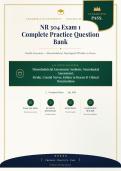
GUA RA N T EED
CHAMBERLAIN UNIVERSITY · COLLEGE OF NURSING PASS.
NR 304 Exam 1
Complete Practice Question
Bank
Health Assessment — Musculoskeletal, Neurological & Failure to Rescue
ALL TOPICS INCLUDED:
Musculoskeletal Assessment, Scoliosis, Neurological
Assessment,
Stroke, Cranial Nerves, Failure to Rescue & Clinical
Deterioration
Complete Edition · July 2026
EXAM FO CUSED DETAILED HIGH-YIELD CONFIDENCE
RATIONALES BUILDER
Actual exam content Tested concepts
Evidence-based Pass with confidence
P r e p a r e · P r a c t i c e · Pa s s
Excellence in Nursing Education
,NR 304 · CHAMBERLAIN UNIVERSIT Y EXAM 1 COMPLETE QUESTION BANK
Section I: Musculoskeletal Assessment — Older Adult Case Study
1 A 67-year-old female states she cannot take walks outside with the frequency she had in the past because it hurts to
walk. Which findings may contribute to this older adult's decreased ability to walk? SATA
A Recently diagnosed with decreased bone density
B 1.5 inches shorter than 1 year ago
C Reduced range of motion of the joints
D Clicking and crepitus when bending knees
E Decrease in bone prominences
Why A, B, C, and D are correct: Decreased bone density (osteoporosis) increases fracture risk. Height loss of 1.5
inches in one year suggests vertebral compression fractures. Reduced ROM and crepitus indicate osteoarthritis — all
contributing to pain with ambulation. Bone prominences do not decrease with age.
2 Based on the same client's report of pain with walking, which assessment findings would the nurse expect? SATA
A Increased constipation
B Pain with ambulation
C Skin breakdown
D Decrease in the frequency of walks
E Vision changes
Why A, B, and D are correct: Decreased mobility from pain leads to reduced walking frequency and constipation
(slowed peristalsis). Pain with ambulation is the stated symptom. Skin breakdown and vision changes are not directly related to
decreased walking from joint pain.
3 The assessment findings include pain with ambulation, decreased walking frequency, and constipation. Which is the
priority nursing action?
A Psych consultation for expressed sadness of decreased ambulation
B Examination for stated pain with ambulation
C Smoking cessation class for smoking habits
D Referral to physical therapy before assessment
Why B is correct: Assessment is always the priority. The nurse must examine the stated pain with ambulation —
including location, severity, quality, and aggravating/alleviating factors — before implementing interventions or referrals.
, 4 The nurse provides education about musculoskeletal impairments and interventions. Which client statements
indicate comprehension? SATA
A "I won't sit for long periods of time."
B "I will add calcium rich foods to my diet."
C "Smoking is my guilty pleasure."
D "I will eat a whole foods diet."
E "I will walk every day for at least 30 minutes."
Why A, B, D, and E are correct: Avoiding prolonged sitting prevents stiffness. Calcium-rich foods support bone
health. A whole foods diet provides balanced nutrition. Daily walking maintains mobility and bone density. Smoking accelerates
bone loss and should be discontinued.
Section II: Neurovascular Assessment & Scoliosis
5 A client presents with an obvious deformity of the right forearm due to an accident. Which items should the nurse
include in the neurovascular assessment? SATA
A Gait
B Skin color
C Sensation
D Strength
E Pulses
Why B, C, and E are correct: Neurovascular assessment includes the 5 P's: Pain, Pallor (skin color), Paresthesias
(sensation), Pulselessness (pulses), and Paralysis. Gait assessment is not appropriate with an acute forearm deformity. Strength
may be difficult to assess accurately with acute injury.
6 Which are risk factors for scoliosis? SATA
A Age
B Occupation
C Family history
D Gender
E Smoking
Why A, C, and D are correct: Scoliosis risk factors include age (adolescent growth spurt), family history (genetic
component), and gender (females have higher risk of curve progression). Occupation and smoking are not established risk factors
for scoliosis.
NR 304 · Chamberlain University College of Nursing Page 2
CHAMBERLAIN UNIVERSITY · COLLEGE OF NURSING PASS.
NR 304 Exam 1
Complete Practice Question
Bank
Health Assessment — Musculoskeletal, Neurological & Failure to Rescue
ALL TOPICS INCLUDED:
Musculoskeletal Assessment, Scoliosis, Neurological
Assessment,
Stroke, Cranial Nerves, Failure to Rescue & Clinical
Deterioration
Complete Edition · July 2026
EXAM FO CUSED DETAILED HIGH-YIELD CONFIDENCE
RATIONALES BUILDER
Actual exam content Tested concepts
Evidence-based Pass with confidence
P r e p a r e · P r a c t i c e · Pa s s
Excellence in Nursing Education
,NR 304 · CHAMBERLAIN UNIVERSIT Y EXAM 1 COMPLETE QUESTION BANK
Section I: Musculoskeletal Assessment — Older Adult Case Study
1 A 67-year-old female states she cannot take walks outside with the frequency she had in the past because it hurts to
walk. Which findings may contribute to this older adult's decreased ability to walk? SATA
A Recently diagnosed with decreased bone density
B 1.5 inches shorter than 1 year ago
C Reduced range of motion of the joints
D Clicking and crepitus when bending knees
E Decrease in bone prominences
Why A, B, C, and D are correct: Decreased bone density (osteoporosis) increases fracture risk. Height loss of 1.5
inches in one year suggests vertebral compression fractures. Reduced ROM and crepitus indicate osteoarthritis — all
contributing to pain with ambulation. Bone prominences do not decrease with age.
2 Based on the same client's report of pain with walking, which assessment findings would the nurse expect? SATA
A Increased constipation
B Pain with ambulation
C Skin breakdown
D Decrease in the frequency of walks
E Vision changes
Why A, B, and D are correct: Decreased mobility from pain leads to reduced walking frequency and constipation
(slowed peristalsis). Pain with ambulation is the stated symptom. Skin breakdown and vision changes are not directly related to
decreased walking from joint pain.
3 The assessment findings include pain with ambulation, decreased walking frequency, and constipation. Which is the
priority nursing action?
A Psych consultation for expressed sadness of decreased ambulation
B Examination for stated pain with ambulation
C Smoking cessation class for smoking habits
D Referral to physical therapy before assessment
Why B is correct: Assessment is always the priority. The nurse must examine the stated pain with ambulation —
including location, severity, quality, and aggravating/alleviating factors — before implementing interventions or referrals.
, 4 The nurse provides education about musculoskeletal impairments and interventions. Which client statements
indicate comprehension? SATA
A "I won't sit for long periods of time."
B "I will add calcium rich foods to my diet."
C "Smoking is my guilty pleasure."
D "I will eat a whole foods diet."
E "I will walk every day for at least 30 minutes."
Why A, B, D, and E are correct: Avoiding prolonged sitting prevents stiffness. Calcium-rich foods support bone
health. A whole foods diet provides balanced nutrition. Daily walking maintains mobility and bone density. Smoking accelerates
bone loss and should be discontinued.
Section II: Neurovascular Assessment & Scoliosis
5 A client presents with an obvious deformity of the right forearm due to an accident. Which items should the nurse
include in the neurovascular assessment? SATA
A Gait
B Skin color
C Sensation
D Strength
E Pulses
Why B, C, and E are correct: Neurovascular assessment includes the 5 P's: Pain, Pallor (skin color), Paresthesias
(sensation), Pulselessness (pulses), and Paralysis. Gait assessment is not appropriate with an acute forearm deformity. Strength
may be difficult to assess accurately with acute injury.
6 Which are risk factors for scoliosis? SATA
A Age
B Occupation
C Family history
D Gender
E Smoking
Why A, C, and D are correct: Scoliosis risk factors include age (adolescent growth spurt), family history (genetic
component), and gender (females have higher risk of curve progression). Occupation and smoking are not established risk factors
for scoliosis.
NR 304 · Chamberlain University College of Nursing Page 2


