

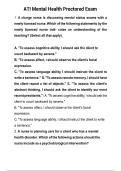
ATI Psychiatric Mental Health Proctored Assessment | Practice Test, Answer Key & Rationales | Latest Update 2026
ATI Psychiatric Mental Health Proctored Assessment 2026 | Practice Test, Answer Key & Rationales This document contains ATI Mental Health Proctored Exam for students sitting for exams in 2026/2027 It contains practice questions and clinical rationales for a nursing licensure examination focused on mental health care. It covers a wide range of psychiatric conditions, including personality disorders, neurocognitive decline, substance use, and mood disorders. The material emphasizes appropriate nursing interventions, therapeutic communication techniques, and the monitoring of pharmacological treatments. Additionally, it outlines protocols for psychiatric emergencies and specialized procedures like electroconvulsive therapy. The text serves as a functional guide for identifying diagnostic criteria and ensuring patient safety within various clinical environments The sources cover a wide array of nursing topics related to mental health care, ranging from foundational assessment techniques to specific psychiatric disorders and therapeutic interventions. Foundations of Mental Health Nursing Mental Status Examination: Assessing cognitive ability (e.g., counting backward by sevens), affect (facial expressions), language (writing sentences), memory, and abstract thinking . Levels of Consciousness: Definitions of altered states such as stuporous (arousing only to painful stimuli like a sternal rub) and the use of the Glasgow Coma Scale . DSM-5: Its role in establishing diagnostic criteria, planning client care, and identifying expected assessment findings . Legal and Ethical Issues: Handling confidentiality and when it must be breached for safety . Understanding torts, such as false imprisonment (unjustified seclusion), assault, and battery . Documentation and safety protocols for mechanical restraints . Types of admissions, including temporary emergency admission for clients at risk of harming others . Psychiatric Disorders Personality Disorders: Characteristics of Antisocial (manipulation, blame), Borderline (fear of abandonment, splitting), Avoidant, and Schizoid disorders . Anxiety and Trauma-Related Disorders: Levels of anxiety (mild, moderate, severe, panic) and appropriate nursing interventions . Generalized Anxiety Disorder (GAD), Panic attacks, and Obsessive-Compulsive Disorder (OCD) . Posttraumatic Stress Disorder (PTSD), Acute Stress Disorder (ASD), and dissociative disorders like Derealization and Dissociative Fugue . Mood Disorders: Major Depressive Disorder (MDD): Phases of care (acute, continuation, maintenance) and risk factors . Bipolar Disorder: Managing manic episodes, setting limits, and relapse prevention . Other mood disorders like Premenstrual Dysphoric Disorder (PMDD) and Dysthymic Disorder . Psychotic Disorders: Schizophrenia and Schizoaffective disorder, including positive symptoms (hallucinations, delusions, clang associations) and negative symptoms (flat affect, lack of motivation) . Neurocognitive Disorders: Alzheimer’s disease (safety, cognitive decline), Dementia, and Delirium (often related to medical issues like UTIs) . Eating Disorders: Anorexia Nervosa (cognitive distortions like catastrophizing) and Bulimia Nervosa (purging behaviors, hypokalemia) . Substance Use Disorders: Withdrawal and abstinence maintenance for alcohol, opioids, benzodiazepines, and tobacco . Somatic Symptom and Related Disorders: Conversion disorder, Illness anxiety disorder, and Factitious disorder . Pediatric/Adolescent Disorders: ADHD, Autism Spectrum Disorder, Conduct Disorder, Oppositional Defiant Disorder, and Intermittent Explosive Disorder . Therapeutic Interventions and Modalities Brain Stimulation Therapies: Indications, teaching, and post-procedure care for Electroconvulsive Therapy (ECT), Transcranial Magnetic Stimulation (TMS), and Vagus Nerve Stimulation (VNS) . Therapeutic Communication: Techniques for establishing a nurse-client relationship, identifying transference, and managing the orientation, working, and termination phases . Therapy Modalities: Psychoanalysis and free association . Behavioral therapies: Aversion therapy, systematic desensitization, flooding, and biofeedback . Cognitive reframing and stress management techniques like mindfulness and muscle relaxation . Group and Family Therapy: Group leadership styles (democratic, laissez-faire), member roles, hidden agendas, and dysfunctional family dynamics like triangulation or manipulation . Community-Based Care: Assertive Community Treatment (ACT), partial hospitalization, and levels of prevention (e.g., tertiary prevention like rehabilitation) . Safety, Crisis, and Violence Suicide: Risk assessment, precautions, identifying overt vs. covert comments, and the use of no-suicide contracts . Grief and Loss: Engel’s five stages and Kübler-Ross’s five stages of grief, along with factors influencing coping ability . Crisis Management: Identifying maturational, situational, and adventitious crises . Violence and Abuse: Recognizing stages of violence (e.g., preassaultive) and managing aggressive behavior . Identifying types of abuse: physical, emotional, sexual, and neglect (including shaken baby syndrome and elder abuse) . Sexual Assault: Care for victims, rape-trauma syndrome, silent rape reaction, and forensic evidence collection . Psychopharmacology The sources discuss numerous medications, including: Antidepressants: SSRIs (Fluoxetine, Paroxetine), TCAs (Amitriptyline, Imipramine), MAOIs (Phenelzine), and others (Bupropion, Mirtazapine) . Mood Stabilizers: Lithium carbonate (toxicity levels, interactions) and Valproate . Antipsychotics: First-generation (Chlorpromazine, Haloperidol) and second-generation (Risperidone, Ziprasidone, Olanzapine, Clozapine) . Anxiolytics: Benzodiazepines (Diazepam, Lorazepam, Chlordiazepoxide) and Buspirone . Substance Use Medications: Disulfiram, Naltrexone, Acamprosate, Methadone, and Clonidine . Others: Donepezil (Alzheimer's), Methylphenidate and Atomoxetine (ADHD) include relevant keywords to improve ranking
Document information
- Uploaded on
- July 24, 2026
- Number of pages
- 95
- Written in
- 2025/2026
- Type
- Exam (elaborations)
- Contains
- Questions & answers


