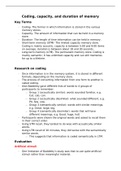
Coding, capacity, and duration of memory
Key Terms
- Coding- The former in which information is stored in the various
memory stores.
- Capacity- The amount of information that can be held in a memory
store.
- Duration- The length of time information can be held in memory.
- Short-term memory (STM)- The limited capacity memory store.
Coding is mainly acoustic, capacity is between 5:00 and 9:00 items
on average, duration is between about 18 and 30 seconds.
- Long-term memory (LTM)- The permanent memory store. Coding is
mainly semantic; it has unlimited capacity and can still memories
for up to a lifetime.
Research on coding
- Once information is in the memory system, it is stored in different
formats, depending on the memory store.
- The process of converting information from one form to another is
called coding.
- Alan Baddeley gave different lists of words to 4 groups of
participants to remember:
→ Group 1 (acoustically similar): words sounded familiar, e.g.
Cat, cab, can.
→ Group 2 (acoustically dissimilar): what sounded different, e.g.
Pit, few, cow.
→ Group 3 (semantically similar): words with similar meanings,
e.g. Great, large, big.
→ Group 4 (semantically dissimilar): words that will have
different meanings, e.g. Good, huge, hot)
- Participants were shown the original words and asked to recall them
in their correct order.
- Using STM recall, they tended to do wise with acoustically similar
words.
- Using LTM recall of 20 minutes, they did worse with the semantically
similar words.
→ This suggests that information is coded semantically in LTM.
Evaluation
Artificial stimuli
- One limitation of Baddeley’s study was that to use quite artificial
stimuli rather than meaningful material.
, - The word lists had no personal meaning to participants.
→ This means we should be cautious about generalising the
findings to different kinds of memory tasks.
→ For example, when processing more meaningful information,
people may use semantic coding for STM tasks.
→ This suggests that the findings from this study have limited
application.
Research on capacity
Digit span
- Joseph Jacobs developed a technique to measure digits span.
- The researcher gives 4 digits and then the participant is asked to
recall these in the correct order our loud. This determines the
individual’s digits band.
- Jacobs found the mean span for digits across all participants was 9.3
items. The mean span for letters was 7.3.
Span of memory and chunking
- George Miller made observations of everyday practice.
- He noted that things come in sevens, e.g. There are 7 notes on the
music scale, 7 days of the week, 7 deadly sins.
- This suggests that the span of STM is about 7 items, plus or minus
2. However, Miller also noted that people can recall 5 words as well
as they can recall 5 letters.
→ They do this by chunking, grouping sets of numbers or letters
into units or chunks.
Evaluation
Lacking validity
- One limitation of Jacob study is that it was conducted a long time
ago.
- Early research in psychology often lacked adequate control. For
example, some participants may have been distracted while they
were being tested, so they didn't perform as well as they might
have.
- This would mean that the results may not be valid because they
were confounding variables they were not controlled.
- However, the results of the study had been confirmed in other
research, supporting its validity.
Not so many chunks
Key Terms
- Coding- The former in which information is stored in the various
memory stores.
- Capacity- The amount of information that can be held in a memory
store.
- Duration- The length of time information can be held in memory.
- Short-term memory (STM)- The limited capacity memory store.
Coding is mainly acoustic, capacity is between 5:00 and 9:00 items
on average, duration is between about 18 and 30 seconds.
- Long-term memory (LTM)- The permanent memory store. Coding is
mainly semantic; it has unlimited capacity and can still memories
for up to a lifetime.
Research on coding
- Once information is in the memory system, it is stored in different
formats, depending on the memory store.
- The process of converting information from one form to another is
called coding.
- Alan Baddeley gave different lists of words to 4 groups of
participants to remember:
→ Group 1 (acoustically similar): words sounded familiar, e.g.
Cat, cab, can.
→ Group 2 (acoustically dissimilar): what sounded different, e.g.
Pit, few, cow.
→ Group 3 (semantically similar): words with similar meanings,
e.g. Great, large, big.
→ Group 4 (semantically dissimilar): words that will have
different meanings, e.g. Good, huge, hot)
- Participants were shown the original words and asked to recall them
in their correct order.
- Using STM recall, they tended to do wise with acoustically similar
words.
- Using LTM recall of 20 minutes, they did worse with the semantically
similar words.
→ This suggests that information is coded semantically in LTM.
Evaluation
Artificial stimuli
- One limitation of Baddeley’s study was that to use quite artificial
stimuli rather than meaningful material.
, - The word lists had no personal meaning to participants.
→ This means we should be cautious about generalising the
findings to different kinds of memory tasks.
→ For example, when processing more meaningful information,
people may use semantic coding for STM tasks.
→ This suggests that the findings from this study have limited
application.
Research on capacity
Digit span
- Joseph Jacobs developed a technique to measure digits span.
- The researcher gives 4 digits and then the participant is asked to
recall these in the correct order our loud. This determines the
individual’s digits band.
- Jacobs found the mean span for digits across all participants was 9.3
items. The mean span for letters was 7.3.
Span of memory and chunking
- George Miller made observations of everyday practice.
- He noted that things come in sevens, e.g. There are 7 notes on the
music scale, 7 days of the week, 7 deadly sins.
- This suggests that the span of STM is about 7 items, plus or minus
2. However, Miller also noted that people can recall 5 words as well
as they can recall 5 letters.
→ They do this by chunking, grouping sets of numbers or letters
into units or chunks.
Evaluation
Lacking validity
- One limitation of Jacob study is that it was conducted a long time
ago.
- Early research in psychology often lacked adequate control. For
example, some participants may have been distracted while they
were being tested, so they didn't perform as well as they might
have.
- This would mean that the results may not be valid because they
were confounding variables they were not controlled.
- However, the results of the study had been confirmed in other
research, supporting its validity.
Not so many chunks