

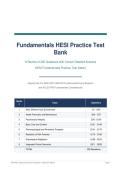
Fundamentals HESI Practice Test
Bank
A Review of 220 Questions with Correct Detailed Answers
HESI Fundamentals Practice Test (New!)
Aligned with the 2026-2027 HESI RN Fundamentals Exam Blueprint
and NCLEX-RN Fundamentals Competencies
Sectio
Topic Questions
n
1 Safe, Effective Care Environment Q1 - Q45
2 Health Promotion and Maintenance Q46 - Q75
3 Psychosocial Integrity Q76 - Q100
4 Basic Care and Comfort Q101 - Q140
5 Pharmacological and Parenteral Therapies Q141 - Q175
6 Reduction of Risk Potential Q176 - Q195
7 Physiological Adaptation Q196 - Q210
8 Integrated Clinical Scenarios Q211 - Q220
TOTAL 220 Questions
HESI RN Fundamentals Exam Preparation | 2026-2027 Edition Page 1
,HESI Fundamentals Practice Test Bank | 220 Questions with Rationales
220 verified questions with comprehensive, A+ graded rationales
covering all HESI Fundamentals content areas with priority setting, delegation, lab value interpretation, and the
nursing process (ADPIE).
HESI RN Fundamentals Exam Preparation | 2026-2027 Edition Page 2
,HESI Fundamentals Practice Test Bank | 220 Questions with Rationales
Exam Overview & Blueprint
This practice test bank is designed to mirror the cognitive complexity, clinical reasoning demands, and
content distribution of the HESI RN Fundamentals examination aligned with the 2026-2027 NCLEX-RN
test plan. The 220 items are distributed across eight major content domains and reflect the HESI
emphasis on safe, effective care environment; health promotion; psychosocial integrity; basic care and
comfort; pharmacological and parenteral therapies; reduction of risk potential; physiological adaptation;
and integrated clinical reasoning.
Cognitive Level Distribution
Questions are calibrated to mirror the NCLEX cognitive level targets: approximately 30% assess recall
and recognition of foundational facts; 50% require application of nursing knowledge to clinical scenarios;
and 20% demand analysis and synthesis of complex client data. Approximately 80% of items are
scenario-based, 15% are direct recall, and 5% are dosage or math calculations. Each distractor is
constructed from the most common errors students make on the HESI Fundamentals exam, including
incorrect priority setting, lab value misinterpretation, delegation errors, and communication mistakes.
Priority Frameworks Reinforced
Throughout this test bank, the questions reinforce the HESI-specific priority frameworks including the ABC
(Airway, Breathing, Circulation) framework, Maslow's Hierarchy of Needs, the Nursing Process (ADPIE -
Assessment, Diagnosis, Planning, Implementation, Evaluation), the Five Rights of Delegation (right task,
right circumstance, right person, right direction/communication, right supervision/evaluation), and the
Safety First principle. Many questions require integrating two or more frameworks to determine the single
best nursing action.
How to Use This Test Bank
For maximum benefit, complete the exam in timed conditions approximating the actual HESI
(approximately 1 minute per question for practice rounds). After completing a section, review every
rationale - including the options you answered correctly - to identify knowledge gaps and reinforce correct
clinical reasoning. The rationales explain not only why the correct answer is right but also why each
distractor is wrong, embedding evidence-based practice, safety frameworks, and NCLEX-style clinical
judgment principles. Aim for 85% or higher on the second pass before sitting for the actual exam.
HESI RN Fundamentals Exam Preparation | 2026-2027 Edition Page 3
, HESI Fundamentals Practice Test Bank | 220 Questions with Rationales
Section 1: Safe, Effective Care Environment
Management of Care, Safety, Infection Control, & Legal/Ethical Issues
Q1: A registered nurse (RN) is planning care for four clients on a medical-surgical unit. Which
client should the RN assign to a licensed practical nurse (LPN)?
A. A client who is 2 hours post-coronary angioplasty with intermittent chest pain
B. A client with chronic obstructive pulmonary disease (COPD) receiving IV heparin for deep vein
thrombosis
C. A stable client with a tracheostomy who requires routine tracheostomy care and oral suctioning
[CORRECT]
D. A newly admitted client with suspected meningitis requiring isolation precautions setup
Correct Answer: C
Rationale: The LPN scope of practice includes caring for stable clients with predictable outcomes and
performing established skills such as tracheostomy care and suctioning. The RN must retain clients who are
unstable, newly admitted with complex assessment needs, receiving high-alert IV medications like heparin, or
experiencing acute complications such as post-angioplasty chest pain. Assigning unstable clients to an LPN
violates the Five Rights of Delegation (right task, right circumstance, right person, right
direction/communication, right supervision/evaluation) and compromises client safety.
Q2: An RN delegates morning care for four clients to an unlicensed assistive personnel (UAP).
Which task requires the RN to intervene?
A. The UAP measures and records urinary output for a client with an indwelling catheter
B. The UAP ambulates a client who is 4 hours post-abdominal surgery without an order
[CORRECT]
C. The UAP applies anti-embolism stockings to a client awaiting discharge
D. The UAP feeds a client with dysphagia who is on a thickened-liquid diet
Correct Answer: B
Rationale: Ambulating a client who is only 4 hours postoperative without a provider order is outside the UAP
scope of practice and risks complications such as wound dehiscence, hemorrhage, or hypotension. Early
postoperative ambulation requires RN assessment and a provider order. Measuring output, applying
anti-embolism stockings, and feeding a client with an established dysphagia diet (with the RN having assessed
swallow safety) are appropriate UAP tasks. The RN must supervise UAP performance and intervene when
scope of practice is exceeded.
Q3: A client scheduled for an elective cholecystectomy asks the nurse, 'Why do I have to sign this
form? The doctor already explained everything.' What is the nurse's best response?
A. 'The form is just a legal formality; you don't really need to read it.'
B. 'Signing indicates that you understand the procedure, risks, and alternatives, and that you
agree to have it done.' [CORRECT]
C. 'You can sign it now and ask the doctor your questions later if anything comes up.'
D. 'The form protects the hospital from lawsuits if something goes wrong during surgery.'
Correct Answer: B
HESI RN Fundamentals Exam Preparation | 2026-2027 Edition Page 4
Bank
A Review of 220 Questions with Correct Detailed Answers
HESI Fundamentals Practice Test (New!)
Aligned with the 2026-2027 HESI RN Fundamentals Exam Blueprint
and NCLEX-RN Fundamentals Competencies
Sectio
Topic Questions
n
1 Safe, Effective Care Environment Q1 - Q45
2 Health Promotion and Maintenance Q46 - Q75
3 Psychosocial Integrity Q76 - Q100
4 Basic Care and Comfort Q101 - Q140
5 Pharmacological and Parenteral Therapies Q141 - Q175
6 Reduction of Risk Potential Q176 - Q195
7 Physiological Adaptation Q196 - Q210
8 Integrated Clinical Scenarios Q211 - Q220
TOTAL 220 Questions
HESI RN Fundamentals Exam Preparation | 2026-2027 Edition Page 1
,HESI Fundamentals Practice Test Bank | 220 Questions with Rationales
220 verified questions with comprehensive, A+ graded rationales
covering all HESI Fundamentals content areas with priority setting, delegation, lab value interpretation, and the
nursing process (ADPIE).
HESI RN Fundamentals Exam Preparation | 2026-2027 Edition Page 2
,HESI Fundamentals Practice Test Bank | 220 Questions with Rationales
Exam Overview & Blueprint
This practice test bank is designed to mirror the cognitive complexity, clinical reasoning demands, and
content distribution of the HESI RN Fundamentals examination aligned with the 2026-2027 NCLEX-RN
test plan. The 220 items are distributed across eight major content domains and reflect the HESI
emphasis on safe, effective care environment; health promotion; psychosocial integrity; basic care and
comfort; pharmacological and parenteral therapies; reduction of risk potential; physiological adaptation;
and integrated clinical reasoning.
Cognitive Level Distribution
Questions are calibrated to mirror the NCLEX cognitive level targets: approximately 30% assess recall
and recognition of foundational facts; 50% require application of nursing knowledge to clinical scenarios;
and 20% demand analysis and synthesis of complex client data. Approximately 80% of items are
scenario-based, 15% are direct recall, and 5% are dosage or math calculations. Each distractor is
constructed from the most common errors students make on the HESI Fundamentals exam, including
incorrect priority setting, lab value misinterpretation, delegation errors, and communication mistakes.
Priority Frameworks Reinforced
Throughout this test bank, the questions reinforce the HESI-specific priority frameworks including the ABC
(Airway, Breathing, Circulation) framework, Maslow's Hierarchy of Needs, the Nursing Process (ADPIE -
Assessment, Diagnosis, Planning, Implementation, Evaluation), the Five Rights of Delegation (right task,
right circumstance, right person, right direction/communication, right supervision/evaluation), and the
Safety First principle. Many questions require integrating two or more frameworks to determine the single
best nursing action.
How to Use This Test Bank
For maximum benefit, complete the exam in timed conditions approximating the actual HESI
(approximately 1 minute per question for practice rounds). After completing a section, review every
rationale - including the options you answered correctly - to identify knowledge gaps and reinforce correct
clinical reasoning. The rationales explain not only why the correct answer is right but also why each
distractor is wrong, embedding evidence-based practice, safety frameworks, and NCLEX-style clinical
judgment principles. Aim for 85% or higher on the second pass before sitting for the actual exam.
HESI RN Fundamentals Exam Preparation | 2026-2027 Edition Page 3
, HESI Fundamentals Practice Test Bank | 220 Questions with Rationales
Section 1: Safe, Effective Care Environment
Management of Care, Safety, Infection Control, & Legal/Ethical Issues
Q1: A registered nurse (RN) is planning care for four clients on a medical-surgical unit. Which
client should the RN assign to a licensed practical nurse (LPN)?
A. A client who is 2 hours post-coronary angioplasty with intermittent chest pain
B. A client with chronic obstructive pulmonary disease (COPD) receiving IV heparin for deep vein
thrombosis
C. A stable client with a tracheostomy who requires routine tracheostomy care and oral suctioning
[CORRECT]
D. A newly admitted client with suspected meningitis requiring isolation precautions setup
Correct Answer: C
Rationale: The LPN scope of practice includes caring for stable clients with predictable outcomes and
performing established skills such as tracheostomy care and suctioning. The RN must retain clients who are
unstable, newly admitted with complex assessment needs, receiving high-alert IV medications like heparin, or
experiencing acute complications such as post-angioplasty chest pain. Assigning unstable clients to an LPN
violates the Five Rights of Delegation (right task, right circumstance, right person, right
direction/communication, right supervision/evaluation) and compromises client safety.
Q2: An RN delegates morning care for four clients to an unlicensed assistive personnel (UAP).
Which task requires the RN to intervene?
A. The UAP measures and records urinary output for a client with an indwelling catheter
B. The UAP ambulates a client who is 4 hours post-abdominal surgery without an order
[CORRECT]
C. The UAP applies anti-embolism stockings to a client awaiting discharge
D. The UAP feeds a client with dysphagia who is on a thickened-liquid diet
Correct Answer: B
Rationale: Ambulating a client who is only 4 hours postoperative without a provider order is outside the UAP
scope of practice and risks complications such as wound dehiscence, hemorrhage, or hypotension. Early
postoperative ambulation requires RN assessment and a provider order. Measuring output, applying
anti-embolism stockings, and feeding a client with an established dysphagia diet (with the RN having assessed
swallow safety) are appropriate UAP tasks. The RN must supervise UAP performance and intervene when
scope of practice is exceeded.
Q3: A client scheduled for an elective cholecystectomy asks the nurse, 'Why do I have to sign this
form? The doctor already explained everything.' What is the nurse's best response?
A. 'The form is just a legal formality; you don't really need to read it.'
B. 'Signing indicates that you understand the procedure, risks, and alternatives, and that you
agree to have it done.' [CORRECT]
C. 'You can sign it now and ask the doctor your questions later if anything comes up.'
D. 'The form protects the hospital from lawsuits if something goes wrong during surgery.'
Correct Answer: B
HESI RN Fundamentals Exam Preparation | 2026-2027 Edition Page 4


