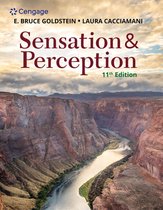
Sensation and Perception (Mindtap Course
List)
by E Goldstein (Author), Laura Cacciamani (Author)
11TH EDITION
,TABLE OF CONTENTS
Chapter 1: Introduction to Sensation and Perception
Chapter 2: Introduction to the Physiology of Perception
Chapter 3: Introduction to Vision
Chapter 4: The Visual System: Cortical Organization and Beyond
Chapter 5: Perceiving Objects and Scenes
Chapter 6: Visual Attention
Chapter 7: Taking Action
Chapter 8: Perceiving Motion
Chapter 9: Perceiving Color
Chapter 10: Perceiving Depth and Size
Chapter 11: Sound, the Auditory System, and Pitch Perception
Chapter 12: Sound Localization and the Auditory Scene
Chapter 13: Speech Perception
Chapter 14: The Cutaneous Senses
Chapter 15: The Chemical Senses
Chapter 16: Perceptual Development
,Sensation and Perception (11th Edition) by
Goldstein & Cacciamani - Test Bank:
MULTIPLE CHOICE QUESTIONS
CHAPTER 1: Introduction to Sensation and Perception
1. The process by which stimulation of sensory receptors produces neural impulses that represent
experiences in the outside world is called:
a) Perception
b) Sensation
c) Transduction
d) Recognition
Answer: b) Sensation
2. Which of the following best defines perception?
a) The physical energy that stimulates a receptor
b) The process of organizing and interpreting sensory information
c) The conversion of physical energy into electrical signals
d) The threshold at which a stimulus is first detected
Answer: b) The process of organizing and interpreting sensory information
3. The process by which environmental energy is converted into electrical signals in the nervous system
is called:
a) Adaptation
b) Perception
, c) Transduction
d) Amplification
Answer: c) Transduction
4. The "stimulus" in sensation and perception refers to:
a) The neural response in the brain
b) The environmental energy that activates receptors
c) The subjective experience of a sensation
d) The threshold of detection
Answer: b) The environmental energy that activates receptors
5. Which approach focuses on the idea that perception is constructed from sensory information
combined with prior knowledge and experience?
a) Ecological approach
b) Bottom-up processing
c) Constructivist approach
d) Gestalt approach
Answer: c) Constructivist approach
6. Bottom-up processing refers to:
a) Processing driven by higher cognitive functions and expectations
b) Processing that begins with incoming sensory data
c) The influence of memory on perception
List)
by E Goldstein (Author), Laura Cacciamani (Author)
11TH EDITION
,TABLE OF CONTENTS
Chapter 1: Introduction to Sensation and Perception
Chapter 2: Introduction to the Physiology of Perception
Chapter 3: Introduction to Vision
Chapter 4: The Visual System: Cortical Organization and Beyond
Chapter 5: Perceiving Objects and Scenes
Chapter 6: Visual Attention
Chapter 7: Taking Action
Chapter 8: Perceiving Motion
Chapter 9: Perceiving Color
Chapter 10: Perceiving Depth and Size
Chapter 11: Sound, the Auditory System, and Pitch Perception
Chapter 12: Sound Localization and the Auditory Scene
Chapter 13: Speech Perception
Chapter 14: The Cutaneous Senses
Chapter 15: The Chemical Senses
Chapter 16: Perceptual Development
,Sensation and Perception (11th Edition) by
Goldstein & Cacciamani - Test Bank:
MULTIPLE CHOICE QUESTIONS
CHAPTER 1: Introduction to Sensation and Perception
1. The process by which stimulation of sensory receptors produces neural impulses that represent
experiences in the outside world is called:
a) Perception
b) Sensation
c) Transduction
d) Recognition
Answer: b) Sensation
2. Which of the following best defines perception?
a) The physical energy that stimulates a receptor
b) The process of organizing and interpreting sensory information
c) The conversion of physical energy into electrical signals
d) The threshold at which a stimulus is first detected
Answer: b) The process of organizing and interpreting sensory information
3. The process by which environmental energy is converted into electrical signals in the nervous system
is called:
a) Adaptation
b) Perception
, c) Transduction
d) Amplification
Answer: c) Transduction
4. The "stimulus" in sensation and perception refers to:
a) The neural response in the brain
b) The environmental energy that activates receptors
c) The subjective experience of a sensation
d) The threshold of detection
Answer: b) The environmental energy that activates receptors
5. Which approach focuses on the idea that perception is constructed from sensory information
combined with prior knowledge and experience?
a) Ecological approach
b) Bottom-up processing
c) Constructivist approach
d) Gestalt approach
Answer: c) Constructivist approach
6. Bottom-up processing refers to:
a) Processing driven by higher cognitive functions and expectations
b) Processing that begins with incoming sensory data
c) The influence of memory on perception