Unit 4 1.1 miss
johannes
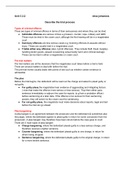
Describe the trial processes used for law making.
In england & wales there are two main sources of the law:
● The government
● The judiciary
Government processes of law making
The United kingdom is a parliamentary democracy. This means that most of the country’s laws
are made by passing acts of parliament. Laws made by parliament are also often referred to as
‘statutes’ or ‘legislation’.
Parliament is made up of three parts:
● The monarch (the queen/king)
● The house of lords
● The house of commons
The monarch has only a formal role in law-making. The king/queen simply gives the royal
assent- their agreement to the new law.
The lords
Members of the house of lords are called peers. There are about 800 peers. In the past, all
peers were noblemen and they were hereditary positions that passed from father to eldest son.
However, today there are only 92 hereditary peers;there are also 26 churches of england
bishops and archbishops. The rest of the members are life peers who cannot pass their position
onto their children. The main job of the lords is to act as a ‘double check’ on new laws.
The commons
The house of commons is the most important part of parliament because it is made up of the
elected representatives of the people: the 650 MP’s. Each MP is elected at a general election to
represent a constituency (a geographical area in the country).
The government
While parliament's job is to represent the people, the government's job is to run the country. The
government is formed by the political party that has a majority of the 650 MP’s. the prime
minister is the leader of the majority party. Most proposals for new laws come from the
government. A proposal for a new law is called a bill.
Bills must be agreed by both houses of parliament and receive the royal assent before they can
become acts of parliament/ laws.
Green paper- before putting a bill before parliament, the government usually publishes a green
paper. This is an initial report to provoke public discussion on the subject. It often includes
questions for interested individuals and organisations to respond to.
johannes
Describe the trial processes used for law making.
In england & wales there are two main sources of the law:
● The government
● The judiciary
Government processes of law making
The United kingdom is a parliamentary democracy. This means that most of the country’s laws
are made by passing acts of parliament. Laws made by parliament are also often referred to as
‘statutes’ or ‘legislation’.
Parliament is made up of three parts:
● The monarch (the queen/king)
● The house of lords
● The house of commons
The monarch has only a formal role in law-making. The king/queen simply gives the royal
assent- their agreement to the new law.
The lords
Members of the house of lords are called peers. There are about 800 peers. In the past, all
peers were noblemen and they were hereditary positions that passed from father to eldest son.
However, today there are only 92 hereditary peers;there are also 26 churches of england
bishops and archbishops. The rest of the members are life peers who cannot pass their position
onto their children. The main job of the lords is to act as a ‘double check’ on new laws.
The commons
The house of commons is the most important part of parliament because it is made up of the
elected representatives of the people: the 650 MP’s. Each MP is elected at a general election to
represent a constituency (a geographical area in the country).
The government
While parliament's job is to represent the people, the government's job is to run the country. The
government is formed by the political party that has a majority of the 650 MP’s. the prime
minister is the leader of the majority party. Most proposals for new laws come from the
government. A proposal for a new law is called a bill.
Bills must be agreed by both houses of parliament and receive the royal assent before they can
become acts of parliament/ laws.
Green paper- before putting a bill before parliament, the government usually publishes a green
paper. This is an initial report to provoke public discussion on the subject. It often includes
questions for interested individuals and organisations to respond to.