

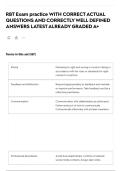
RBT Exam practice WITH CORRECT ACTUAL
QUESTIONS AND CORRECTLY WELL DEFINED
ANSWERS LATEST ALREADY GRADED A+
Terms in this set (167)
Ethical Pertaining to right and wrong in conduct. Being in
accordance with the rules or standards for right
conduct or practice
Feedback and Reflection Respond appropriately to feedback and maintain
or improve performance. Take feedback and be a
reflective practitioner.
Communication Communication with stakeholders as authorized.
Follow protocol of how to communicate.
Communicate effectively with all team members.
Professional Boundaries Avoid dual relationships, conflicts of interest,
social media contacts. Always take notes.
,Client Dignity Be respectful and thoughtful about the client's
needs and wants.
Never do or say anything to cause
embarrassment to the client.
Do not do something in front of your client that
you would not do if working with a typical
developing child.
How to Prepare for Data Collection 1. Read data from last session
2. Prepare material and programs for current
session based on data from last session.
3. Determine what programs you plan to work on
during the session.
4. Gather materials for those programs.
5. Set up the first set of programs so they are
ready for the client when you begin your session.
The Role of the RBT in the Service Implement measurement, assessment, skill
Delivery System acquisition, behavior reduction, documentation
and reporting, and maintain professional conduct
in the scope of the practice under the direct
supervision of a BCBA or BCaBA.
RBT Assisting with Individual The RBT can interview stakeholders, gather
Assessment Procedures baseline data by observing the client's behaviors
in his/her natural environment, or probe client by
asking them to perform a task we are unsure they
can perform without providing assistance.
Dealing with Stakeholders The RBT should only communicate with
stakeholders as authorized by the supervisor. Any
specific questions should be deferred to the
BCBA or BCaBA. If you do communicate you
must be objective, use behavioral language,
avoid speculation, stick to topic appropriate for
an RBT.
, Assist Training Stakeholders RBT can assist with training stakeholders by giving
them instruction, modeling, rehearsal, and
feedback with regard to behavioral skills training.
Report Other Variables illness, relocation or change in medication.
Components of a Written Behavior 1. Identify, describe, create a goal for a behavior
Plan in observable terms.
2. Assess antecedent/consequence that may
maintain behavior.
3. Identify hypothesis of function of behavior.
4. Identify possible replacement behaviors.
5. Select and implement
antecedent/consequence based interventions.
6. Create crisis intervention plan.
7. Implementation, modification, generalization
and maintenance procedures.
QUESTIONS AND CORRECTLY WELL DEFINED
ANSWERS LATEST ALREADY GRADED A+
Terms in this set (167)
Ethical Pertaining to right and wrong in conduct. Being in
accordance with the rules or standards for right
conduct or practice
Feedback and Reflection Respond appropriately to feedback and maintain
or improve performance. Take feedback and be a
reflective practitioner.
Communication Communication with stakeholders as authorized.
Follow protocol of how to communicate.
Communicate effectively with all team members.
Professional Boundaries Avoid dual relationships, conflicts of interest,
social media contacts. Always take notes.
,Client Dignity Be respectful and thoughtful about the client's
needs and wants.
Never do or say anything to cause
embarrassment to the client.
Do not do something in front of your client that
you would not do if working with a typical
developing child.
How to Prepare for Data Collection 1. Read data from last session
2. Prepare material and programs for current
session based on data from last session.
3. Determine what programs you plan to work on
during the session.
4. Gather materials for those programs.
5. Set up the first set of programs so they are
ready for the client when you begin your session.
The Role of the RBT in the Service Implement measurement, assessment, skill
Delivery System acquisition, behavior reduction, documentation
and reporting, and maintain professional conduct
in the scope of the practice under the direct
supervision of a BCBA or BCaBA.
RBT Assisting with Individual The RBT can interview stakeholders, gather
Assessment Procedures baseline data by observing the client's behaviors
in his/her natural environment, or probe client by
asking them to perform a task we are unsure they
can perform without providing assistance.
Dealing with Stakeholders The RBT should only communicate with
stakeholders as authorized by the supervisor. Any
specific questions should be deferred to the
BCBA or BCaBA. If you do communicate you
must be objective, use behavioral language,
avoid speculation, stick to topic appropriate for
an RBT.
, Assist Training Stakeholders RBT can assist with training stakeholders by giving
them instruction, modeling, rehearsal, and
feedback with regard to behavioral skills training.
Report Other Variables illness, relocation or change in medication.
Components of a Written Behavior 1. Identify, describe, create a goal for a behavior
Plan in observable terms.
2. Assess antecedent/consequence that may
maintain behavior.
3. Identify hypothesis of function of behavior.
4. Identify possible replacement behaviors.
5. Select and implement
antecedent/consequence based interventions.
6. Create crisis intervention plan.
7. Implementation, modification, generalization
and maintenance procedures.


