

Nightingale College
ISEH · 662 NSB
★ ★
N School of Nursing
EST. 2010
CONFIDENCE · COMPETENCE · COMPASSION
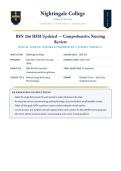
BSN 266 HESI Updated — Comprehensive Nursing
Review
M E D I C A L-S U R G I C A L N U RS I N G & P H A R M ACO LO G Y | A L R E A DY G RA D E D A +
INSTITUTION Nightingale College COURSE CODE BSN 266
PROGRAM Bachelor of Science in Nursing ACADEMIC YEAR
(BSN)
EXAM TITLE BSN 266 HESI Updated — TOTAL QUESTIONS 56 Questions
Comprehensive Nursing Review
COURSE TITLE Medical-Surgical Nursing & FORMAT Multiple Choice — Select the
Pharmacology Single Best Answer
EXAMINATION INSTRUCTIONS
▸ Select the single best answer for each question unless otherwise instructed.
▸ Nursing interventions, pharmacology, pathophysiology, and prioritization are all testable content.
▸ Select all that apply (SATA) questions require careful evaluation of each option.
▸ Correct answers and detailed rationales appear below each question for NCLEX/HESI review purposes.
▸ All content reflects evidence-based nursing practice and current clinical guidelines.
, SECTION I — MEDICAL-SURGICAL NURSING &
Questions 1 – 56
PHARMACOLOGY
1. An older adult client with a long history of chronic obstructive pulmonary disease (COPD)
is admitted with progressive shortness of breath and a persistent cough. She is anxious
and is complaining of a dry mouth. Which intervention should the nurse implement?
A. Administer a prescribed sedative
B. Assist client to an upright position
C. Encourage client to drink water
D. Apply a high flow venturi mask
CORRECT ANSWER B — Assist client to an upright position
RATIONALE For a client with COPD experiencing progressive shortness of breath, the priority
intervention is to position the client upright (Fowler's position). This uses gravity
to assist the diaphragm and improve lung expansion, reducing the work of
breathing. Sedatives are contraindicated as they can depress respiratory drive.
Drinking water is appropriate but secondary to positioning. A venturi mask may
be needed but positioning is the immediate priority.
,2. A client with multiple sclerosis (MS) is admitted to the medical unit. The client reports
fatigue, muscle weakness, and diplopia. Which action should the nurse implement to
reduce the client's risk for falls? (Select all that apply.)
A. Provide assistance to bedside commode
B. Provide frequent rest periods
C. Offer to assist with warm baths in the morning
D. Monitor pulse oximetry during activities
E. Teach to patch one eye while walking
CORRECT ANSWER A, B, E — Provide assistance to bedside commode; Provide frequent rest
periods; Teach to patch one eye while walking
RATIONALE MS clients are at high risk for falls due to muscle weakness, fatigue, and diplopia
(double vision). Providing assistance to the commode reduces fall risk during
transfers. Frequent rest periods conserve energy and reduce fatigue. Patching one
eye while walking eliminates double vision, improving balance and safety. Warm
baths can exacerbate MS symptoms (Uhthoff's sign). Pulse oximetry monitoring is
not directly related to fall prevention.
3. A client arrives to the ED following a motor vehicle collision. The nurse observes the client
experiencing increasing dyspnea and notes absent breath sounds on the left side. Which
procedure should the nurse prepare for the client?
A. Bronchoscopy
B. Chest tube insertion
C. Endotracheal intubation
D. Pulmonary function test
CORRECT ANSWER B — Chest tube insertion
RATIONALE Absent breath sounds on one side with increasing dyspnea following trauma
suggests a pneumothorax (collapsed lung). A chest tube insertion is required to
re-expand the lung by evacuating air from the pleural space. Bronchoscopy is
used for airway visualization, endotracheal intubation is for airway protection,
and PFTs are not appropriate in this emergency situation.
, 4. Following a transurethral resection of the prostate (TURP), a client is discharged from the
hospital with an indwelling urinary catheter. Which instruction is most important for the
nurse to include in the discharge teaching plan?
A. Eliminate all spicy foods from your diet
B. Drink 3 liters of water each day
C. Clamp the catheter when taking a shower
D. Avoid driving a car for 2 weeks
CORRECT ANSWER B — Drink 3 liters of water each day
RATIONALE After TURP, the client should drink at least 3 liters of water daily to maintain urine
flow and prevent clot formation and catheter obstruction. This is the most
important instruction to prevent complications. Clamping the catheter during
showers is not recommended; the catheter should remain patent. Driving
restrictions and dietary modifications are less critical.
5. An adult woman with Graves' disease is admitted with severe dehydration and
malnutrition. She is currently restless and refusing to eat. Which action is most important
for the nurse to implement?
A. Teach client relaxation techniques
B. Determine the client's food preferences
C. Maintain a patent intravenous site
D. Keep room temperature cool
CORRECT ANSWER C — Maintain a patent intravenous site
RATIONALE In a client with Graves' disease who is severely dehydrated and refusing to eat,
maintaining a patent IV site is the priority to ensure hydration and provide
necessary medications and nutrition. This addresses the immediate life-
threatening issues of dehydration and malnutrition. While other interventions are
appropriate, IV access is the priority.
ISEH · 662 NSB
★ ★
N School of Nursing
EST. 2010
CONFIDENCE · COMPETENCE · COMPASSION
BSN 266 HESI Updated — Comprehensive Nursing
Review
M E D I C A L-S U R G I C A L N U RS I N G & P H A R M ACO LO G Y | A L R E A DY G RA D E D A +
INSTITUTION Nightingale College COURSE CODE BSN 266
PROGRAM Bachelor of Science in Nursing ACADEMIC YEAR
(BSN)
EXAM TITLE BSN 266 HESI Updated — TOTAL QUESTIONS 56 Questions
Comprehensive Nursing Review
COURSE TITLE Medical-Surgical Nursing & FORMAT Multiple Choice — Select the
Pharmacology Single Best Answer
EXAMINATION INSTRUCTIONS
▸ Select the single best answer for each question unless otherwise instructed.
▸ Nursing interventions, pharmacology, pathophysiology, and prioritization are all testable content.
▸ Select all that apply (SATA) questions require careful evaluation of each option.
▸ Correct answers and detailed rationales appear below each question for NCLEX/HESI review purposes.
▸ All content reflects evidence-based nursing practice and current clinical guidelines.
, SECTION I — MEDICAL-SURGICAL NURSING &
Questions 1 – 56
PHARMACOLOGY
1. An older adult client with a long history of chronic obstructive pulmonary disease (COPD)
is admitted with progressive shortness of breath and a persistent cough. She is anxious
and is complaining of a dry mouth. Which intervention should the nurse implement?
A. Administer a prescribed sedative
B. Assist client to an upright position
C. Encourage client to drink water
D. Apply a high flow venturi mask
CORRECT ANSWER B — Assist client to an upright position
RATIONALE For a client with COPD experiencing progressive shortness of breath, the priority
intervention is to position the client upright (Fowler's position). This uses gravity
to assist the diaphragm and improve lung expansion, reducing the work of
breathing. Sedatives are contraindicated as they can depress respiratory drive.
Drinking water is appropriate but secondary to positioning. A venturi mask may
be needed but positioning is the immediate priority.
,2. A client with multiple sclerosis (MS) is admitted to the medical unit. The client reports
fatigue, muscle weakness, and diplopia. Which action should the nurse implement to
reduce the client's risk for falls? (Select all that apply.)
A. Provide assistance to bedside commode
B. Provide frequent rest periods
C. Offer to assist with warm baths in the morning
D. Monitor pulse oximetry during activities
E. Teach to patch one eye while walking
CORRECT ANSWER A, B, E — Provide assistance to bedside commode; Provide frequent rest
periods; Teach to patch one eye while walking
RATIONALE MS clients are at high risk for falls due to muscle weakness, fatigue, and diplopia
(double vision). Providing assistance to the commode reduces fall risk during
transfers. Frequent rest periods conserve energy and reduce fatigue. Patching one
eye while walking eliminates double vision, improving balance and safety. Warm
baths can exacerbate MS symptoms (Uhthoff's sign). Pulse oximetry monitoring is
not directly related to fall prevention.
3. A client arrives to the ED following a motor vehicle collision. The nurse observes the client
experiencing increasing dyspnea and notes absent breath sounds on the left side. Which
procedure should the nurse prepare for the client?
A. Bronchoscopy
B. Chest tube insertion
C. Endotracheal intubation
D. Pulmonary function test
CORRECT ANSWER B — Chest tube insertion
RATIONALE Absent breath sounds on one side with increasing dyspnea following trauma
suggests a pneumothorax (collapsed lung). A chest tube insertion is required to
re-expand the lung by evacuating air from the pleural space. Bronchoscopy is
used for airway visualization, endotracheal intubation is for airway protection,
and PFTs are not appropriate in this emergency situation.
, 4. Following a transurethral resection of the prostate (TURP), a client is discharged from the
hospital with an indwelling urinary catheter. Which instruction is most important for the
nurse to include in the discharge teaching plan?
A. Eliminate all spicy foods from your diet
B. Drink 3 liters of water each day
C. Clamp the catheter when taking a shower
D. Avoid driving a car for 2 weeks
CORRECT ANSWER B — Drink 3 liters of water each day
RATIONALE After TURP, the client should drink at least 3 liters of water daily to maintain urine
flow and prevent clot formation and catheter obstruction. This is the most
important instruction to prevent complications. Clamping the catheter during
showers is not recommended; the catheter should remain patent. Driving
restrictions and dietary modifications are less critical.
5. An adult woman with Graves' disease is admitted with severe dehydration and
malnutrition. She is currently restless and refusing to eat. Which action is most important
for the nurse to implement?
A. Teach client relaxation techniques
B. Determine the client's food preferences
C. Maintain a patent intravenous site
D. Keep room temperature cool
CORRECT ANSWER C — Maintain a patent intravenous site
RATIONALE In a client with Graves' disease who is severely dehydrated and refusing to eat,
maintaining a patent IV site is the priority to ensure hydration and provide
necessary medications and nutrition. This addresses the immediate life-
threatening issues of dehydration and malnutrition. While other interventions are
appropriate, IV access is the priority.


