

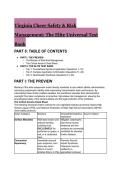
Virginia Cheer Safety & Risk
Management: The Elite Universal Test
Bank
PART 0: TABLE OF CONTENTS
● PART I: THE PREVIEW
○ The Mission of Elite Risk Management
○ The Critical Axioms Cheat Sheet
● PART II: THE ELITE TEST BANK
○ Tier 1: Foundational Syntax & Application (Questions 1–10)
○ Tier 2: Complex Application & Simulation (Questions 11–20)
○ Tier 3: Grandmaster Synthesis (Questions 21–30)
PART I: THE PREVIEW
Mastery of this elite assessment matrix directly translates to zero-defect athletic administration,
minimizing catastrophic liability while maximizing interscholastic team performance. By
internalizing these strictly codified variables, the practitioner elevates their administrative
oversight from basic compliance to proactive, high-stakes risk management, ensuring the
physiological safety of the student-athlete and the legal protection of the institution.
The Critical Axioms Cheat Sheet
The following structured matrix outlines the non-negotiable statutes governing Virginia High
School League (VHSL) and National Federation of State High School Associations (NFHS)
cheer safety protocols.
Axiom Category Directive Clinical/Administrative Source Citation
Implication
Surface Mandates Multi-base tosses and Mitigates catastrophic
airborne twisting blunt-force trauma;
tumbling must hardwood and wet
EXCLUSIVELY be surfaces are universally
performed on grass, a prohibited for elevated
mat, or a rubberized kinetic releases.
track.
Concussion Immediate removal Prevents Second
Supremacy upon suspicion; zero Impact Syndrome.
same-day return. Clearance must be
Return to Learn verified by a
dictates Return to Play. specialized Licensed
,Axiom Category Directive Clinical/Administrative Source Citation
Implication
Health Care Provider
(LHCP).
Prop Liability Hard-edged props Prevents lacerations,
cannot be dropped joint dislocations, and
from a stunt. compromised base
Hands-free poms carry grips during complex
identical restrictions to load-ins and dismounts.
traditional poms.
The 20-Day Rule VHSL requires 20 days Ensures adequate
of FALL stunt/tumble physiological
practices prior to event acclimatization and skill
participation. progression.
Summer/out-of-season
practices do not count
toward this metric.
Spotter Sterility Catchers/spotters must Spotters cannot hold
be visually and props, engage in
physically dedicated synchronized
entirely to the top choreography, or
person. violate the sterile
airspace of a
dismount's drop zone.
PART II: THE ELITE TEST BANK
Tier 1: Foundational Syntax & Application
Q1: A varsity cheerleading squad is preparing to perform during a halftime show on a traditional
hardwood basketball court. The coach intends to incorporate a multi-base basket toss into the
routine. Based on the principles of NFHS and VHSL Spirit Rules, which action is the MOST
ACCURATE? A) The basket toss may proceed if the top person executes a straight ride with no
twisting rotation during the apex of the toss. B) The basket toss may proceed if the squad
strategically places an appropriate 4-inch landing mat on the hardwood floor prior to execution.
C) The basket toss may proceed provided there is a dedicated back spotter and an additional
front spotter to mitigate lateral drift. D) The basket toss is universally prohibited indoors unless
the facility's verified ceiling height exceeds 25 feet.
● Answer: B (The basket toss may proceed if the squad strategically places an appropriate
4-inch landing mat on the hardwood floor prior to execution.)
● Distractor Analysis:
○ A is incorrect: The biomechanical reality of a basket toss involves multi-base kinetic
propulsion, which requires a yielding surface for safe deceleration. Even a straight
ride toss is strictly prohibited on bare hardwood surfaces.
○ C is incorrect: Spotting personnel do not alter the friction and impact absorption
ratings of the physical environment. Multi-base tosses without proper matting
remain illegal regardless of the number of spotters utilized.
○ D is incorrect: Facility dimensions do not supersede surface regulations. While
, ceiling height is an environmental factor, the primary regulatory barrier is the lack of
a compliant impact-absorbing surface.
The Mentor's Analysis: Surface restrictions operate as the primary defense mechanism
against catastrophic blunt-force and spinal trauma. NFHS guidelines strictly limit multi-base
tosses (such as basket or elevator tosses) and airborne twisting tumbling to mats, grass, or
rubberized tracks. Professional/Academic Intuition: Never compromise on the surface
rule; if a yielding surface or mat is unavailable, the kinetic energy of the skill must be
grounded.
Q2: During an aggressive competition routine, a flyer strikes her head against a base's shoulder
during a cradle catch. She does not lose consciousness but reports feeling "foggy" and
experiences mild photophobia. Based on the principles of the VHSL Concussion Management
Protocol, which immediate action is the MOST APPROPRIATE? A) Monitor the athlete on the
sideline for 15 minutes; if the fogginess and photophobia completely resolve, she may return to
the routine. B) Administer a rapid sideline cognitive test; if she passes the baseline parameters,
she may return for the second half of the game. C) Immediately remove her from the activity;
she is unequivocally barred from returning to play that same day. D) Allow her to perform only
grounded dance routines, but strictly restrict her from flying, basing, or tumbling.
● Answer: C (Immediately remove her from the activity; she is unequivocally barred from
returning to play that same day.)
● Distractor Analysis:
○ A is incorrect: The "15-minute clearance" is an outdated, highly dangerous legacy
protocol that directly violates current medical standards and state laws.
○ B is incorrect: Even if an athlete successfully masks symptoms or passes a sideline
cognitive evaluation, the initial presence of any concussive symptom mandates an
absolute same-day exclusion.
○ D is incorrect: "Partial" or modified participation while symptomatic is clinically
forbidden. Removal from play mandates a complete cessation of physical exertion
to protect the brain from Second Impact Syndrome.
The Mentor's Analysis: Concussion protocols dictate an absolute, uncompromising clinical
standard: immediate removal upon suspicion, with zero possibility of same-day return. Loss of
consciousness is entirely unnecessary to confirm a suspected concussion.
Professional/Academic Intuition: When in doubt, sit them out. Same-day return is never
an option for a suspected traumatic brain injury, as metabolic recovery requires strict
cognitive and physical rest.
Q3: A team executes an extended stunt featuring a top person held entirely above the bases'
heads. Based on the principles of NFHS spotting requirements regarding elevated skills, in
which of the following scenarios is a dedicated spotter NOT required? A) A double-based
extension transitioning smoothly into a straight cradle dismount. B) A single-based extended
stunt where the top person remains strictly vertical and is supported by the base at the waist. C)
A double-based extended liberty featuring a single-leg support structure. D) A single-based
chair sit where the top person is leaning backward to execute a visual arm motion.
● Answer: B (A single-based extended stunt where the top person remains strictly vertical
and is supported by the base at the waist.)
● Distractor Analysis:
○ A is incorrect: Double-based extended stunts require spotters to protect the head
and neck of the flyer during unexpected collapse.
○ C is incorrect: An extended liberty (single-leg) inherently requires a spotter due to
the instability of the top person's center of gravity and the reduced surface area of
Management: The Elite Universal Test
Bank
PART 0: TABLE OF CONTENTS
● PART I: THE PREVIEW
○ The Mission of Elite Risk Management
○ The Critical Axioms Cheat Sheet
● PART II: THE ELITE TEST BANK
○ Tier 1: Foundational Syntax & Application (Questions 1–10)
○ Tier 2: Complex Application & Simulation (Questions 11–20)
○ Tier 3: Grandmaster Synthesis (Questions 21–30)
PART I: THE PREVIEW
Mastery of this elite assessment matrix directly translates to zero-defect athletic administration,
minimizing catastrophic liability while maximizing interscholastic team performance. By
internalizing these strictly codified variables, the practitioner elevates their administrative
oversight from basic compliance to proactive, high-stakes risk management, ensuring the
physiological safety of the student-athlete and the legal protection of the institution.
The Critical Axioms Cheat Sheet
The following structured matrix outlines the non-negotiable statutes governing Virginia High
School League (VHSL) and National Federation of State High School Associations (NFHS)
cheer safety protocols.
Axiom Category Directive Clinical/Administrative Source Citation
Implication
Surface Mandates Multi-base tosses and Mitigates catastrophic
airborne twisting blunt-force trauma;
tumbling must hardwood and wet
EXCLUSIVELY be surfaces are universally
performed on grass, a prohibited for elevated
mat, or a rubberized kinetic releases.
track.
Concussion Immediate removal Prevents Second
Supremacy upon suspicion; zero Impact Syndrome.
same-day return. Clearance must be
Return to Learn verified by a
dictates Return to Play. specialized Licensed
,Axiom Category Directive Clinical/Administrative Source Citation
Implication
Health Care Provider
(LHCP).
Prop Liability Hard-edged props Prevents lacerations,
cannot be dropped joint dislocations, and
from a stunt. compromised base
Hands-free poms carry grips during complex
identical restrictions to load-ins and dismounts.
traditional poms.
The 20-Day Rule VHSL requires 20 days Ensures adequate
of FALL stunt/tumble physiological
practices prior to event acclimatization and skill
participation. progression.
Summer/out-of-season
practices do not count
toward this metric.
Spotter Sterility Catchers/spotters must Spotters cannot hold
be visually and props, engage in
physically dedicated synchronized
entirely to the top choreography, or
person. violate the sterile
airspace of a
dismount's drop zone.
PART II: THE ELITE TEST BANK
Tier 1: Foundational Syntax & Application
Q1: A varsity cheerleading squad is preparing to perform during a halftime show on a traditional
hardwood basketball court. The coach intends to incorporate a multi-base basket toss into the
routine. Based on the principles of NFHS and VHSL Spirit Rules, which action is the MOST
ACCURATE? A) The basket toss may proceed if the top person executes a straight ride with no
twisting rotation during the apex of the toss. B) The basket toss may proceed if the squad
strategically places an appropriate 4-inch landing mat on the hardwood floor prior to execution.
C) The basket toss may proceed provided there is a dedicated back spotter and an additional
front spotter to mitigate lateral drift. D) The basket toss is universally prohibited indoors unless
the facility's verified ceiling height exceeds 25 feet.
● Answer: B (The basket toss may proceed if the squad strategically places an appropriate
4-inch landing mat on the hardwood floor prior to execution.)
● Distractor Analysis:
○ A is incorrect: The biomechanical reality of a basket toss involves multi-base kinetic
propulsion, which requires a yielding surface for safe deceleration. Even a straight
ride toss is strictly prohibited on bare hardwood surfaces.
○ C is incorrect: Spotting personnel do not alter the friction and impact absorption
ratings of the physical environment. Multi-base tosses without proper matting
remain illegal regardless of the number of spotters utilized.
○ D is incorrect: Facility dimensions do not supersede surface regulations. While
, ceiling height is an environmental factor, the primary regulatory barrier is the lack of
a compliant impact-absorbing surface.
The Mentor's Analysis: Surface restrictions operate as the primary defense mechanism
against catastrophic blunt-force and spinal trauma. NFHS guidelines strictly limit multi-base
tosses (such as basket or elevator tosses) and airborne twisting tumbling to mats, grass, or
rubberized tracks. Professional/Academic Intuition: Never compromise on the surface
rule; if a yielding surface or mat is unavailable, the kinetic energy of the skill must be
grounded.
Q2: During an aggressive competition routine, a flyer strikes her head against a base's shoulder
during a cradle catch. She does not lose consciousness but reports feeling "foggy" and
experiences mild photophobia. Based on the principles of the VHSL Concussion Management
Protocol, which immediate action is the MOST APPROPRIATE? A) Monitor the athlete on the
sideline for 15 minutes; if the fogginess and photophobia completely resolve, she may return to
the routine. B) Administer a rapid sideline cognitive test; if she passes the baseline parameters,
she may return for the second half of the game. C) Immediately remove her from the activity;
she is unequivocally barred from returning to play that same day. D) Allow her to perform only
grounded dance routines, but strictly restrict her from flying, basing, or tumbling.
● Answer: C (Immediately remove her from the activity; she is unequivocally barred from
returning to play that same day.)
● Distractor Analysis:
○ A is incorrect: The "15-minute clearance" is an outdated, highly dangerous legacy
protocol that directly violates current medical standards and state laws.
○ B is incorrect: Even if an athlete successfully masks symptoms or passes a sideline
cognitive evaluation, the initial presence of any concussive symptom mandates an
absolute same-day exclusion.
○ D is incorrect: "Partial" or modified participation while symptomatic is clinically
forbidden. Removal from play mandates a complete cessation of physical exertion
to protect the brain from Second Impact Syndrome.
The Mentor's Analysis: Concussion protocols dictate an absolute, uncompromising clinical
standard: immediate removal upon suspicion, with zero possibility of same-day return. Loss of
consciousness is entirely unnecessary to confirm a suspected concussion.
Professional/Academic Intuition: When in doubt, sit them out. Same-day return is never
an option for a suspected traumatic brain injury, as metabolic recovery requires strict
cognitive and physical rest.
Q3: A team executes an extended stunt featuring a top person held entirely above the bases'
heads. Based on the principles of NFHS spotting requirements regarding elevated skills, in
which of the following scenarios is a dedicated spotter NOT required? A) A double-based
extension transitioning smoothly into a straight cradle dismount. B) A single-based extended
stunt where the top person remains strictly vertical and is supported by the base at the waist. C)
A double-based extended liberty featuring a single-leg support structure. D) A single-based
chair sit where the top person is leaning backward to execute a visual arm motion.
● Answer: B (A single-based extended stunt where the top person remains strictly vertical
and is supported by the base at the waist.)
● Distractor Analysis:
○ A is incorrect: Double-based extended stunts require spotters to protect the head
and neck of the flyer during unexpected collapse.
○ C is incorrect: An extended liberty (single-leg) inherently requires a spotter due to
the instability of the top person's center of gravity and the reduced surface area of


