

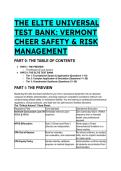
THE ELITE UNIVERSAL
TEST BANK: VERMONT
CHEER SAFETY & RISK
MANAGEMENT
PART 0: THE TABLE OF CONTENTS
● PART I: THE PREVIEW
○ The Mission & Core Axioms
● PART II: THE ELITE TEST BANK
○ Tier 1: Foundational Syntax & Application (Questions 1–10)
○ Tier 2: Complex Application & Simulation (Questions 11–20)
○ Tier 3: Grandmaster Synthesis (Questions 21–30)
PART I: THE PREVIEW
Mastering this elite test bank transforms you from a procedural bystander into an absolute
vanguard of athletic administration, ensuring maximum competitive excellence without ever
compromising athlete safety or institutional liability. You are training to synthesize biomechanical
regulations, clinical protocols, and state law into split-second, flawless decisions.
The "Critical Axioms" Cheat Sheet:
Regulatory Pillar Core Mandate Operational Execution
Vermont Concussion Law (16 Immediate removal upon Zero same-day return. Written
V.S.A. § 1431) suspicion. clearance from a licensed
health care professional
required.
NFHS Bifurcation Rule 2 (Cheer) and Rule 3 Never apply a Cheer
(Dance) are independent. biomechanical limitation to a
Dance routine.
VPA Out-of-Season Must be voluntary, No school uniforms, no contact
non-evaluative, and unbranded. drills, and no implicit mandates
for roster spots.
VPA Equity Policy Gender identity validation Administration confirms identity;
requires no medical diagnosis. all students are protected from
discrimination.
,PART II: THE ELITE TEST BANK
Tier 1: Foundational Syntax & Application
Q1: During a varsity cheer practice, an athlete takes a minor elbow to the head during a cradle
dismount. The athlete denies experiencing any symptoms, but the coach observes brief
disorientation. Based on the principles of the Vermont Concussion Law (16 V.S.A. § 1431),
which action is IMMEDIATELY required? A) Administer a sideline cognitive test; if passed, the
athlete may return to practice after 15 minutes of observation. B) Remove the athlete from
practice for the remainder of the day and advise the parents to monitor for symptoms overnight
before allowing return. C) Remove the athlete from practice immediately and prohibit return until
written clearance is provided by a licensed health care provider trained in concussion
management. D) Consult the athlete's Pre-Participation Exam (PPE) to check for a history of
concussions before deciding on removal.
● Answer/Respuesta/Réponse: C (Remove the athlete from practice immediately and
prohibit return until written clearance is provided by a licensed health care provider trained
in concussion management.)
● Distractor Analysis:
○ A is incorrect: Sideline cognitive tests administered by a coach do not override state
law, which unequivocally bans same-day return for any suspected head injury,
regardless of transient symptom resolution.
○ B is incorrect: While removal is correct, merely advising parents to monitor is
insufficient. The law explicitly mandates written clearance from a specifically
licensed health care professional before Return-to-Play is ever permitted.
○ D is incorrect: The Pre-Participation Exam (PPE) is a preventative screening tool
utilized to baseline athletes; it has zero bearing on the immediate triage and
mandatory statutory removal protocol required by active, real-time neurological
trauma.
The Mentor's Analysis: The absolute cornerstone of Vermont sports safety is the systematic
removal of discretion from the coaching staff regarding head injuries. When facing Suspected
Neurological Trauma, the immediate priority is Statutory Removal. By utilizing Clinical
Delegation, you bypass the common trap of Subjective Coach Diagnosis.
Professional/Academic Intuition: When in doubt, sit them out; coaches identify and
remove, clinicians diagnose and clear.
Q2: A high school cheerleading coach wishes to host a specialized stunting clinic in March, well
outside the official VPA-designated fall and winter cheer seasons. Based on the principles of the
VPA Out-of-Season Coaching Policy, which condition is MOST ACCURATE for hosting this
clinic? A) The clinic may mandate attendance for athletes intending to try out for the varsity
squad next season, provided no contact drills occur. B) The clinic must be purely voluntary,
utilize zero school branding or uniforms, and be open to all eligible students. C) The clinic is fully
permitted to use school transportation and host formal scrimmages since coaching restrictions
are completely lifted during the spring. D) The coach may operate the clinic using school logos
as long as the athletes pay an independent registration fee to a booster club.
● Answer/Respuesta/Réponse: B (The clinic must be purely voluntary, utilize zero school
branding or uniforms, and be open to all eligible students.)
● Distractor Analysis:
○ A is incorrect: Mandating attendance or using out-of-season participation as a factor
, in regular-season team selection is explicitly and aggressively prohibited by VPA
policy.
○ C is incorrect: Coaching restrictions are only fully lifted during Summer Recess, not
the spring out-of-season period. Furthermore, contact and scrimmages remain
strictly prohibited during out-of-season Skills and Drills Instruction.
○ D is incorrect: The VPA policy explicitly bans the use of school uniforms, logos, or
branding during out-of-season instruction, regardless of the financial structure or
booster club involvement.
The Mentor's Analysis: Out-of-season regulations exist to prevent early sports specialization
and to protect student-athletes from undue physiological and psychological pressure. When
facing Off-Season Development, the immediate priority is Voluntary Accessibility. By utilizing
Brand and Consequence Separation, you bypass the common trap of Implicit Mandates.
Professional/Academic Intuition: Out-of-season instruction must be an isolated,
brand-free zone where participation carries absolutely zero punitive weight for the
athlete.
Q3: The NFHS executed a major structural reorganization of the Spirit Rules Book for the
2025-2026 cycle. Based on the principles of the NFHS Rules Architecture, which conclusion
regarding rule application is MOST ACCURATE? A) Rule 1 dictates all general constraints,
while Rule 2 merges both Cheer and Dance definitions to ensure universal continuity across all
spirit activities. B) General Risk Management is located in Rule 1, whereas Cheer regulations
are exclusively isolated in Rule 2 and Dance regulations are completely rewritten in Rule 3. C)
All definitions from Rule 1 were deleted in favor of allowing state associations like the VPA to
establish their own biomechanical glossaries. D) Dance regulations are adapted directly from
Cheer rules to maintain unified safety protocols and spotting requirements across both spirit
activities.
● Answer/Respuesta/Réponse: B (General Risk Management is located in Rule 1,
whereas Cheer regulations are exclusively isolated in Rule 2 and Dance regulations are
completely rewritten in Rule 3.)
● Distractor Analysis:
○ A is incorrect: The definitions were specifically separated into Rule 2 (Cheer) and
Rule 3 (Dance) to avoid the profound confusion caused by merging them in legacy
manuals.
○ C is incorrect: The definitions were not deleted; they were meticulously relocated
into their highly specific activity sections to prevent dangerous cross-disciplinary
misapplication.
○ D is incorrect: The core rationale for the restructure was to explicitly stop adapting
Dance rules from Cheer rules, recognizing them as distinct athletic disciplines with
entirely different footwear, floor contact, and biomechanical profiles.
The Mentor's Analysis: The bifurcation of Cheer and Dance acknowledges the divergent
biomechanical realities of the two sports. When facing Rule Interpretation, the immediate priority
is Activity-Specific Context. By utilizing Isolated Regulatory Silos, you bypass the common trap
of Cross-Disciplinary Misapplication. Professional/Academic Intuition: Never project a Cheer
limitation onto a Dance routine; the NFHS architecture treats them as entirely
autonomous athletic ecosystems.
Q4: In an effort to modernize acrobatic safety, USA Cheer and the NFHS updated the definition
of a "Loading Position/Load." Based on the principles of the NFHS Spirit Rules (2026-27
updates), what distinguishes a legal load from an illegal transitional dip? A) The top person must
have at least one hand connected to a bracer while maintaining a prep level posture. B) The top
TEST BANK: VERMONT
CHEER SAFETY & RISK
MANAGEMENT
PART 0: THE TABLE OF CONTENTS
● PART I: THE PREVIEW
○ The Mission & Core Axioms
● PART II: THE ELITE TEST BANK
○ Tier 1: Foundational Syntax & Application (Questions 1–10)
○ Tier 2: Complex Application & Simulation (Questions 11–20)
○ Tier 3: Grandmaster Synthesis (Questions 21–30)
PART I: THE PREVIEW
Mastering this elite test bank transforms you from a procedural bystander into an absolute
vanguard of athletic administration, ensuring maximum competitive excellence without ever
compromising athlete safety or institutional liability. You are training to synthesize biomechanical
regulations, clinical protocols, and state law into split-second, flawless decisions.
The "Critical Axioms" Cheat Sheet:
Regulatory Pillar Core Mandate Operational Execution
Vermont Concussion Law (16 Immediate removal upon Zero same-day return. Written
V.S.A. § 1431) suspicion. clearance from a licensed
health care professional
required.
NFHS Bifurcation Rule 2 (Cheer) and Rule 3 Never apply a Cheer
(Dance) are independent. biomechanical limitation to a
Dance routine.
VPA Out-of-Season Must be voluntary, No school uniforms, no contact
non-evaluative, and unbranded. drills, and no implicit mandates
for roster spots.
VPA Equity Policy Gender identity validation Administration confirms identity;
requires no medical diagnosis. all students are protected from
discrimination.
,PART II: THE ELITE TEST BANK
Tier 1: Foundational Syntax & Application
Q1: During a varsity cheer practice, an athlete takes a minor elbow to the head during a cradle
dismount. The athlete denies experiencing any symptoms, but the coach observes brief
disorientation. Based on the principles of the Vermont Concussion Law (16 V.S.A. § 1431),
which action is IMMEDIATELY required? A) Administer a sideline cognitive test; if passed, the
athlete may return to practice after 15 minutes of observation. B) Remove the athlete from
practice for the remainder of the day and advise the parents to monitor for symptoms overnight
before allowing return. C) Remove the athlete from practice immediately and prohibit return until
written clearance is provided by a licensed health care provider trained in concussion
management. D) Consult the athlete's Pre-Participation Exam (PPE) to check for a history of
concussions before deciding on removal.
● Answer/Respuesta/Réponse: C (Remove the athlete from practice immediately and
prohibit return until written clearance is provided by a licensed health care provider trained
in concussion management.)
● Distractor Analysis:
○ A is incorrect: Sideline cognitive tests administered by a coach do not override state
law, which unequivocally bans same-day return for any suspected head injury,
regardless of transient symptom resolution.
○ B is incorrect: While removal is correct, merely advising parents to monitor is
insufficient. The law explicitly mandates written clearance from a specifically
licensed health care professional before Return-to-Play is ever permitted.
○ D is incorrect: The Pre-Participation Exam (PPE) is a preventative screening tool
utilized to baseline athletes; it has zero bearing on the immediate triage and
mandatory statutory removal protocol required by active, real-time neurological
trauma.
The Mentor's Analysis: The absolute cornerstone of Vermont sports safety is the systematic
removal of discretion from the coaching staff regarding head injuries. When facing Suspected
Neurological Trauma, the immediate priority is Statutory Removal. By utilizing Clinical
Delegation, you bypass the common trap of Subjective Coach Diagnosis.
Professional/Academic Intuition: When in doubt, sit them out; coaches identify and
remove, clinicians diagnose and clear.
Q2: A high school cheerleading coach wishes to host a specialized stunting clinic in March, well
outside the official VPA-designated fall and winter cheer seasons. Based on the principles of the
VPA Out-of-Season Coaching Policy, which condition is MOST ACCURATE for hosting this
clinic? A) The clinic may mandate attendance for athletes intending to try out for the varsity
squad next season, provided no contact drills occur. B) The clinic must be purely voluntary,
utilize zero school branding or uniforms, and be open to all eligible students. C) The clinic is fully
permitted to use school transportation and host formal scrimmages since coaching restrictions
are completely lifted during the spring. D) The coach may operate the clinic using school logos
as long as the athletes pay an independent registration fee to a booster club.
● Answer/Respuesta/Réponse: B (The clinic must be purely voluntary, utilize zero school
branding or uniforms, and be open to all eligible students.)
● Distractor Analysis:
○ A is incorrect: Mandating attendance or using out-of-season participation as a factor
, in regular-season team selection is explicitly and aggressively prohibited by VPA
policy.
○ C is incorrect: Coaching restrictions are only fully lifted during Summer Recess, not
the spring out-of-season period. Furthermore, contact and scrimmages remain
strictly prohibited during out-of-season Skills and Drills Instruction.
○ D is incorrect: The VPA policy explicitly bans the use of school uniforms, logos, or
branding during out-of-season instruction, regardless of the financial structure or
booster club involvement.
The Mentor's Analysis: Out-of-season regulations exist to prevent early sports specialization
and to protect student-athletes from undue physiological and psychological pressure. When
facing Off-Season Development, the immediate priority is Voluntary Accessibility. By utilizing
Brand and Consequence Separation, you bypass the common trap of Implicit Mandates.
Professional/Academic Intuition: Out-of-season instruction must be an isolated,
brand-free zone where participation carries absolutely zero punitive weight for the
athlete.
Q3: The NFHS executed a major structural reorganization of the Spirit Rules Book for the
2025-2026 cycle. Based on the principles of the NFHS Rules Architecture, which conclusion
regarding rule application is MOST ACCURATE? A) Rule 1 dictates all general constraints,
while Rule 2 merges both Cheer and Dance definitions to ensure universal continuity across all
spirit activities. B) General Risk Management is located in Rule 1, whereas Cheer regulations
are exclusively isolated in Rule 2 and Dance regulations are completely rewritten in Rule 3. C)
All definitions from Rule 1 were deleted in favor of allowing state associations like the VPA to
establish their own biomechanical glossaries. D) Dance regulations are adapted directly from
Cheer rules to maintain unified safety protocols and spotting requirements across both spirit
activities.
● Answer/Respuesta/Réponse: B (General Risk Management is located in Rule 1,
whereas Cheer regulations are exclusively isolated in Rule 2 and Dance regulations are
completely rewritten in Rule 3.)
● Distractor Analysis:
○ A is incorrect: The definitions were specifically separated into Rule 2 (Cheer) and
Rule 3 (Dance) to avoid the profound confusion caused by merging them in legacy
manuals.
○ C is incorrect: The definitions were not deleted; they were meticulously relocated
into their highly specific activity sections to prevent dangerous cross-disciplinary
misapplication.
○ D is incorrect: The core rationale for the restructure was to explicitly stop adapting
Dance rules from Cheer rules, recognizing them as distinct athletic disciplines with
entirely different footwear, floor contact, and biomechanical profiles.
The Mentor's Analysis: The bifurcation of Cheer and Dance acknowledges the divergent
biomechanical realities of the two sports. When facing Rule Interpretation, the immediate priority
is Activity-Specific Context. By utilizing Isolated Regulatory Silos, you bypass the common trap
of Cross-Disciplinary Misapplication. Professional/Academic Intuition: Never project a Cheer
limitation onto a Dance routine; the NFHS architecture treats them as entirely
autonomous athletic ecosystems.
Q4: In an effort to modernize acrobatic safety, USA Cheer and the NFHS updated the definition
of a "Loading Position/Load." Based on the principles of the NFHS Spirit Rules (2026-27
updates), what distinguishes a legal load from an illegal transitional dip? A) The top person must
have at least one hand connected to a bracer while maintaining a prep level posture. B) The top


