

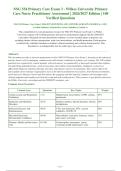
NSG 554 Primary Care Exam 3 - Wilkes University Primary
Care Nurse Practitioner Assessment | 2026/2027 Edition | 100
Verified Questions
NSG 554 Primary Care Exam 3 2026-2027 QUESTIONS AND ANSWERS ALREADY GRADED A+. 100%
Verified Solutions | Updated Per Latest Guidelines | Graded A+
This comprehensive exam preparation resource for NSG 554 Primary Care Exam 3 at Wilkes
University contains 100 verified questions and answers meticulously aligned with the 2026/2027
curriculum. Designed for nurse practitioner students, it covers essential topics in primary care
including chronic disease management, acute care interventions, and health promotion. Each question
is followed by a detailed rationale to reinforce clinical reasoning and evidence-based practice. This
document is an indispensable tool for achieving a top score on the exam.
Abstract:
This document provides a rigorous preparation tool for NSG 554 Primary Care Exam 3, focusing on the advanced
practice nurse's role in managing common acute and chronic conditions in primary care settings. The 100 verified
questions are organized by content domain, with each answer accompanied by a thorough rationale that explains
the underlying pathophysiology, clinical reasoning, and evidence-based guidelines. Emphasis is placed on
differential diagnosis, pharmacotherapy selection, and patient-centered care planning. The content reflects the
latest updates from national organizations such as the American Diabetes Association, Joint National Committee,
and Centers for Disease Control and Prevention. By engaging with this material, students will strengthen their
clinical judgment and readiness for both the exam and real-world practice. This resource is specifically tailored to
the Wilkes University curriculum and the 2026/2027 academic year.
Content Area Overview:
Content Area Questions Key Topics Weight
Cardiovascular and Respiratory 1-25 Hypertension, heart failure, COPD, asthma, 25%
Conditions pneumonia
Endocrine and Metabolic 26-45 Diabetes mellitus, thyroid disorders, obesity, 20%
Disorders dyslipidemia
Infectious Diseases and 46-65 UTIs, skin infections, STIs, vaccine 20%
Immunizations schedules, COVID-19
Musculoskeletal and 66-80 Osteoarthritis, back pain, fractures, rashes, 15%
Dermatologic Conditions skin cancer screening
Women's Health and Preventive 81-100 Contraception, menopause, cancer 20%
Care screening, health maintenance visits
Page 1
,Q1. Which of the following best explains why SGLT2 inhibitors reduce cardiovascular mortality in
patients with type 2 diabetes, independent of glycemic control?
A. Increased ketone production improves myocardial efficiency
B. Reduction in plasma volume and blood pressure
C. Inhibition of the sodium-hydrogen exchanger in the myocardium
D. Enhanced insulin secretion from pancreatic beta cells
Correct Answer: A. Increased ketone production improves myocardial efficiency
Rationale: SGLT2 inhibitors increase ketone body production (beta-hydroxybutyrate), which serves as a
more efficient fuel for the myocardium, improving cardiac energetics. While volume reduction and blood
pressure lowering occur, they do not fully explain the mortality benefit. The sodium-hydrogen exchanger
inhibition is a proposed mechanism for empagliflozin but is not the primary independent factor. SGLT2
inhibitors do not stimulate insulin secretion.
Why Wrong:
B - Volume reduction contributes but is not the primary mechanism for mortality reduction
independent of glycemic control.
C - SGLT2 inhibitors may inhibit NHE, but this is not the best explanation for cardiovascular
mortality benefit.
D - SGLT2 inhibitors do not enhance insulin secretion; they increase urinary glucose excretion.
Reference: Zinman, B. et al. (2015). EMPA-REG OUTCOME. N Engl J Med; 373:2117-2128.
Q2. A patient with a history of recurrent calcium oxalate kidney stones presents with a new stone.
Urine studies show low citrate and high calcium. Which intervention is most likely to reduce
recurrence?
A. Increase dietary calcium intake
B. Prescribe potassium citrate
C. Restrict dietary oxalate
D. Administer hydrochlorothiazide
Correct Answer: B. Prescribe potassium citrate
Rationale: Potassium citrate increases urinary citrate, which chelates calcium and inhibits stone
formation. Low citrate is a major risk factor for calcium oxalate stones. Increasing dietary calcium can
paradoxically reduce oxalate absorption but does not address hypocitraturia. Oxalate restriction is less
effective when citrate is low. Hydrochlorothiazide reduces urinary calcium but does not correct low
citrate.
Why Wrong:
A - Increasing dietary calcium may reduce oxalate absorption but does not correct hypocitraturia.
C - Oxalate restriction is secondary; hypocitraturia is the primary identified abnormality.
D - Thiazides reduce calcium excretion but do not address low citrate levels.
Reference: Pearle, M.S. et al. (2021). Medical management of kidney stones. AUA Guideline.
Page 2
,Q3. A patient with moderate persistent asthma is well controlled on low-dose inhaled corticosteroid
(ICS) plus long-acting beta-agonist (LABA). Which change indicates step-down therapy is
appropriate?
A. No nighttime awakenings and FEV1 >80% predicted for 3 months
B. Use of rescue inhaler twice per week for 6 weeks
C. ACT score of 19 with FEV1 75% predicted
D. One exacerbation requiring oral steroids in the past year
Correct Answer: A. No nighttime awakenings and FEV1 >80% predicted for 3 months
Rationale: Step-down is considered when asthma is well controlled for at least 3 months, defined by
daytime symptoms 2 days/week, no nighttime awakenings, rescue use 2 days/week, and normal lung
function. Option A meets these criteria. Option B indicates poor control (rescue use >2 days/week). ACT
score <20 is not well controlled. A recent exacerbation suggests stepping down is unsafe.
Why Wrong:
B - Rescue use twice per week for 6 weeks indicates inadequate control; step-down would be
inappropriate.
C - ACT score 19 is not well controlled; FEV1 <80% also indicates poor control.
D - An exacerbation requiring oral steroids in the past year suggests step-up, not step-down.
Reference: GINA 2023 Report, Global Strategy for Asthma Management and Prevention.
Q4. A patient with hypertension and stage 3 chronic kidney disease (eGFR 40 mL/min) is started on
lisinopril. After one week, serum creatinine rises from 1.5 to 2.0 mg/dL and potassium to 5.6 mEq/L.
What is the most appropriate next step?
A. Discontinue lisinopril permanently and start amlodipine
B. Continue lisinopril and add a loop diuretic
C. Hold lisinopril, recheck labs in 1 week; if creatinine stabilizes, restart
D. Reduce lisinopril dose and add spironolactone
Correct Answer: C. Hold lisinopril, recheck labs in 1 week; if creatinine stabilizes, restart
Rationale: An initial rise in creatinine up to 30% is expected with ACE inhibitors due to hemodynamic
changes; it often stabilizes. Hyperkalemia may be transient. Holding the drug and rechecking labs is
appropriate. If creatinine stabilizes or returns to baseline, the drug can be restarted. Permanent
discontinuation is not indicated unless rise >30% or progressive. Adding a loop diuretic may help
hyperkalemia but is not first step. Spironolactone would worsen hyperkalemia.
Why Wrong:
A - A 33% rise is within acceptable range; permanent discontinuation is premature.
B - Continuing without adjustment risks worsening hyperkalemia; holding is safer.
D - Adding spironolactone would further increase potassium and is contraindicated.
Reference: KDIGO 2021 Clinical Practice Guideline for the Management of Blood Pressure in CKD.
Page 3
, Q5. A patient presents with acute onset of right lower quadrant pain, nausea, and low-grade fever.
Ultrasound shows a non-compressible, dilated appendix with wall thickening. Which finding would
most strongly support non-operative management with antibiotics alone?
A. Appendicolith present on CT
B. Abscess <3 cm on imaging
C. Duration of symptoms >48 hours
D. White blood cell count >18,000/µL
Correct Answer: B. Abscess <3 cm on imaging
Rationale: Small abscesses (<3 cm) may be managed with antibiotics alone or percutaneous drainage,
making non-operative management more feasible. Appendicolith, prolonged symptoms, and marked
leukocytosis are associated with higher risk of failure of antibiotic therapy and often require surgery.
Why Wrong:
A - Appendicolith is a risk factor for complicated appendicitis and antibiotic failure.
C - Symptom duration >48 hours is associated with perforation and higher failure rate.
D - WBC >18,000 indicates severe inflammation, often requiring surgical intervention.
Reference: Di Saverio, S. et al. (2020). WSES Jerusalem guidelines for diagnosis and treatment of acute
appendicitis. World J Emerg Surg.
Q6. Which of the following vaccine recommendations is correct for a patient with asplenia
(functional or anatomic) who is 35 years old and has no prior vaccinations?
A. PCV20 alone, with PPSV23 after 5 years
B. PCV15 followed by PPSV23 at least 8 weeks later
C. PPSV23 alone, with a second dose after 5 years
D. PCV13 followed by PCV20 after 1 year
Correct Answer: B. PCV15 followed by PPSV23 at least 8 weeks later
Rationale: For adults with asplenia aged "e19 years, ACIP recommends PCV15 followed by PPSV23 at
least 8 weeks later (or PCV20 alone). Option B is correct. PCV20 alone is also acceptable, but PCV20
alone is not followed by PPSV23. PPSV23 alone does not cover serotypes in PCV. PCV13 is no longer
recommended for adults.
Why Wrong:
A - PCV20 alone is an option, but it is not followed by PPSV23; the sequence is either
PCV15->PPSV23 or PCV20 alone.
C - PPSV23 alone does not provide protection against serotypes unique to PCV.
D - PCV13 is no longer recommended for this age group; PCV15 or PCV20 is used.
Reference: MMWR. (2022). Use of 15-Valent and 20-Valent Pneumococcal Conjugate Vaccines Among
Adults Aged 65 Years. 71(4):109-117.
Page 4
Care Nurse Practitioner Assessment | 2026/2027 Edition | 100
Verified Questions
NSG 554 Primary Care Exam 3 2026-2027 QUESTIONS AND ANSWERS ALREADY GRADED A+. 100%
Verified Solutions | Updated Per Latest Guidelines | Graded A+
This comprehensive exam preparation resource for NSG 554 Primary Care Exam 3 at Wilkes
University contains 100 verified questions and answers meticulously aligned with the 2026/2027
curriculum. Designed for nurse practitioner students, it covers essential topics in primary care
including chronic disease management, acute care interventions, and health promotion. Each question
is followed by a detailed rationale to reinforce clinical reasoning and evidence-based practice. This
document is an indispensable tool for achieving a top score on the exam.
Abstract:
This document provides a rigorous preparation tool for NSG 554 Primary Care Exam 3, focusing on the advanced
practice nurse's role in managing common acute and chronic conditions in primary care settings. The 100 verified
questions are organized by content domain, with each answer accompanied by a thorough rationale that explains
the underlying pathophysiology, clinical reasoning, and evidence-based guidelines. Emphasis is placed on
differential diagnosis, pharmacotherapy selection, and patient-centered care planning. The content reflects the
latest updates from national organizations such as the American Diabetes Association, Joint National Committee,
and Centers for Disease Control and Prevention. By engaging with this material, students will strengthen their
clinical judgment and readiness for both the exam and real-world practice. This resource is specifically tailored to
the Wilkes University curriculum and the 2026/2027 academic year.
Content Area Overview:
Content Area Questions Key Topics Weight
Cardiovascular and Respiratory 1-25 Hypertension, heart failure, COPD, asthma, 25%
Conditions pneumonia
Endocrine and Metabolic 26-45 Diabetes mellitus, thyroid disorders, obesity, 20%
Disorders dyslipidemia
Infectious Diseases and 46-65 UTIs, skin infections, STIs, vaccine 20%
Immunizations schedules, COVID-19
Musculoskeletal and 66-80 Osteoarthritis, back pain, fractures, rashes, 15%
Dermatologic Conditions skin cancer screening
Women's Health and Preventive 81-100 Contraception, menopause, cancer 20%
Care screening, health maintenance visits
Page 1
,Q1. Which of the following best explains why SGLT2 inhibitors reduce cardiovascular mortality in
patients with type 2 diabetes, independent of glycemic control?
A. Increased ketone production improves myocardial efficiency
B. Reduction in plasma volume and blood pressure
C. Inhibition of the sodium-hydrogen exchanger in the myocardium
D. Enhanced insulin secretion from pancreatic beta cells
Correct Answer: A. Increased ketone production improves myocardial efficiency
Rationale: SGLT2 inhibitors increase ketone body production (beta-hydroxybutyrate), which serves as a
more efficient fuel for the myocardium, improving cardiac energetics. While volume reduction and blood
pressure lowering occur, they do not fully explain the mortality benefit. The sodium-hydrogen exchanger
inhibition is a proposed mechanism for empagliflozin but is not the primary independent factor. SGLT2
inhibitors do not stimulate insulin secretion.
Why Wrong:
B - Volume reduction contributes but is not the primary mechanism for mortality reduction
independent of glycemic control.
C - SGLT2 inhibitors may inhibit NHE, but this is not the best explanation for cardiovascular
mortality benefit.
D - SGLT2 inhibitors do not enhance insulin secretion; they increase urinary glucose excretion.
Reference: Zinman, B. et al. (2015). EMPA-REG OUTCOME. N Engl J Med; 373:2117-2128.
Q2. A patient with a history of recurrent calcium oxalate kidney stones presents with a new stone.
Urine studies show low citrate and high calcium. Which intervention is most likely to reduce
recurrence?
A. Increase dietary calcium intake
B. Prescribe potassium citrate
C. Restrict dietary oxalate
D. Administer hydrochlorothiazide
Correct Answer: B. Prescribe potassium citrate
Rationale: Potassium citrate increases urinary citrate, which chelates calcium and inhibits stone
formation. Low citrate is a major risk factor for calcium oxalate stones. Increasing dietary calcium can
paradoxically reduce oxalate absorption but does not address hypocitraturia. Oxalate restriction is less
effective when citrate is low. Hydrochlorothiazide reduces urinary calcium but does not correct low
citrate.
Why Wrong:
A - Increasing dietary calcium may reduce oxalate absorption but does not correct hypocitraturia.
C - Oxalate restriction is secondary; hypocitraturia is the primary identified abnormality.
D - Thiazides reduce calcium excretion but do not address low citrate levels.
Reference: Pearle, M.S. et al. (2021). Medical management of kidney stones. AUA Guideline.
Page 2
,Q3. A patient with moderate persistent asthma is well controlled on low-dose inhaled corticosteroid
(ICS) plus long-acting beta-agonist (LABA). Which change indicates step-down therapy is
appropriate?
A. No nighttime awakenings and FEV1 >80% predicted for 3 months
B. Use of rescue inhaler twice per week for 6 weeks
C. ACT score of 19 with FEV1 75% predicted
D. One exacerbation requiring oral steroids in the past year
Correct Answer: A. No nighttime awakenings and FEV1 >80% predicted for 3 months
Rationale: Step-down is considered when asthma is well controlled for at least 3 months, defined by
daytime symptoms 2 days/week, no nighttime awakenings, rescue use 2 days/week, and normal lung
function. Option A meets these criteria. Option B indicates poor control (rescue use >2 days/week). ACT
score <20 is not well controlled. A recent exacerbation suggests stepping down is unsafe.
Why Wrong:
B - Rescue use twice per week for 6 weeks indicates inadequate control; step-down would be
inappropriate.
C - ACT score 19 is not well controlled; FEV1 <80% also indicates poor control.
D - An exacerbation requiring oral steroids in the past year suggests step-up, not step-down.
Reference: GINA 2023 Report, Global Strategy for Asthma Management and Prevention.
Q4. A patient with hypertension and stage 3 chronic kidney disease (eGFR 40 mL/min) is started on
lisinopril. After one week, serum creatinine rises from 1.5 to 2.0 mg/dL and potassium to 5.6 mEq/L.
What is the most appropriate next step?
A. Discontinue lisinopril permanently and start amlodipine
B. Continue lisinopril and add a loop diuretic
C. Hold lisinopril, recheck labs in 1 week; if creatinine stabilizes, restart
D. Reduce lisinopril dose and add spironolactone
Correct Answer: C. Hold lisinopril, recheck labs in 1 week; if creatinine stabilizes, restart
Rationale: An initial rise in creatinine up to 30% is expected with ACE inhibitors due to hemodynamic
changes; it often stabilizes. Hyperkalemia may be transient. Holding the drug and rechecking labs is
appropriate. If creatinine stabilizes or returns to baseline, the drug can be restarted. Permanent
discontinuation is not indicated unless rise >30% or progressive. Adding a loop diuretic may help
hyperkalemia but is not first step. Spironolactone would worsen hyperkalemia.
Why Wrong:
A - A 33% rise is within acceptable range; permanent discontinuation is premature.
B - Continuing without adjustment risks worsening hyperkalemia; holding is safer.
D - Adding spironolactone would further increase potassium and is contraindicated.
Reference: KDIGO 2021 Clinical Practice Guideline for the Management of Blood Pressure in CKD.
Page 3
, Q5. A patient presents with acute onset of right lower quadrant pain, nausea, and low-grade fever.
Ultrasound shows a non-compressible, dilated appendix with wall thickening. Which finding would
most strongly support non-operative management with antibiotics alone?
A. Appendicolith present on CT
B. Abscess <3 cm on imaging
C. Duration of symptoms >48 hours
D. White blood cell count >18,000/µL
Correct Answer: B. Abscess <3 cm on imaging
Rationale: Small abscesses (<3 cm) may be managed with antibiotics alone or percutaneous drainage,
making non-operative management more feasible. Appendicolith, prolonged symptoms, and marked
leukocytosis are associated with higher risk of failure of antibiotic therapy and often require surgery.
Why Wrong:
A - Appendicolith is a risk factor for complicated appendicitis and antibiotic failure.
C - Symptom duration >48 hours is associated with perforation and higher failure rate.
D - WBC >18,000 indicates severe inflammation, often requiring surgical intervention.
Reference: Di Saverio, S. et al. (2020). WSES Jerusalem guidelines for diagnosis and treatment of acute
appendicitis. World J Emerg Surg.
Q6. Which of the following vaccine recommendations is correct for a patient with asplenia
(functional or anatomic) who is 35 years old and has no prior vaccinations?
A. PCV20 alone, with PPSV23 after 5 years
B. PCV15 followed by PPSV23 at least 8 weeks later
C. PPSV23 alone, with a second dose after 5 years
D. PCV13 followed by PCV20 after 1 year
Correct Answer: B. PCV15 followed by PPSV23 at least 8 weeks later
Rationale: For adults with asplenia aged "e19 years, ACIP recommends PCV15 followed by PPSV23 at
least 8 weeks later (or PCV20 alone). Option B is correct. PCV20 alone is also acceptable, but PCV20
alone is not followed by PPSV23. PPSV23 alone does not cover serotypes in PCV. PCV13 is no longer
recommended for adults.
Why Wrong:
A - PCV20 alone is an option, but it is not followed by PPSV23; the sequence is either
PCV15->PPSV23 or PCV20 alone.
C - PPSV23 alone does not provide protection against serotypes unique to PCV.
D - PCV13 is no longer recommended for this age group; PCV15 or PCV20 is used.
Reference: MMWR. (2022). Use of 15-Valent and 20-Valent Pneumococcal Conjugate Vaccines Among
Adults Aged 65 Years. 71(4):109-117.
Page 4


