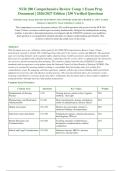
NUR 280 Comprehensive Review Comp 1 Exam Prep
Document | 2026/2027 Edition | 250 Verified Questions
NUR 280 Comp 1 Exam 2026-2027 QUESTIONS AND ANSWERS ALREADY GRADED A+. 100% Verified
Solutions | Updated Per Latest Guidelines | Graded A+
This comprehensive review document contains 250 verified questions and answers for the NUR 280
Comp 1 Exam, covering essential topics in nursing fundamentals. Designed for undergraduate nursing
students, it provides a thorough preparation tool aligned with the 2026/2027 academic year guidelines.
Each question is accompanied by detailed rationales to enhance understanding and retention. This
resource is ideal for achieving a high score on the exam.
Abstract:
This document serves as a definitive study guide for the NUR 280 Comprehensive Review Comp 1 Exam,
meticulously curated to include 250 verified questions that mirror the exam's content and difficulty. The questions
span core nursing domains such as patient safety, pharmacology, health assessment, and professional standards.
Each answer is justified with a detailed rationale, explaining why the correct choice is optimal and why distractors
are incorrect, thereby promoting deep learning. The content is aligned with the latest 2026/2027 academic
standards and incorporates recent updates from the National Council of State Boards of Nursing (NCSBN). This
resource is essential for nursing students seeking to consolidate their knowledge and excel in their first
comprehensive exam. By engaging with these questions, students will develop critical thinking skills and clinical
judgment necessary for safe and effective nursing practice. The structured format allows for systematic review,
ensuring comprehensive coverage of all exam topics. Ultimately, this document aims to boost student confidence
and performance through rigorous, high-quality preparation.
Content Area Overview:
Content Area Questions Key Topics Weight
Fundamentals of Nursing 1-50 Nursing process, patient safety, hygiene, 20%
Practice mobility, vital signs
Pharmacology and Medication 51-100 Drug classifications, dosage calculations, 20%
Administration routes of administration, adverse effects
Health Assessment 101-150 Head-to-toe assessment, normal vs. 20%
abnormal findings, documentation
Infection Control and Safety 151-190 Standard precautions, isolation precautions, 16%
hand hygiene, PPE use
Patient Education and 191-220 Teaching strategies, health literacy, 12%
Communication therapeutic communication, cultural
competence
Ethical and Legal Considerations 221-250 Informed consent, HIPAA, advance 12%
directives, nursing ethics
Page 1
,Q1. A patient with chronic kidney disease (CKD) stage 4 is prescribed enoxaparin for DVT
prophylaxis. Which pharmacokinetic consideration is most critical when determining the dose?
A. Enoxaparin is highly protein-bound and competes with uremic toxins for albumin binding sites.
B. Enoxaparin undergoes extensive hepatic metabolism via CYP450 enzymes, requiring dose
adjustment in hepatic impairment.
C. Enoxaparin is primarily eliminated unchanged by the kidneys, leading to accumulation and
increased bleeding risk in CKD.
D. Enoxaparin has a large volume of distribution, so loading doses are necessary to achieve
therapeutic levels.
Correct Answer: C. Enoxaparin is primarily eliminated unchanged by the kidneys, leading to
accumulation and increased bleeding risk in CKD.
Rationale: Enoxaparin is a low molecular weight heparin that is primarily excreted renally. In CKD
stage 4, reduced clearance leads to drug accumulation and heightened anticoagulant effect, increasing
bleeding risk. Options A, B, and D are incorrect: enoxaparin has low protein binding, minimal hepatic
metabolism, and does not require loading doses.
Why Wrong:
A - Enoxaparin has low protein binding (about 80% but not significantly affected by uremic toxins);
dose adjustment is based on renal function, not protein binding.
B - Enoxaparin metabolism is not CYP450-dependent; it is cleared renally, not hepatically.
D - Enoxaparin does not require loading doses; its therapeutic effect is achieved with fixed or
weight-based doses.
Reference: Lehne, R.A. (2026). Pharmacology for Nursing Care, 12th Ed., Ch. 34
Q2. A patient presents with acute onset of confusion, ataxia, and nystagmus. Serum sodium is 118
mEq/L. Which intervention should the nurse question?
A. Administer 3% hypertonic saline at 50 mL/hour.
B. Initiate fluid restriction to 800 mL/day.
C. Administer oral sodium chloride tablets 3 g twice daily.
D. Infuse 0.9% normal saline at 100 mL/hour.
Correct Answer: A. Administer 3% hypertonic saline at 50 mL/hour.
Rationale: Rapid correction of severe hyponatremia can cause osmotic demyelination syndrome. Current
guidelines recommend a slow correction rate (8 mEq/L in 24 hours). 3% hypertonic saline at 50 mL/hour
is too aggressive without close monitoring. Options B, C, and D are safer initial interventions for
asymptomatic or mildly symptomatic hyponatremia.
Why Wrong:
B - Fluid restriction is appropriate for euvolemic hyponatremia but not the primary intervention for
severe symptoms.
C - Oral salt is appropriate for mild hyponatremia but not for acute severe symptoms where IV
therapy is needed.
D - 0.9% normal saline is often used but may not correct severe hyponatremia rapidly enough;
however, it is safer than hypertonic saline.
Reference: Lewis, S.L. et al. (2026). Medical-Surgical Nursing, 11th Ed., Ch. 16
Page 2
,Q3. A patient receiving IV heparin for pulmonary embolism develops a platelet count drop from
250,000 to 110,000 over 5 days. Which action is most appropriate?
A. Continue heparin and monitor platelet count daily.
B. Discontinue heparin and start fondaparinux.
C. Administer platelet transfusion and continue heparin.
D. Switch from heparin to enoxaparin.
Correct Answer: B. Discontinue heparin and start fondaparinux.
Rationale: The platelet drop suggests heparin-induced thrombocytopenia (HIT) type II. Heparin must be
stopped immediately, and a non-heparin anticoagulant like fondaparinux (a factor Xa inhibitor) should be
initiated. Options A, C, and D are contraindicated because they involve continued heparin exposure or
cross-reactivity with LMWH.
Why Wrong:
A - Continuing heparin in HIT can lead to thrombosis; the platelet drop is a warning sign.
C - Platelet transfusion is generally avoided in HIT unless bleeding; heparin should be stopped.
D - Enoxaparin has cross-reactivity with HIT antibodies and is not safe.
Reference: Lehne, R.A. (2026). Pharmacology for Nursing Care, 12th Ed., Ch. 34
Q4. A patient with heart failure with reduced ejection fraction (HFrEF) is started on
sacubitril/valsartan. Which laboratory value requires immediate monitoring and dose adjustment?
A. Serum potassium >5.5 mEq/L
B. Serum creatinine increase >0.3 mg/dL
C. Hemoglobin <10 g/dL
D. BNP level >100 pg/mL
Correct Answer: B. Serum creatinine increase >0.3 mg/dL
Rationale: Sacubitril/valsartan increases natriuretic peptides and can cause renal impairment. A rise in
serum creatinine >0.3 mg/dL indicates acute kidney injury, requiring dose reduction or discontinuation.
Hyperkalemia (option A) is also a concern but monitoring creatinine is more specific for dose adjustment.
BNP levels are expected to change with therapy.
Why Wrong:
A - Hyperkalemia is a known side effect but dose adjustment is primarily based on renal function,
not potassium alone.
C - Anemia is not a direct contraindication or dose adjustment criterion for sacubitril/valsartan.
D - BNP levels may decrease with therapy; monitoring is not for dose adjustment.
Reference: Yancy, C.W. et al. (2026). ACC/AHA/HFSA Guideline for the Management of Heart Failure,
JACC
Page 3
, Q5. A patient with type 2 diabetes and CKD stage 3 is prescribed metformin. Which assessment
finding indicates a contraindication to metformin therapy?
A. HbA1c 7.2%
B. eGFR 35 mL/min/1.73m²
C. BMI 32 kg/m²
D. Fasting glucose 140 mg/dL
Correct Answer: B. eGFR 35 mL/min/1.73m²
Rationale: Metformin is contraindicated when eGFR is less than 30 mL/min/1.73m² due to increased risk
of lactic acidosis. An eGFR of 25 indicates stage 4 CKD, making metformin unsafe. Options A, C, and D
are not contraindications.
Why Wrong:
A - HbA1c 7.2% indicates poor glycemic control but is not a contraindication; metformin is
indicated.
C - BMI 32 is an indication for metformin use, not a contraindication.
D - Fasting glucose 140 mg/dL is elevated but not a contraindication.
Reference: American Diabetes Association (2026). Standards of Medical Care in Diabetes, Diabetes
Care
Q6. A patient on a mechanical ventilator has an arterial blood gas: pH 7.21, PaCO2 60 mm Hg,
PaO2 85 mm Hg, HCO3- 24 mEq/L. Which ventilator adjustment is most appropriate?
A. Increase tidal volume to 8 mL/kg
B. Increase respiratory rate to 20 breaths/min
C. Decrease FiO2 to 40%
D. Apply positive end-expiratory pressure (PEEP) of 5 cm H2O
Correct Answer: B. Increase respiratory rate to 20 breaths/min
Rationale: The ABG shows uncompensated respiratory acidosis (low pH, high PaCO2, normal HCO3).
The primary problem is hypoventilation. Increasing respiratory rate will enhance CO2 elimination.
Increasing tidal volume (option A) could also help but risks volutrauma; increasing rate is preferred.
FiO2 (option C) is adequate; PEEP (option D) improves oxygenation but not ventilation.
Why Wrong:
A - Increasing tidal volume may improve ventilation but increases risk of barotrauma; rate
adjustment is safer.
C - Decreasing FiO2 is not indicated as PaO2 is adequate; the issue is hypercapnia.
D - PEEP improves oxygenation but does not address hypercapnia.
Reference: Urden, L.D. et al. (2026). Critical Care Nursing, 9th Ed., Ch. 12
Page 4
Document | 2026/2027 Edition | 250 Verified Questions
NUR 280 Comp 1 Exam 2026-2027 QUESTIONS AND ANSWERS ALREADY GRADED A+. 100% Verified
Solutions | Updated Per Latest Guidelines | Graded A+
This comprehensive review document contains 250 verified questions and answers for the NUR 280
Comp 1 Exam, covering essential topics in nursing fundamentals. Designed for undergraduate nursing
students, it provides a thorough preparation tool aligned with the 2026/2027 academic year guidelines.
Each question is accompanied by detailed rationales to enhance understanding and retention. This
resource is ideal for achieving a high score on the exam.
Abstract:
This document serves as a definitive study guide for the NUR 280 Comprehensive Review Comp 1 Exam,
meticulously curated to include 250 verified questions that mirror the exam's content and difficulty. The questions
span core nursing domains such as patient safety, pharmacology, health assessment, and professional standards.
Each answer is justified with a detailed rationale, explaining why the correct choice is optimal and why distractors
are incorrect, thereby promoting deep learning. The content is aligned with the latest 2026/2027 academic
standards and incorporates recent updates from the National Council of State Boards of Nursing (NCSBN). This
resource is essential for nursing students seeking to consolidate their knowledge and excel in their first
comprehensive exam. By engaging with these questions, students will develop critical thinking skills and clinical
judgment necessary for safe and effective nursing practice. The structured format allows for systematic review,
ensuring comprehensive coverage of all exam topics. Ultimately, this document aims to boost student confidence
and performance through rigorous, high-quality preparation.
Content Area Overview:
Content Area Questions Key Topics Weight
Fundamentals of Nursing 1-50 Nursing process, patient safety, hygiene, 20%
Practice mobility, vital signs
Pharmacology and Medication 51-100 Drug classifications, dosage calculations, 20%
Administration routes of administration, adverse effects
Health Assessment 101-150 Head-to-toe assessment, normal vs. 20%
abnormal findings, documentation
Infection Control and Safety 151-190 Standard precautions, isolation precautions, 16%
hand hygiene, PPE use
Patient Education and 191-220 Teaching strategies, health literacy, 12%
Communication therapeutic communication, cultural
competence
Ethical and Legal Considerations 221-250 Informed consent, HIPAA, advance 12%
directives, nursing ethics
Page 1
,Q1. A patient with chronic kidney disease (CKD) stage 4 is prescribed enoxaparin for DVT
prophylaxis. Which pharmacokinetic consideration is most critical when determining the dose?
A. Enoxaparin is highly protein-bound and competes with uremic toxins for albumin binding sites.
B. Enoxaparin undergoes extensive hepatic metabolism via CYP450 enzymes, requiring dose
adjustment in hepatic impairment.
C. Enoxaparin is primarily eliminated unchanged by the kidneys, leading to accumulation and
increased bleeding risk in CKD.
D. Enoxaparin has a large volume of distribution, so loading doses are necessary to achieve
therapeutic levels.
Correct Answer: C. Enoxaparin is primarily eliminated unchanged by the kidneys, leading to
accumulation and increased bleeding risk in CKD.
Rationale: Enoxaparin is a low molecular weight heparin that is primarily excreted renally. In CKD
stage 4, reduced clearance leads to drug accumulation and heightened anticoagulant effect, increasing
bleeding risk. Options A, B, and D are incorrect: enoxaparin has low protein binding, minimal hepatic
metabolism, and does not require loading doses.
Why Wrong:
A - Enoxaparin has low protein binding (about 80% but not significantly affected by uremic toxins);
dose adjustment is based on renal function, not protein binding.
B - Enoxaparin metabolism is not CYP450-dependent; it is cleared renally, not hepatically.
D - Enoxaparin does not require loading doses; its therapeutic effect is achieved with fixed or
weight-based doses.
Reference: Lehne, R.A. (2026). Pharmacology for Nursing Care, 12th Ed., Ch. 34
Q2. A patient presents with acute onset of confusion, ataxia, and nystagmus. Serum sodium is 118
mEq/L. Which intervention should the nurse question?
A. Administer 3% hypertonic saline at 50 mL/hour.
B. Initiate fluid restriction to 800 mL/day.
C. Administer oral sodium chloride tablets 3 g twice daily.
D. Infuse 0.9% normal saline at 100 mL/hour.
Correct Answer: A. Administer 3% hypertonic saline at 50 mL/hour.
Rationale: Rapid correction of severe hyponatremia can cause osmotic demyelination syndrome. Current
guidelines recommend a slow correction rate (8 mEq/L in 24 hours). 3% hypertonic saline at 50 mL/hour
is too aggressive without close monitoring. Options B, C, and D are safer initial interventions for
asymptomatic or mildly symptomatic hyponatremia.
Why Wrong:
B - Fluid restriction is appropriate for euvolemic hyponatremia but not the primary intervention for
severe symptoms.
C - Oral salt is appropriate for mild hyponatremia but not for acute severe symptoms where IV
therapy is needed.
D - 0.9% normal saline is often used but may not correct severe hyponatremia rapidly enough;
however, it is safer than hypertonic saline.
Reference: Lewis, S.L. et al. (2026). Medical-Surgical Nursing, 11th Ed., Ch. 16
Page 2
,Q3. A patient receiving IV heparin for pulmonary embolism develops a platelet count drop from
250,000 to 110,000 over 5 days. Which action is most appropriate?
A. Continue heparin and monitor platelet count daily.
B. Discontinue heparin and start fondaparinux.
C. Administer platelet transfusion and continue heparin.
D. Switch from heparin to enoxaparin.
Correct Answer: B. Discontinue heparin and start fondaparinux.
Rationale: The platelet drop suggests heparin-induced thrombocytopenia (HIT) type II. Heparin must be
stopped immediately, and a non-heparin anticoagulant like fondaparinux (a factor Xa inhibitor) should be
initiated. Options A, C, and D are contraindicated because they involve continued heparin exposure or
cross-reactivity with LMWH.
Why Wrong:
A - Continuing heparin in HIT can lead to thrombosis; the platelet drop is a warning sign.
C - Platelet transfusion is generally avoided in HIT unless bleeding; heparin should be stopped.
D - Enoxaparin has cross-reactivity with HIT antibodies and is not safe.
Reference: Lehne, R.A. (2026). Pharmacology for Nursing Care, 12th Ed., Ch. 34
Q4. A patient with heart failure with reduced ejection fraction (HFrEF) is started on
sacubitril/valsartan. Which laboratory value requires immediate monitoring and dose adjustment?
A. Serum potassium >5.5 mEq/L
B. Serum creatinine increase >0.3 mg/dL
C. Hemoglobin <10 g/dL
D. BNP level >100 pg/mL
Correct Answer: B. Serum creatinine increase >0.3 mg/dL
Rationale: Sacubitril/valsartan increases natriuretic peptides and can cause renal impairment. A rise in
serum creatinine >0.3 mg/dL indicates acute kidney injury, requiring dose reduction or discontinuation.
Hyperkalemia (option A) is also a concern but monitoring creatinine is more specific for dose adjustment.
BNP levels are expected to change with therapy.
Why Wrong:
A - Hyperkalemia is a known side effect but dose adjustment is primarily based on renal function,
not potassium alone.
C - Anemia is not a direct contraindication or dose adjustment criterion for sacubitril/valsartan.
D - BNP levels may decrease with therapy; monitoring is not for dose adjustment.
Reference: Yancy, C.W. et al. (2026). ACC/AHA/HFSA Guideline for the Management of Heart Failure,
JACC
Page 3
, Q5. A patient with type 2 diabetes and CKD stage 3 is prescribed metformin. Which assessment
finding indicates a contraindication to metformin therapy?
A. HbA1c 7.2%
B. eGFR 35 mL/min/1.73m²
C. BMI 32 kg/m²
D. Fasting glucose 140 mg/dL
Correct Answer: B. eGFR 35 mL/min/1.73m²
Rationale: Metformin is contraindicated when eGFR is less than 30 mL/min/1.73m² due to increased risk
of lactic acidosis. An eGFR of 25 indicates stage 4 CKD, making metformin unsafe. Options A, C, and D
are not contraindications.
Why Wrong:
A - HbA1c 7.2% indicates poor glycemic control but is not a contraindication; metformin is
indicated.
C - BMI 32 is an indication for metformin use, not a contraindication.
D - Fasting glucose 140 mg/dL is elevated but not a contraindication.
Reference: American Diabetes Association (2026). Standards of Medical Care in Diabetes, Diabetes
Care
Q6. A patient on a mechanical ventilator has an arterial blood gas: pH 7.21, PaCO2 60 mm Hg,
PaO2 85 mm Hg, HCO3- 24 mEq/L. Which ventilator adjustment is most appropriate?
A. Increase tidal volume to 8 mL/kg
B. Increase respiratory rate to 20 breaths/min
C. Decrease FiO2 to 40%
D. Apply positive end-expiratory pressure (PEEP) of 5 cm H2O
Correct Answer: B. Increase respiratory rate to 20 breaths/min
Rationale: The ABG shows uncompensated respiratory acidosis (low pH, high PaCO2, normal HCO3).
The primary problem is hypoventilation. Increasing respiratory rate will enhance CO2 elimination.
Increasing tidal volume (option A) could also help but risks volutrauma; increasing rate is preferred.
FiO2 (option C) is adequate; PEEP (option D) improves oxygenation but not ventilation.
Why Wrong:
A - Increasing tidal volume may improve ventilation but increases risk of barotrauma; rate
adjustment is safer.
C - Decreasing FiO2 is not indicated as PaO2 is adequate; the issue is hypercapnia.
D - PEEP improves oxygenation but does not address hypercapnia.
Reference: Urden, L.D. et al. (2026). Critical Care Nursing, 9th Ed., Ch. 12
Page 4