

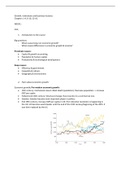
Growth, institutions and business lectures:
Chapters 1-4, 6-10, 12-16.
WEEK1:
CH1;
1. Introduction to the course:
Big questions:
- What causes long-run economic growth?
- What causes differences in economic growth & income?
Proximate causes:
• Capital & growth accounting.
• Population & human capital.
• Productivity & technological development.
Deep causes:
• Efficiency & government.
• Inequality & culture.
• Geography & environment.
2. Facts about economic growth:
Economic growth; Pre-modern economic growth:
• 15th century: mechanical reason. Black death (pandemic). Decrease population -> increase
GDP per capita.
• Holland end 16th century: Structural change. Rural country to a commercial one.
• Sweden: Sweden became most important player in politics.
• End 19th century: increase GDP per capita in UK: first industrial revolution is happening in
the UK. UK becomes world leader until the end of the 19th century/beginning of the 20th. It
was then replaced by the US.
,Facts; Economic growth; The very long-run:
Facts; Economic growth; the end of economic growth?
Optimistic view:
• US growth expected at 2 percent per year.
Facts; Economic growth; the end of economic growth? Pessimist view:
• Growth rate of economic leader.
,Facts; Economic growth; The doubling times:
facts; Economic growth; GDP per capita, 1870-2016:
• Not only western, also other parts of the world.
, Facts; Economic growth; GDP per capita, 1800-2000:
• Growing trend for almost every country.
• Slope of the line is different for every country.
Facts; Economic growth; GDP per capita, 1880-2000:
Facts; Economic growth; GDP per worker, 1960-2000:
• Your position didn’t really
change over time.
• If you were rich in the past, you
still rich.
• If you were poor, you didn’t
really improve over time.
Chapters 1-4, 6-10, 12-16.
WEEK1:
CH1;
1. Introduction to the course:
Big questions:
- What causes long-run economic growth?
- What causes differences in economic growth & income?
Proximate causes:
• Capital & growth accounting.
• Population & human capital.
• Productivity & technological development.
Deep causes:
• Efficiency & government.
• Inequality & culture.
• Geography & environment.
2. Facts about economic growth:
Economic growth; Pre-modern economic growth:
• 15th century: mechanical reason. Black death (pandemic). Decrease population -> increase
GDP per capita.
• Holland end 16th century: Structural change. Rural country to a commercial one.
• Sweden: Sweden became most important player in politics.
• End 19th century: increase GDP per capita in UK: first industrial revolution is happening in
the UK. UK becomes world leader until the end of the 19th century/beginning of the 20th. It
was then replaced by the US.
,Facts; Economic growth; The very long-run:
Facts; Economic growth; the end of economic growth?
Optimistic view:
• US growth expected at 2 percent per year.
Facts; Economic growth; the end of economic growth? Pessimist view:
• Growth rate of economic leader.
,Facts; Economic growth; The doubling times:
facts; Economic growth; GDP per capita, 1870-2016:
• Not only western, also other parts of the world.
, Facts; Economic growth; GDP per capita, 1800-2000:
• Growing trend for almost every country.
• Slope of the line is different for every country.
Facts; Economic growth; GDP per capita, 1880-2000:
Facts; Economic growth; GDP per worker, 1960-2000:
• Your position didn’t really
change over time.
• If you were rich in the past, you
still rich.
• If you were poor, you didn’t
really improve over time.



