

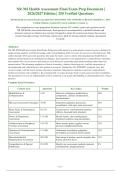
NR 302 Health Assessment Final Exam Prep Document |
2026/2027 Edition | 250 Verified Questions
NR 302 Health Assessment Final Exam 2026-2027 QUESTIONS AND ANSWERS ALREADY GRADED A+. 100%
Verified Solutions | Updated Per Latest Guidelines | Graded A+
This comprehensive exam preparation document contains 250 verified, exam-style questions for the
NR 302 Health Assessment final exam. Each question is accompanied by a detailed rationale and
distractor analysis to reinforce key concepts. Designed to mirror the actual exam format, this resource
ensures thorough coverage of all major content areas. Ideal for nursing students seeking a guaranteed
A+ grade.
Abstract:
The NR 302 Health Assessment Final Exam Preparation Document is a meticulously curated resource designed to
equip nursing students with the knowledge and critical thinking skills necessary for success on the final exam. This
edition includes 250 exam-style questions that span the entire course content, from foundational health history
taking to advanced physical examination techniques. Each question is accompanied by a comprehensive rationale
that explains the correct answer and analyzes each distractor, promoting deep understanding rather than rote
memorization. The document emphasizes clinical reasoning, evidence-based practice, and the integration of
developmental and cultural factors into patient assessment. Updated for the 2026/2027 academic year, this
resource aligns with the latest nursing education standards and prepares students to perform comprehensive
health assessments with confidence. By systematically covering all major body systems and assessment modalities,
this document serves as an indispensable tool for achieving a top grade and building a solid foundation for clinical
practice.
Content Area Overview:
Content Area Questions Key Topics Weight
Health History & 1-40 Interview techniques, health history 16%
Communication components, cultural considerations,
documentation
Physical Assessment Techniques 41-80 Inspection, palpation, percussion, 16%
auscultation, vital signs, pain assessment
Head, Neck, & Neurological 81-110 Cranial nerves, sensory/motor function, 12%
Assessment reflexes, head and neck structures
Thorax & Respiratory 111-140 Breath sounds, chest configuration, 12%
Assessment respiratory patterns, lung auscultation
Cardiovascular & Peripheral 141-170 Heart sounds, pulses, jugular venous 12%
Vascular Assessment pressure, peripheral perfusion
Abdomen & Gastrointestinal 171-200 Abdominal auscultation, palpation, 12%
Assessment liver/spleen assessment, bowel sounds
Musculoskeletal & 201-230 Joint range of motion, muscle strength, skin 12%
Integumentary Assessment lesions, pressure ulcers
Comprehensive & Special 231-250 Head-to-toe assessment, pediatric/geriatric 8%
Populations considerations, pregnant patient
Page 1
,Q1. A patient with chronic systolic heart failure presents with dyspnea and a third heart sound (S3).
Which pathophysiological mechanism primarily underlies the S3?
A. Rapid ventricular filling during early diastole due to reduced compliance
B. Atrial contraction against a stiff ventricle in late diastole
C. Turbulent blood flow across a narrowed mitral valve during systole
D. Ventricular gallop caused by increased afterload and ventricular hypertrophy
Correct Answer: A. Rapid ventricular filling during early diastole due to reduced compliance
Rationale: S3 is generated by rapid deceleration of blood entering a noncompliant ventricle during early
diastole, often due to volume overload or dilated cardiomyopathy. Option B describes S4 (atrial kick).
Options C and D are not associated with S3; mitral stenosis causes a diastolic murmur, and increased
afterload may produce S4.
Why Wrong:
B - Atrial contraction against a stiff ventricle produces S4, not S3.
C - Turbulent flow across a narrowed mitral valve causes a diastolic murmur, not S3.
D - Increased afterload and hypertrophy more commonly generate S4, not S3.
Reference: Bickley, L.S. (2026). Bates' Guide to Physical Examination and History Taking, 14th Ed., Ch.
9.
Q2. During a respiratory assessment, you note that a patient's trachea is deviated to the left. Which
condition is most likely responsible?
A. Right-sided tension pneumothorax
B. Left-sided pleural effusion
C. Right lower lobe pneumonia with consolidation
D. Left-sided atelectasis
Correct Answer: A. Right-sided tension pneumothorax
Rationale: Tracheal deviation away from the affected side indicates a space-occupying process such as
tension pneumothorax or large pleural effusion. In tension pneumothorax, air accumulates in the pleural
space, pushing the trachea to the opposite side. Option B (left pleural effusion) would shift trachea to the
right. Option C (right pneumonia) typically does not cause tracheal deviation. Option D (left atelectasis)
would pull trachea toward the left.
Why Wrong:
B - Left pleural effusion would shift the trachea to the right, not left.
C - Consolidation from pneumonia does not typically cause tracheal deviation.
D - Left atelectasis would pull the trachea toward the left, not push it away.
Reference: Bickley, L.S. (2026). Bates' Guide to Physical Examination and History Taking, 14th Ed., Ch.
14.
Page 2
,Q3. Which of the following findings is most indicative of chronic arterial insufficiency in the lower
extremities?
A. Dependent rubor and pallor on elevation
B. Brawny edema and stasis dermatitis
C. Palpable dorsalis pedis pulses bilaterally
D. Warm, erythematous skin with weeping ulcers
Correct Answer: A. Dependent rubor and pallor on elevation
Rationale: Chronic arterial insufficiency leads to pale skin on elevation (due to gravity-dependent
reduction in blood flow) and dependent rubor (reactive hyperemia when lowered). Brawny edema and
stasis dermatitis (B) are venous insufficiency findings. Palpable pulses (C) are normal and argue against
arterial disease. Warm erythematous skin with weeping ulcers (D) suggests venous stasis ulcers.
Why Wrong:
B - Brawny edema and stasis dermatitis are characteristic of chronic venous insufficiency.
C - Palpable dorsalis pedis pulses indicate adequate arterial flow, ruling out significant arterial
insufficiency.
D - Warm erythematous skin with weeping ulcers is typical of venous stasis ulcers, not arterial
insufficiency.
Reference: Jarvis, C. (2026). Physical Examination and Health Assessment, 9th Ed., Ch. 20.
Q4. A patient presents with a blood pressure of 148/92 mm Hg in the right arm and 132/86 mm Hg
in the left arm. Which of the following is the most appropriate next step?
A. Repeat measurements in both arms after 5 minutes of rest
B. Diagnose hypertension and initiate antihypertensive therapy
C. Consider subclavian artery stenosis or aortic dissection
D. Record the higher reading and proceed with routine care
Correct Answer: A. Repeat measurements in both arms after 5 minutes of rest
Rationale: A difference of >10 mm Hg between arms requires confirmation after rest to rule out
measurement error. If persistent, it may indicate subclavian stenosis or aortic pathology, but immediate
diagnosis or therapy is premature. Option A is the standard first step per AHA guidelines.
Why Wrong:
B - Diagnosis of hypertension requires multiple elevated readings over time and consistent
technique.
C - This is a possible cause, but confirmation of the discrepancy is needed first.
D - Recording the higher reading is appropriate only after confirming the difference is reproducible.
Reference: Whelton, P.K. et al. (2025). 2025 ACC/AHA Guideline for the Prevention and Management of
Hypertension.
Page 3
, Q5. Which of the following cranial nerve assessments is correctly paired with its function?
A. CN VIII - Tested by Weber and Rinne tuning fork tests for hearing and balance
B. CN V - Assessed by having the patient shrug shoulders against resistance
C. CN IX - Evaluated by checking pupillary light reflex and accommodation
D. CN XI - Tested by asking the patient to protrude the tongue and move it side to side
Correct Answer: A. CN VIII - Tested by Weber and Rinne tuning fork tests for hearing and balance
Rationale: CN VIII (vestibulocochlear) is assessed with Weber and Rinne tests for hearing and balance.
CN V (trigeminal) is motor for chewing and sensory for face, not shoulder shrug (that's CN XI). CN IX
(glossopharyngeal) is tested by gag reflex and swallowing, not pupillary reflex (CN II/III). CN XI
(accessory) is tested by shoulder shrug and head rotation, not tongue movement (CN XII).
Why Wrong:
B - Shoulder shrug tests CN XI (accessory), not CN V.
C - Pupillary light reflex tests CN II and III, not CN IX.
D - Tongue protrusion tests CN XII (hypoglossal), not CN XI.
Reference: Bickley, L.S. (2026). Bates' Guide to Physical Examination and History Taking, 14th Ed., Ch.
16.
Q6. A patient with known cirrhosis presents with distended abdomen, shifting dullness, and a
positive fluid wave. Which of the following best explains the mechanism of these findings?
A. Decreased oncotic pressure due to hypoalbuminemia leading to transudative ascites
B. Increased hydrostatic pressure from portal hypertension alone
C. Exudative ascites from peritoneal inflammation due to bacterial translocation
D. Lymphatic obstruction causing chylous ascites with milky appearance
Correct Answer: A. Decreased oncotic pressure due to hypoalbuminemia leading to transudative
ascites
Rationale: In cirrhosis, hypoalbuminemia reduces plasma oncotic pressure, favoring fluid shift into the
peritoneal cavity, often with portal hypertension contributing. The combination produces transudative
ascites. Option B is incomplete; portal hypertension alone is not the sole cause. Option C describes
exudative ascites (e.g., peritonitis). Option D describes chylous ascites from lymphatic obstruction.
Why Wrong:
B - Portal hypertension contributes but decreased oncotic pressure is a key additional factor.
C - Exudative ascites is typical of inflammatory processes, not uncomplicated cirrhosis.
D - Chylous ascites is milky and due to lymphatic obstruction, not typical in cirrhosis.
Reference: Sorensen, K. (2026). Pathophysiology: The Biologic Basis for Disease in Adults and Children,
9th Ed., Ch. 42.
Page 4
2026/2027 Edition | 250 Verified Questions
NR 302 Health Assessment Final Exam 2026-2027 QUESTIONS AND ANSWERS ALREADY GRADED A+. 100%
Verified Solutions | Updated Per Latest Guidelines | Graded A+
This comprehensive exam preparation document contains 250 verified, exam-style questions for the
NR 302 Health Assessment final exam. Each question is accompanied by a detailed rationale and
distractor analysis to reinforce key concepts. Designed to mirror the actual exam format, this resource
ensures thorough coverage of all major content areas. Ideal for nursing students seeking a guaranteed
A+ grade.
Abstract:
The NR 302 Health Assessment Final Exam Preparation Document is a meticulously curated resource designed to
equip nursing students with the knowledge and critical thinking skills necessary for success on the final exam. This
edition includes 250 exam-style questions that span the entire course content, from foundational health history
taking to advanced physical examination techniques. Each question is accompanied by a comprehensive rationale
that explains the correct answer and analyzes each distractor, promoting deep understanding rather than rote
memorization. The document emphasizes clinical reasoning, evidence-based practice, and the integration of
developmental and cultural factors into patient assessment. Updated for the 2026/2027 academic year, this
resource aligns with the latest nursing education standards and prepares students to perform comprehensive
health assessments with confidence. By systematically covering all major body systems and assessment modalities,
this document serves as an indispensable tool for achieving a top grade and building a solid foundation for clinical
practice.
Content Area Overview:
Content Area Questions Key Topics Weight
Health History & 1-40 Interview techniques, health history 16%
Communication components, cultural considerations,
documentation
Physical Assessment Techniques 41-80 Inspection, palpation, percussion, 16%
auscultation, vital signs, pain assessment
Head, Neck, & Neurological 81-110 Cranial nerves, sensory/motor function, 12%
Assessment reflexes, head and neck structures
Thorax & Respiratory 111-140 Breath sounds, chest configuration, 12%
Assessment respiratory patterns, lung auscultation
Cardiovascular & Peripheral 141-170 Heart sounds, pulses, jugular venous 12%
Vascular Assessment pressure, peripheral perfusion
Abdomen & Gastrointestinal 171-200 Abdominal auscultation, palpation, 12%
Assessment liver/spleen assessment, bowel sounds
Musculoskeletal & 201-230 Joint range of motion, muscle strength, skin 12%
Integumentary Assessment lesions, pressure ulcers
Comprehensive & Special 231-250 Head-to-toe assessment, pediatric/geriatric 8%
Populations considerations, pregnant patient
Page 1
,Q1. A patient with chronic systolic heart failure presents with dyspnea and a third heart sound (S3).
Which pathophysiological mechanism primarily underlies the S3?
A. Rapid ventricular filling during early diastole due to reduced compliance
B. Atrial contraction against a stiff ventricle in late diastole
C. Turbulent blood flow across a narrowed mitral valve during systole
D. Ventricular gallop caused by increased afterload and ventricular hypertrophy
Correct Answer: A. Rapid ventricular filling during early diastole due to reduced compliance
Rationale: S3 is generated by rapid deceleration of blood entering a noncompliant ventricle during early
diastole, often due to volume overload or dilated cardiomyopathy. Option B describes S4 (atrial kick).
Options C and D are not associated with S3; mitral stenosis causes a diastolic murmur, and increased
afterload may produce S4.
Why Wrong:
B - Atrial contraction against a stiff ventricle produces S4, not S3.
C - Turbulent flow across a narrowed mitral valve causes a diastolic murmur, not S3.
D - Increased afterload and hypertrophy more commonly generate S4, not S3.
Reference: Bickley, L.S. (2026). Bates' Guide to Physical Examination and History Taking, 14th Ed., Ch.
9.
Q2. During a respiratory assessment, you note that a patient's trachea is deviated to the left. Which
condition is most likely responsible?
A. Right-sided tension pneumothorax
B. Left-sided pleural effusion
C. Right lower lobe pneumonia with consolidation
D. Left-sided atelectasis
Correct Answer: A. Right-sided tension pneumothorax
Rationale: Tracheal deviation away from the affected side indicates a space-occupying process such as
tension pneumothorax or large pleural effusion. In tension pneumothorax, air accumulates in the pleural
space, pushing the trachea to the opposite side. Option B (left pleural effusion) would shift trachea to the
right. Option C (right pneumonia) typically does not cause tracheal deviation. Option D (left atelectasis)
would pull trachea toward the left.
Why Wrong:
B - Left pleural effusion would shift the trachea to the right, not left.
C - Consolidation from pneumonia does not typically cause tracheal deviation.
D - Left atelectasis would pull the trachea toward the left, not push it away.
Reference: Bickley, L.S. (2026). Bates' Guide to Physical Examination and History Taking, 14th Ed., Ch.
14.
Page 2
,Q3. Which of the following findings is most indicative of chronic arterial insufficiency in the lower
extremities?
A. Dependent rubor and pallor on elevation
B. Brawny edema and stasis dermatitis
C. Palpable dorsalis pedis pulses bilaterally
D. Warm, erythematous skin with weeping ulcers
Correct Answer: A. Dependent rubor and pallor on elevation
Rationale: Chronic arterial insufficiency leads to pale skin on elevation (due to gravity-dependent
reduction in blood flow) and dependent rubor (reactive hyperemia when lowered). Brawny edema and
stasis dermatitis (B) are venous insufficiency findings. Palpable pulses (C) are normal and argue against
arterial disease. Warm erythematous skin with weeping ulcers (D) suggests venous stasis ulcers.
Why Wrong:
B - Brawny edema and stasis dermatitis are characteristic of chronic venous insufficiency.
C - Palpable dorsalis pedis pulses indicate adequate arterial flow, ruling out significant arterial
insufficiency.
D - Warm erythematous skin with weeping ulcers is typical of venous stasis ulcers, not arterial
insufficiency.
Reference: Jarvis, C. (2026). Physical Examination and Health Assessment, 9th Ed., Ch. 20.
Q4. A patient presents with a blood pressure of 148/92 mm Hg in the right arm and 132/86 mm Hg
in the left arm. Which of the following is the most appropriate next step?
A. Repeat measurements in both arms after 5 minutes of rest
B. Diagnose hypertension and initiate antihypertensive therapy
C. Consider subclavian artery stenosis or aortic dissection
D. Record the higher reading and proceed with routine care
Correct Answer: A. Repeat measurements in both arms after 5 minutes of rest
Rationale: A difference of >10 mm Hg between arms requires confirmation after rest to rule out
measurement error. If persistent, it may indicate subclavian stenosis or aortic pathology, but immediate
diagnosis or therapy is premature. Option A is the standard first step per AHA guidelines.
Why Wrong:
B - Diagnosis of hypertension requires multiple elevated readings over time and consistent
technique.
C - This is a possible cause, but confirmation of the discrepancy is needed first.
D - Recording the higher reading is appropriate only after confirming the difference is reproducible.
Reference: Whelton, P.K. et al. (2025). 2025 ACC/AHA Guideline for the Prevention and Management of
Hypertension.
Page 3
, Q5. Which of the following cranial nerve assessments is correctly paired with its function?
A. CN VIII - Tested by Weber and Rinne tuning fork tests for hearing and balance
B. CN V - Assessed by having the patient shrug shoulders against resistance
C. CN IX - Evaluated by checking pupillary light reflex and accommodation
D. CN XI - Tested by asking the patient to protrude the tongue and move it side to side
Correct Answer: A. CN VIII - Tested by Weber and Rinne tuning fork tests for hearing and balance
Rationale: CN VIII (vestibulocochlear) is assessed with Weber and Rinne tests for hearing and balance.
CN V (trigeminal) is motor for chewing and sensory for face, not shoulder shrug (that's CN XI). CN IX
(glossopharyngeal) is tested by gag reflex and swallowing, not pupillary reflex (CN II/III). CN XI
(accessory) is tested by shoulder shrug and head rotation, not tongue movement (CN XII).
Why Wrong:
B - Shoulder shrug tests CN XI (accessory), not CN V.
C - Pupillary light reflex tests CN II and III, not CN IX.
D - Tongue protrusion tests CN XII (hypoglossal), not CN XI.
Reference: Bickley, L.S. (2026). Bates' Guide to Physical Examination and History Taking, 14th Ed., Ch.
16.
Q6. A patient with known cirrhosis presents with distended abdomen, shifting dullness, and a
positive fluid wave. Which of the following best explains the mechanism of these findings?
A. Decreased oncotic pressure due to hypoalbuminemia leading to transudative ascites
B. Increased hydrostatic pressure from portal hypertension alone
C. Exudative ascites from peritoneal inflammation due to bacterial translocation
D. Lymphatic obstruction causing chylous ascites with milky appearance
Correct Answer: A. Decreased oncotic pressure due to hypoalbuminemia leading to transudative
ascites
Rationale: In cirrhosis, hypoalbuminemia reduces plasma oncotic pressure, favoring fluid shift into the
peritoneal cavity, often with portal hypertension contributing. The combination produces transudative
ascites. Option B is incomplete; portal hypertension alone is not the sole cause. Option C describes
exudative ascites (e.g., peritonitis). Option D describes chylous ascites from lymphatic obstruction.
Why Wrong:
B - Portal hypertension contributes but decreased oncotic pressure is a key additional factor.
C - Exudative ascites is typical of inflammatory processes, not uncomplicated cirrhosis.
D - Chylous ascites is milky and due to lymphatic obstruction, not typical in cirrhosis.
Reference: Sorensen, K. (2026). Pathophysiology: The Biologic Basis for Disease in Adults and Children,
9th Ed., Ch. 42.
Page 4


