

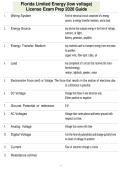
Florida Limited Energy (low voltage)
License Exam Prep 2026 Guide
1. Wiring System Form of electrical circuit comprised of a energy
source, a energy transfer medium, and a load.
2. Energy Source Any device that outputs energy in the form of voltage,
current, or light.
Battery, generator, amplifier
3. Energy Transfer Medium Any material used to transport energy from one place
to another.
copper wire, fiber-optic cable, air
4. Load Any component of a circuit that receives the trans-
ferred energy.
resister, lightbulb, speaker, motor
5. Electromotive Force (emf) or Volatge The force that results in the motion of electrons due
to a ditterence in potential
6. DC Voltage Voltage that flows in one direction only.
Either positive or negative
7. Ground Potential or reference 0V
8. AC Voltages Voltage that varies above and below ground with
respect to time.
9. Analog Voltage Voltage that varies with time
10. Digital Voltage Is in the form of pulses(bits) and change quickly from
on level of voltage to another
11. Current Flow of electrons through a circuit
12. Resistance (ohms)
, Florida Limited Energy (low voltage)
License Exam Prep 2026 Guide
Limited the number of electrons and the amount of
energy transferred
13. Ohms Law I=E/R
I=amps
E=volts
R=resistance(ohms(
14. Power (watts) w Time rate of doing work in an electrical circuit.
15. Noise Unwanted signal in system
16. SNR(Signal-to-Noise Signal Power/Noise Power
17. Inductance(L) The property of a circuit that causes an opposition to
any change of current within a circuit.
18. Counterelectromotive Force(CEMF) Voltage induced by a magnetic field in a inductor that
opposes current flow in a circuit
19. Reactance(X)I Inductor's reaction to a change in current
20. Henry(H) Unit of Inductance
21. Cross Talk Introduction of signals between conductors in close
proximity to each other
22. Capacitor Formed when two metals are separated by an insu-
lator
Have the ability to store energy in the form of elec-
trostatic charge
23. Capacitive Reactance The opposition to a change in voltage
24. Impedance(Z)
, The total opposition to the flow of electrical energy
in a circuit, which is a combination of resistance,
inductance, and capacitance
25. Baud Rate rate at which digital pulses are transmitted(bits per
second)
26. Rise Time 10% to 90%
27. Fall Time 90% to 10%
28. Earth Ground System Reference for all grounds within a building
29. Insulation Non-conductive material that encases wire or cable
30. Near-End Cross Talk Interference where the interfering signal is traveling
in the opposite direction to the desired signal
31. Far-End Cross Talk Coupling of received signals on the received signals
of an adjacent pair
32. Modulation The process of modifying the a carrier frequency in
rhythm to the audio frequency.
33. 3 Forms of modulation Amplitude Modulation
Frequency Modulation
Phase Modulation
34. Light Pipe When a transparent material such as glass or plastic
is coated with a less light conductive material.
35. Critical Angle The angle at which light will not be reflected from a
surface
36. Parts of fiber optic cable
, glass core
glass cladding
protective silicone coating
butter jacket
strength member
outer jacket
37. Refraction Index The angle at which light is reflected from the walls of
the fiber
38. Mode How the light is propagated(transmitted) through
the fiber
39. Fiber Bandwidth information-carrying capacity of the fiber. measured
in Megahertz per kilometer(MHz/km)
40. National Electrical Code(NEC) A set of guideline issued by the NFPA(National Fire
Protection Association) that minimize the hazards of
electrical shock, explosions, and fire caused by elec-
trical wiring
41. Network Topology The basic design or configuration of an information
network that works together as a unit
42. Communication Links The connections between devices, such as, phone
lines, private lines, fiber-optic cables, coaxial cables,
and so on
43. Local Area Network A system confined to a specific area, that allows all the
computer hardware and software to work together
44. Point-to-point Topology Data communication takes place between two de-
vices that are directly connected to each other
License Exam Prep 2026 Guide
1. Wiring System Form of electrical circuit comprised of a energy
source, a energy transfer medium, and a load.
2. Energy Source Any device that outputs energy in the form of voltage,
current, or light.
Battery, generator, amplifier
3. Energy Transfer Medium Any material used to transport energy from one place
to another.
copper wire, fiber-optic cable, air
4. Load Any component of a circuit that receives the trans-
ferred energy.
resister, lightbulb, speaker, motor
5. Electromotive Force (emf) or Volatge The force that results in the motion of electrons due
to a ditterence in potential
6. DC Voltage Voltage that flows in one direction only.
Either positive or negative
7. Ground Potential or reference 0V
8. AC Voltages Voltage that varies above and below ground with
respect to time.
9. Analog Voltage Voltage that varies with time
10. Digital Voltage Is in the form of pulses(bits) and change quickly from
on level of voltage to another
11. Current Flow of electrons through a circuit
12. Resistance (ohms)
, Florida Limited Energy (low voltage)
License Exam Prep 2026 Guide
Limited the number of electrons and the amount of
energy transferred
13. Ohms Law I=E/R
I=amps
E=volts
R=resistance(ohms(
14. Power (watts) w Time rate of doing work in an electrical circuit.
15. Noise Unwanted signal in system
16. SNR(Signal-to-Noise Signal Power/Noise Power
17. Inductance(L) The property of a circuit that causes an opposition to
any change of current within a circuit.
18. Counterelectromotive Force(CEMF) Voltage induced by a magnetic field in a inductor that
opposes current flow in a circuit
19. Reactance(X)I Inductor's reaction to a change in current
20. Henry(H) Unit of Inductance
21. Cross Talk Introduction of signals between conductors in close
proximity to each other
22. Capacitor Formed when two metals are separated by an insu-
lator
Have the ability to store energy in the form of elec-
trostatic charge
23. Capacitive Reactance The opposition to a change in voltage
24. Impedance(Z)
, The total opposition to the flow of electrical energy
in a circuit, which is a combination of resistance,
inductance, and capacitance
25. Baud Rate rate at which digital pulses are transmitted(bits per
second)
26. Rise Time 10% to 90%
27. Fall Time 90% to 10%
28. Earth Ground System Reference for all grounds within a building
29. Insulation Non-conductive material that encases wire or cable
30. Near-End Cross Talk Interference where the interfering signal is traveling
in the opposite direction to the desired signal
31. Far-End Cross Talk Coupling of received signals on the received signals
of an adjacent pair
32. Modulation The process of modifying the a carrier frequency in
rhythm to the audio frequency.
33. 3 Forms of modulation Amplitude Modulation
Frequency Modulation
Phase Modulation
34. Light Pipe When a transparent material such as glass or plastic
is coated with a less light conductive material.
35. Critical Angle The angle at which light will not be reflected from a
surface
36. Parts of fiber optic cable
, glass core
glass cladding
protective silicone coating
butter jacket
strength member
outer jacket
37. Refraction Index The angle at which light is reflected from the walls of
the fiber
38. Mode How the light is propagated(transmitted) through
the fiber
39. Fiber Bandwidth information-carrying capacity of the fiber. measured
in Megahertz per kilometer(MHz/km)
40. National Electrical Code(NEC) A set of guideline issued by the NFPA(National Fire
Protection Association) that minimize the hazards of
electrical shock, explosions, and fire caused by elec-
trical wiring
41. Network Topology The basic design or configuration of an information
network that works together as a unit
42. Communication Links The connections between devices, such as, phone
lines, private lines, fiber-optic cables, coaxial cables,
and so on
43. Local Area Network A system confined to a specific area, that allows all the
computer hardware and software to work together
44. Point-to-point Topology Data communication takes place between two de-
vices that are directly connected to each other


