

WGU D665 Learner Development and the Science of Learning
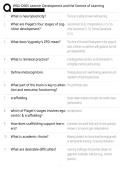
1. What is neuroplasticity? The brain's ability to rewire with learning.
2. What are Piaget's four stages of cog- Sensorimotor (0-2), Preoperational (2-7), Con-
nitive development? crete Operational (7-11), Formal Operational
(12+).
3. What does Vygotsky's ZPD mean? The Zone of Proximal Development is the range of
tasks a learner can perform with guidance but not
yet independently.
4. What is retrieval practice? A strategy where learners recall information to
strengthen memory and learning.
5. Define metacognition. Thinking about one's own thinking; awareness and
regulation of learning processes.
6. What part of the brain is key to atten- The prefrontal cortex.
tion and executive functioning?
7. scaffolding breaks down complex concepts into smaller steps
(preschoolers)
8. which of Piaget's stages involves ego- preoperational
centric & scaffolding?
9. How does scaffolding support learn- It provides structured help early on and gradually
ers? removes it as learners gain independence.
10. What is academic choice? Allowing students to choose how they engage with
or demonstrate learning, increasing motivation.
11. What are desirable difficulties? Learning challenges that promote deeper en-
gagement and better retention (e.g., retrieval
practice).
, WGU D665 Learner Development and the Science of Learning
12. Which learning strategy combines Dual coding.
text and visuals?
13. Name the brain structure that consol- Hippocampus.
idates memory.
14. What is the purpose of the Cognitive To improve retention by spreading learning over
learning strategy: spaced practice? time.
15. What does Erikson's "Industry vs. In- Developing a sense of competence in school-age
feriority" stage represent? children.
16. Why is feedback important for learn- It helps learners correct errors and reinforce accu-
ing? rate knowledge.
17. What instructional strategy supports Chunking information and using visuals to reduce
cognitive load theory? working memory strain.
18. The cerebrum is responsible for problem-solving & higher-level thinking
19. The prefrontal cortex is responsible decision-making, impulse control
for
20. The hippocampus is responsible for Memory formation
21. The cerebellum is responsible for Coordination, motor learning. ( ll in cerebellum like
two legs, foundation, supports coordination.)
22. The brain stem is responsible for regulation of essential body functions
1. What is neuroplasticity? The brain's ability to rewire with learning.
2. What are Piaget's four stages of cog- Sensorimotor (0-2), Preoperational (2-7), Con-
nitive development? crete Operational (7-11), Formal Operational
(12+).
3. What does Vygotsky's ZPD mean? The Zone of Proximal Development is the range of
tasks a learner can perform with guidance but not
yet independently.
4. What is retrieval practice? A strategy where learners recall information to
strengthen memory and learning.
5. Define metacognition. Thinking about one's own thinking; awareness and
regulation of learning processes.
6. What part of the brain is key to atten- The prefrontal cortex.
tion and executive functioning?
7. scaffolding breaks down complex concepts into smaller steps
(preschoolers)
8. which of Piaget's stages involves ego- preoperational
centric & scaffolding?
9. How does scaffolding support learn- It provides structured help early on and gradually
ers? removes it as learners gain independence.
10. What is academic choice? Allowing students to choose how they engage with
or demonstrate learning, increasing motivation.
11. What are desirable difficulties? Learning challenges that promote deeper en-
gagement and better retention (e.g., retrieval
practice).
, WGU D665 Learner Development and the Science of Learning
12. Which learning strategy combines Dual coding.
text and visuals?
13. Name the brain structure that consol- Hippocampus.
idates memory.
14. What is the purpose of the Cognitive To improve retention by spreading learning over
learning strategy: spaced practice? time.
15. What does Erikson's "Industry vs. In- Developing a sense of competence in school-age
feriority" stage represent? children.
16. Why is feedback important for learn- It helps learners correct errors and reinforce accu-
ing? rate knowledge.
17. What instructional strategy supports Chunking information and using visuals to reduce
cognitive load theory? working memory strain.
18. The cerebrum is responsible for problem-solving & higher-level thinking
19. The prefrontal cortex is responsible decision-making, impulse control
for
20. The hippocampus is responsible for Memory formation
21. The cerebellum is responsible for Coordination, motor learning. ( ll in cerebellum like
two legs, foundation, supports coordination.)
22. The brain stem is responsible for regulation of essential body functions


