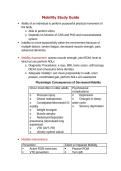
Mobility Study Guide
Ability of an individual to perform purposeful physical movement of
the body.
o Able to perform ADLs
o Depends on function of CNS and PNS and musculoskeletal
system
Inability to move purposefully within the environment because of
multiple factors: severe fatigue, decreased muscle strength, pain,
advanced dementia
Mobility Assessment: assess muscle strength, joint ROM, level at
which pt can perform ADLs
o Diagnostic Procedures: x-rays, MRI, bone scans, arthroscopy,
DEXA scan (measures bone density)
o Adequate mobility= can move purposefully to walk, erect
posture, coordinated gait, perform ADLs w/o assistance
Physiologic Consequences of Decreased Mobility
Occur most often in older adults Psychosocial
complications
o Pressure injury o Depression
o Disuse osteoporosis o Changes in sleep-
o Constipation/decreased GI wake cycle
motility o Sensory deprivation
o Weight loss/gain
o Muscle atrophy
o Atelectasis/hypostatic
pneumonia (decreased lung
expansion)
o VTE (DVT, PE)
o Urinary system calculi
Mobility Interventions:
Prevention Client w/ Impaired Mobility
Active ROM exercises Passive ROM
VTE prevention Turn q2h
, Evaluate needs: assistive Keep skin clean & dry
devices, PT/OT, encourage self- Encourage IS/cough &
care deep breathing exercises
Adequate hydration
Nutrition, prevent obesity
Promote elimination & slow
muscle loss
Prevent bone loss
PT/OT
s/s of complications
Fractures
Types of Fractures: closed vs open, complete vs incomplete,
displaced vs nondisplaced
Fracture healing process: fracture hematoma granulation
tissue Callus Formation Ossification Consolidation
Remodeling
Fractures Assessment: neurovascular checks, dx, hx
Potential problems: risk for infection, impaired mobility, pain,
impaired tissue perfusion
Complications: infection, VTE
o Compartment syndrome:
causes: casts, splints, excessive traction, bleeding,
inflammation, edema
Manifestations: 6 P’s: Pain, Pressure, Paresthesia,
Pallor, Paralysis, Pulses/Perfusion
o Fat Embolism:
Manifestations: s/s usually develop in 24-48 hrs;
Respiratory: chest pain, tachypnea, cyanosis,
dyspnea, apprehension, tachycardia,
hypoxemia, changes in mental status,
irritability
Decrease in PaO2, decreased platelet count
and hematocrit
, Petechiae on the neck, chest wall, axilla and
head
Pallor fat cells in urine, sputum or blood
Interventions: oxygen, notify MD, IV fluids and
steroids
Fractures Treatment:
o Traction:
Skeletal: aligns bones, joints and treats
contractures; long term
Skin: Buck’s Traction- relieves muscles spasms;
short term
o Casts: plaster, fiberglass.
To reduce swelling: elevate for the first 24-72 hrs
after applied, apply eyes wrapped in thin towel,
frequently move fingers or toes of injured limb
For itching: DON’T stick objects inside cast to itch,
hair dryer on cool setting, no powders, lotions or
deodorants.
WHEN TO NOTIFY MD??
o Arthroplasty: indications for surgery?
Assessments: incision drainage, circulation and
pain
Post-op nursing care: neurovascular assessment of
extremity, elevate to manage pain and edema, do
not turn the pt to the affected side, encourage use
of trapeze bar, exercise unaffected extremities,
PT/OT, elevated toilet seats and chairs, no soft
pillows in seats
Pt teaching: exercise all unaffected extremities,
limited weight bearing 6-12 weeks, proper use of
assistive devices, no tub bath or driving for 4-6
weeks, use grabbers or reachers to avoid bending
over, for 6 weeks knees apart- do not cross legs or
ankles, avoid low seating, no side lying position
Complications: dislocation, osteoarthritis, shortening
of affected leg, VTE (usually DVT) and fat embolism
Ability of an individual to perform purposeful physical movement of
the body.
o Able to perform ADLs
o Depends on function of CNS and PNS and musculoskeletal
system
Inability to move purposefully within the environment because of
multiple factors: severe fatigue, decreased muscle strength, pain,
advanced dementia
Mobility Assessment: assess muscle strength, joint ROM, level at
which pt can perform ADLs
o Diagnostic Procedures: x-rays, MRI, bone scans, arthroscopy,
DEXA scan (measures bone density)
o Adequate mobility= can move purposefully to walk, erect
posture, coordinated gait, perform ADLs w/o assistance
Physiologic Consequences of Decreased Mobility
Occur most often in older adults Psychosocial
complications
o Pressure injury o Depression
o Disuse osteoporosis o Changes in sleep-
o Constipation/decreased GI wake cycle
motility o Sensory deprivation
o Weight loss/gain
o Muscle atrophy
o Atelectasis/hypostatic
pneumonia (decreased lung
expansion)
o VTE (DVT, PE)
o Urinary system calculi
Mobility Interventions:
Prevention Client w/ Impaired Mobility
Active ROM exercises Passive ROM
VTE prevention Turn q2h
, Evaluate needs: assistive Keep skin clean & dry
devices, PT/OT, encourage self- Encourage IS/cough &
care deep breathing exercises
Adequate hydration
Nutrition, prevent obesity
Promote elimination & slow
muscle loss
Prevent bone loss
PT/OT
s/s of complications
Fractures
Types of Fractures: closed vs open, complete vs incomplete,
displaced vs nondisplaced
Fracture healing process: fracture hematoma granulation
tissue Callus Formation Ossification Consolidation
Remodeling
Fractures Assessment: neurovascular checks, dx, hx
Potential problems: risk for infection, impaired mobility, pain,
impaired tissue perfusion
Complications: infection, VTE
o Compartment syndrome:
causes: casts, splints, excessive traction, bleeding,
inflammation, edema
Manifestations: 6 P’s: Pain, Pressure, Paresthesia,
Pallor, Paralysis, Pulses/Perfusion
o Fat Embolism:
Manifestations: s/s usually develop in 24-48 hrs;
Respiratory: chest pain, tachypnea, cyanosis,
dyspnea, apprehension, tachycardia,
hypoxemia, changes in mental status,
irritability
Decrease in PaO2, decreased platelet count
and hematocrit
, Petechiae on the neck, chest wall, axilla and
head
Pallor fat cells in urine, sputum or blood
Interventions: oxygen, notify MD, IV fluids and
steroids
Fractures Treatment:
o Traction:
Skeletal: aligns bones, joints and treats
contractures; long term
Skin: Buck’s Traction- relieves muscles spasms;
short term
o Casts: plaster, fiberglass.
To reduce swelling: elevate for the first 24-72 hrs
after applied, apply eyes wrapped in thin towel,
frequently move fingers or toes of injured limb
For itching: DON’T stick objects inside cast to itch,
hair dryer on cool setting, no powders, lotions or
deodorants.
WHEN TO NOTIFY MD??
o Arthroplasty: indications for surgery?
Assessments: incision drainage, circulation and
pain
Post-op nursing care: neurovascular assessment of
extremity, elevate to manage pain and edema, do
not turn the pt to the affected side, encourage use
of trapeze bar, exercise unaffected extremities,
PT/OT, elevated toilet seats and chairs, no soft
pillows in seats
Pt teaching: exercise all unaffected extremities,
limited weight bearing 6-12 weeks, proper use of
assistive devices, no tub bath or driving for 4-6
weeks, use grabbers or reachers to avoid bending
over, for 6 weeks knees apart- do not cross legs or
ankles, avoid low seating, no side lying position
Complications: dislocation, osteoarthritis, shortening
of affected leg, VTE (usually DVT) and fat embolism