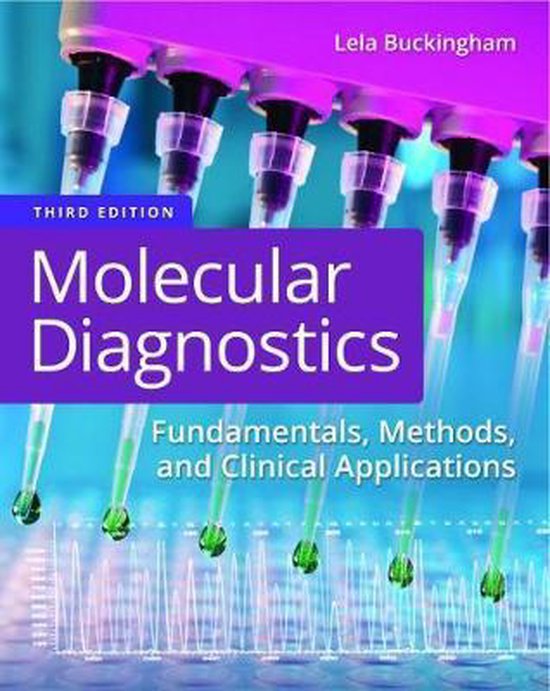
Test Bank - Molecular Diagnostics: Fundamentals, Methods, and Clinical Applications 3rd Edition (Buckingham, 2020)
TEST BANK
Molecular Diagnostics
Fundamentals, Methods, and Clinical Applications
Lela Buckingham
3rd Edition
, Test Bank - Molecular Diagnostics: Fundamentals, Methods, and Clinical Applications 3rd Edition (Buckingham, 2020)
Table of Contents
Section I: Fundamentals of Molecular Biology: An Overview
1 Nucleic Acids and Proteins
2 Gene Expression and Epigenetics
Section II: Common Techniques in Molecular Biology
3 Nucleic Acid Extraction Methods
4 Resolution and Detection of Nucleic Acids
5 Analysis and Characterization of Nucleic Acids and Proteins
6 Nucleic Acid Amplification
7 Chromosomal Structure and Chromosomal Mutations
8 Gene Mutations
9 DNA Sequencing
Section III: Techniques in the Clinical Laboratory
10 DNA Polymorphisms and Human Identification
11 Detection and Identification of Microorganisms
12 Molecular Detection of Inherited Diseases
13 Molecular Oncology
14 DNA-Based Tissue Typing
15 Quality Assurance and Quality Control in the Molecular Laboratory
, Test Bank - Molecular Diagnostics: Fundamentals, Methods, and Clinical Applications 3rd Edition (Buckingham, 2020)
Chapter 1: Nucleic Acids and Proteins
Multiple Choice
1. DNA contains deoxyribonucleotide triphosphates joined together by what type of
covalent bond?
A. Aldehyde
B. Ester
C. Phosphodiester
D. Peptide
ANS: C
2. Nucleotides in DNA consist of which of the following?
A. Nitrogen base, deoxyribose, and phosphate
B. Nitrogen base, ribose, and sulfur
C. Carbon base, ribose, and phosphate
D. Carbon base, glucose, and carboxyl
ANS: A
3. Which of the five ribose carbons of the deoxyribonucleotide are involved in the
formation of the DNA chain?
A. 1' and 5' B. 2' and 4' C. 3' and 4' D. 3' and 5'
ANS. D 3
4. In a DNA molecule, one end has a free hydroxyl group, and one end has a free
A. phosphate group. B. hydroxyl group. C. amino group.
Copyright © 2020
, Test Bank - Molecular Diagnostics: Fundamentals, Methods, and Clinical Applications 3rd Edition (Buckingham, 2020)
D. carboxyl group.
ANS: A
5. What type of bonds spontaneously form between two complementary strands of DNA?
A. Hydrogen bonds
B. Covalent bonds
C. Phosphodiester bonds
D. Polar covalent bonds
ANS: C
6. In a double-stranded DNA molecule, base pairing between strands occurs between
A. a purine and a purine.
B. a pyrimidine and a pyrimidine.
C. a purine and a pyrimidine.
D. all types of nucleotide bases.
ANS: C
7. Which of the following is a purine? A. Thymine
B. Cytosine C. Adenine D. Alanine
ANS: C
8. Which DNA sequence is complementary to 5'GATTCTCAAAGGACT3'? A.
5'GATTCTCAAAGGACT3'
B. 3'GATTCTCAAAGGACT5' C. 3'CTAAGAGTTTCCTGA5' D. 5'CTAAGAGTTTCCTGA3'
ANS: C
Copyright © 2020
TEST BANK
Molecular Diagnostics
Fundamentals, Methods, and Clinical Applications
Lela Buckingham
3rd Edition
, Test Bank - Molecular Diagnostics: Fundamentals, Methods, and Clinical Applications 3rd Edition (Buckingham, 2020)
Table of Contents
Section I: Fundamentals of Molecular Biology: An Overview
1 Nucleic Acids and Proteins
2 Gene Expression and Epigenetics
Section II: Common Techniques in Molecular Biology
3 Nucleic Acid Extraction Methods
4 Resolution and Detection of Nucleic Acids
5 Analysis and Characterization of Nucleic Acids and Proteins
6 Nucleic Acid Amplification
7 Chromosomal Structure and Chromosomal Mutations
8 Gene Mutations
9 DNA Sequencing
Section III: Techniques in the Clinical Laboratory
10 DNA Polymorphisms and Human Identification
11 Detection and Identification of Microorganisms
12 Molecular Detection of Inherited Diseases
13 Molecular Oncology
14 DNA-Based Tissue Typing
15 Quality Assurance and Quality Control in the Molecular Laboratory
, Test Bank - Molecular Diagnostics: Fundamentals, Methods, and Clinical Applications 3rd Edition (Buckingham, 2020)
Chapter 1: Nucleic Acids and Proteins
Multiple Choice
1. DNA contains deoxyribonucleotide triphosphates joined together by what type of
covalent bond?
A. Aldehyde
B. Ester
C. Phosphodiester
D. Peptide
ANS: C
2. Nucleotides in DNA consist of which of the following?
A. Nitrogen base, deoxyribose, and phosphate
B. Nitrogen base, ribose, and sulfur
C. Carbon base, ribose, and phosphate
D. Carbon base, glucose, and carboxyl
ANS: A
3. Which of the five ribose carbons of the deoxyribonucleotide are involved in the
formation of the DNA chain?
A. 1' and 5' B. 2' and 4' C. 3' and 4' D. 3' and 5'
ANS. D 3
4. In a DNA molecule, one end has a free hydroxyl group, and one end has a free
A. phosphate group. B. hydroxyl group. C. amino group.
Copyright © 2020
, Test Bank - Molecular Diagnostics: Fundamentals, Methods, and Clinical Applications 3rd Edition (Buckingham, 2020)
D. carboxyl group.
ANS: A
5. What type of bonds spontaneously form between two complementary strands of DNA?
A. Hydrogen bonds
B. Covalent bonds
C. Phosphodiester bonds
D. Polar covalent bonds
ANS: C
6. In a double-stranded DNA molecule, base pairing between strands occurs between
A. a purine and a purine.
B. a pyrimidine and a pyrimidine.
C. a purine and a pyrimidine.
D. all types of nucleotide bases.
ANS: C
7. Which of the following is a purine? A. Thymine
B. Cytosine C. Adenine D. Alanine
ANS: C
8. Which DNA sequence is complementary to 5'GATTCTCAAAGGACT3'? A.
5'GATTCTCAAAGGACT3'
B. 3'GATTCTCAAAGGACT5' C. 3'CTAAGAGTTTCCTGA5' D. 5'CTAAGAGTTTCCTGA3'
ANS: C
Copyright © 2020