

NDEE Exam 5 - Review Questions and Answers with Complete
Solutions UPDATED!!!.
Correct
Incorrect
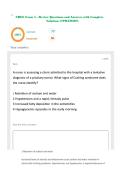
1 Retention of sodium and water
Increased levels of steroids and aldosterone cause sodium and water retention in
clients with Cushing syndrome. Hypertension, not hypotension, is expected because of
, sodium and water retention. The extremities will be thin; subcutaneous fat deposits
occur in the upper trunk, especially the back between the scapulae. Hyperglycemia, not
hypoglycemia, occurs because of
3 "Are you on lithium carbonate therapy?"increased secretion of glucocorticoids.
Hyperglycemia is sustained and not restricted to the morning hours.
Lithium carbonate is known to interfere with normal kidney response to antidiuretic
hormone. Therefore enquiring about lithium carbonate therapy can help assess for diabetes
insipidus, which has a clinical manifestation of frequent urination. Inquiry about history of
cancer helps in assessing syndrome of inappropriate antidiuretic hormone (SIADH) because
some cancer therapy drugs result in SIADH. Treatment with fluoroquinolone antibiotics also
can result in SIADH. Hodgkin's and NonHodgkin's lymphoma are causes of SIADH.
1 Oxytocin to promote uterine contractions
Oxytocin is a posterior pituitary hormone that acts on the uterus to stimulate uterine
contractions. Therefore the nurse should administer oxytocin to the client. Prolactin is an
anterior pituitary hormone that promotes breast milk production, not milk ejection.
Luteinizing hormone is an anterior pituitary hormone that stimulates progesterone secretion
and ovulation and does not promote painless labor. Follicle-stimulating hormone is secreted
by the anterior pituitary and is involved in estrogen secretion and follicle maturation.
3 Stress ulcer
An ulcer of the upper gastrointestinal tract is related to excessive secretion of stress-related
hormones, which increases hydrochloric acid production. Histamine H2 antagonists decrease
acid secretion. Colitis is not a complication of burns. Gastritis is not a complication of burns.
Metabolic acidosis is not a complication of burns unless hypermetabolism or renal failure
occurs; metabolic acidosis is not treated with H2 antagonists.
,
,
Solutions UPDATED!!!.
Correct
Incorrect
1 Retention of sodium and water
Increased levels of steroids and aldosterone cause sodium and water retention in
clients with Cushing syndrome. Hypertension, not hypotension, is expected because of
, sodium and water retention. The extremities will be thin; subcutaneous fat deposits
occur in the upper trunk, especially the back between the scapulae. Hyperglycemia, not
hypoglycemia, occurs because of
3 "Are you on lithium carbonate therapy?"increased secretion of glucocorticoids.
Hyperglycemia is sustained and not restricted to the morning hours.
Lithium carbonate is known to interfere with normal kidney response to antidiuretic
hormone. Therefore enquiring about lithium carbonate therapy can help assess for diabetes
insipidus, which has a clinical manifestation of frequent urination. Inquiry about history of
cancer helps in assessing syndrome of inappropriate antidiuretic hormone (SIADH) because
some cancer therapy drugs result in SIADH. Treatment with fluoroquinolone antibiotics also
can result in SIADH. Hodgkin's and NonHodgkin's lymphoma are causes of SIADH.
1 Oxytocin to promote uterine contractions
Oxytocin is a posterior pituitary hormone that acts on the uterus to stimulate uterine
contractions. Therefore the nurse should administer oxytocin to the client. Prolactin is an
anterior pituitary hormone that promotes breast milk production, not milk ejection.
Luteinizing hormone is an anterior pituitary hormone that stimulates progesterone secretion
and ovulation and does not promote painless labor. Follicle-stimulating hormone is secreted
by the anterior pituitary and is involved in estrogen secretion and follicle maturation.
3 Stress ulcer
An ulcer of the upper gastrointestinal tract is related to excessive secretion of stress-related
hormones, which increases hydrochloric acid production. Histamine H2 antagonists decrease
acid secretion. Colitis is not a complication of burns. Gastritis is not a complication of burns.
Metabolic acidosis is not a complication of burns unless hypermetabolism or renal failure
occurs; metabolic acidosis is not treated with H2 antagonists.
,
,


