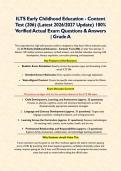
ILTS Early Childhood Education - Content
Test (206) (Latest 2026/2027 Update) 100%
Verified Actual Exam Questions & Answers
| Grade A
This comprehensive, high-yield practice toolkit is designed to help future Illinois educators pass
the ILTS Early Childhood Education - Content Test (206) on their first attempt. It
delivers 100 realistic practice questions, verified answers, and detailed rationales covering child
development, literacy acquisition, curriculum planning, and assessment.
Key Features of the Resource
• Realistic Exam Simulation: Exactly mirrors the question types and formatting of the
actual ILTS 206.
• Detailed Answer Rationales: Every question includes a thorough explanation
• State-Aligned Content: Covers the specific state competencies required for Illinois
educator licensure.
Exam Domains Covered
This practice set aligns with the four primary subareas of the ILTS 206 exam:
1. Child Development, Learning, and Assessment (approx. 25 questions):
Focuses on physical, cognitive, social, and emotional development, as well as
developmentally appropriate assessment strategies.
2. Language and Literacy Development (approx. 31 questions): Targets early
language acquisition, reading foundations, and writing processes.
3. Learning Across the Curriculum (approx. 31 questions): Reviews methodologies
for teaching math, science, social studies, health, and the arts.
4. Professional Relationships and Responsibilities (approx. 13 questions):
Explores family involvement, collaboration, and ethical/legal teaching standards.
Why Students should Value This
Future educators use this guide to test their readiness against the state's minimum passing
score of 240. By practicing with these targeted questions, candidates drastically reduce test
anxiety, improve pacing for the 3-hour and 30-minute time limit, and pinpoint the exact content
areas they need to review before taking the official exam.
,Q1. How do open-ended questions and statements during play benefit two- and
three-year-olds? [Multiple Choice]
A) determining children's aptitude levels and readiness for other activities
B) encouraging children's linguistic creativity and self-expression
C) fostering children's focus and self-confidence in their abilities
D) obtaining feedback from children with a variety of verbal and vocabulary abilities
Answer: encouraging children's linguistic creativity and self-expression
Explanation: Open-ended prompts invite children to use their own knowledge, feelings, and
language to generate responses, which supports expressive language and creative thinking. The
distractors describe other possible outcomes but not the main purpose: such prompts are not
primarily diagnostic for aptitude, not simply a way to gather feedback across levels, and while
they may help confidence, their core function is to elicit rich language and self-expression.
Q2. This family-professional conversation most clearly demonstrates which
reason for involving families in planning? [Multiple Choice]
A) parents are their children's first teachers and are experts about their own children
B) parents primarily provide materials from home to support classroom activities
C) family concerns should be deferred to specialists for planning
D) parents should be taught classroom strategies to follow at home
Answer: parents are their children's first teachers and are experts about their own
children
Explanation: The exchange shows the team's respect for the mother's insights and partnership in
planning, reflecting the principle that parents know their children best. The distractors misstate
the role: the goal is not merely to train parents in classroom strategies, nor to defer concerns
only to specialists, nor to treat parents primarily as material suppliers.
Q3. In the diagram, which option best matches the teacher's suggestion for
supporting a 15-month-old after a tornado? [Multiple Choice]
A) recommending that the mother discuss the events of the tornado
B) encouraging the mother to follow a predictable routine with her child and allow
him to stay close to her when he expresses the need
, C) reminding the mother that children are resilient and that her child will cope with the
events of the tornado as time passes
D) showing the mother ways to rebuild her child's independence by establishing regular
times for him to play independently
Answer: encouraging the mother to follow a predictable routine with her child and allow
him to stay close to her when he expresses the need
Explanation: After trauma, young children are best supported by consistent routines and the
opportunity for closeness and reassurance when distressed; these actions help restore safety and
predictability. The distractors are less appropriate: saying the child will simply be resilient
minimizes immediate needs; focusing on independent play too soon could undermine the child's
need for closeness; and while discussing events may be useful for older children, it is not the
primary immediate support described for this young child.
Q4. Which step is associated with developmentally appropriate practice (DAP)
for preschoolers? [Multiple Choice]
A) including a positive behavior system to promote children's socialization
B) introducing children to preliminary phonological and phonemic awareness activities
C) knowing what is individually appropriate for each child's interests and abilities
D) helping each child learn foundational counting and number sense concepts
Answer: knowing what is individually appropriate for each child's interests and abilities
Explanation: DAP emphasizes tailoring experiences to each child's individual interests and
abilities so instruction matches developmental needs. The other choices may be components of a
preschool program but are not the central DAP step: specific skills instruction or behavior systems
are not substitutes for knowing each child's unique profile.
Q5. Which classroom practice would best support preservation of children's
home languages? [Multiple Choice]
A) providing children with ample opportunities to socialize with other people who speak
their home language during each week
B) engaging children in storytelling activities that include vocabulary from their home
languages and reflect their home cultures
C) displaying family portraits and drawings of the children and their families with
captions underneath both in English and in children's home languages
D) ensuring that a translator is available for parents and children with a home language
other than English during parent-teacher conferences
, Answer: engaging children in storytelling activities that include vocabulary from their
home languages and reflect their home cultures
Explanation: Regular classroom activities that intentionally use home-language vocabulary and
cultural content reinforce and value children's home languages, supporting preservation. The
distractors are related but less effective for daily language preservation: having a translator
helps communication with families but doesn't sustain children's everyday language use; social
opportunities are helpful but not a structured classroom strategy; displaying captions is
supportive but less interactive than storytelling that actively uses the home language.
Q6. Why is a performance assessment especially valuable for measuring
students' reading comprehension? [Multiple Choice]
A) building on students' daily authentic work and projects to determine progress
B) providing standardized measures to facilitate comparison between students
C) highlighting students' strengths and reducing students' test anxiety
D) allowing for quick administration and results to students and teachers
Answer: building on students' daily authentic work and projects to determine progress
Explanation: Performance assessments evaluate students through real tasks and products that
mirror daily classroom work, giving insight into authentic application of skills. The distractors
describe other possible benefits of certain assessments but are not the central feature of
performance assessment: while they may reduce anxiety or show strengths, performance
assessments are not primarily about speed or standardized comparison.
Q7. According to Vygotsky's theories, how should a preschooler's self-directed
commentary while building a block house be described? [Multiple Choice]
A) demonstrating an understanding of only one's perspective
B) asserting control over the environment
C) initiating communication with others in order to seek assistance
D) thinking out loud in order to self-direct learning
Answer: thinking out loud in order to self-direct learning
Explanation: Vygotsky described private speech as children talking through tasks to guide their
own thinking and behavior; the child’s spoken choices are a form of self-directed problem solving.
The other options are wrong: 'demonstrating an understanding of only one's perspective'
describes egocentrism rather than self-guidance; 'asserting control over the environment'
misreads the speech as a power move rather than a cognitive strategy; and 'initiating
Test (206) (Latest 2026/2027 Update) 100%
Verified Actual Exam Questions & Answers
| Grade A
This comprehensive, high-yield practice toolkit is designed to help future Illinois educators pass
the ILTS Early Childhood Education - Content Test (206) on their first attempt. It
delivers 100 realistic practice questions, verified answers, and detailed rationales covering child
development, literacy acquisition, curriculum planning, and assessment.
Key Features of the Resource
• Realistic Exam Simulation: Exactly mirrors the question types and formatting of the
actual ILTS 206.
• Detailed Answer Rationales: Every question includes a thorough explanation
• State-Aligned Content: Covers the specific state competencies required for Illinois
educator licensure.
Exam Domains Covered
This practice set aligns with the four primary subareas of the ILTS 206 exam:
1. Child Development, Learning, and Assessment (approx. 25 questions):
Focuses on physical, cognitive, social, and emotional development, as well as
developmentally appropriate assessment strategies.
2. Language and Literacy Development (approx. 31 questions): Targets early
language acquisition, reading foundations, and writing processes.
3. Learning Across the Curriculum (approx. 31 questions): Reviews methodologies
for teaching math, science, social studies, health, and the arts.
4. Professional Relationships and Responsibilities (approx. 13 questions):
Explores family involvement, collaboration, and ethical/legal teaching standards.
Why Students should Value This
Future educators use this guide to test their readiness against the state's minimum passing
score of 240. By practicing with these targeted questions, candidates drastically reduce test
anxiety, improve pacing for the 3-hour and 30-minute time limit, and pinpoint the exact content
areas they need to review before taking the official exam.
,Q1. How do open-ended questions and statements during play benefit two- and
three-year-olds? [Multiple Choice]
A) determining children's aptitude levels and readiness for other activities
B) encouraging children's linguistic creativity and self-expression
C) fostering children's focus and self-confidence in their abilities
D) obtaining feedback from children with a variety of verbal and vocabulary abilities
Answer: encouraging children's linguistic creativity and self-expression
Explanation: Open-ended prompts invite children to use their own knowledge, feelings, and
language to generate responses, which supports expressive language and creative thinking. The
distractors describe other possible outcomes but not the main purpose: such prompts are not
primarily diagnostic for aptitude, not simply a way to gather feedback across levels, and while
they may help confidence, their core function is to elicit rich language and self-expression.
Q2. This family-professional conversation most clearly demonstrates which
reason for involving families in planning? [Multiple Choice]
A) parents are their children's first teachers and are experts about their own children
B) parents primarily provide materials from home to support classroom activities
C) family concerns should be deferred to specialists for planning
D) parents should be taught classroom strategies to follow at home
Answer: parents are their children's first teachers and are experts about their own
children
Explanation: The exchange shows the team's respect for the mother's insights and partnership in
planning, reflecting the principle that parents know their children best. The distractors misstate
the role: the goal is not merely to train parents in classroom strategies, nor to defer concerns
only to specialists, nor to treat parents primarily as material suppliers.
Q3. In the diagram, which option best matches the teacher's suggestion for
supporting a 15-month-old after a tornado? [Multiple Choice]
A) recommending that the mother discuss the events of the tornado
B) encouraging the mother to follow a predictable routine with her child and allow
him to stay close to her when he expresses the need
, C) reminding the mother that children are resilient and that her child will cope with the
events of the tornado as time passes
D) showing the mother ways to rebuild her child's independence by establishing regular
times for him to play independently
Answer: encouraging the mother to follow a predictable routine with her child and allow
him to stay close to her when he expresses the need
Explanation: After trauma, young children are best supported by consistent routines and the
opportunity for closeness and reassurance when distressed; these actions help restore safety and
predictability. The distractors are less appropriate: saying the child will simply be resilient
minimizes immediate needs; focusing on independent play too soon could undermine the child's
need for closeness; and while discussing events may be useful for older children, it is not the
primary immediate support described for this young child.
Q4. Which step is associated with developmentally appropriate practice (DAP)
for preschoolers? [Multiple Choice]
A) including a positive behavior system to promote children's socialization
B) introducing children to preliminary phonological and phonemic awareness activities
C) knowing what is individually appropriate for each child's interests and abilities
D) helping each child learn foundational counting and number sense concepts
Answer: knowing what is individually appropriate for each child's interests and abilities
Explanation: DAP emphasizes tailoring experiences to each child's individual interests and
abilities so instruction matches developmental needs. The other choices may be components of a
preschool program but are not the central DAP step: specific skills instruction or behavior systems
are not substitutes for knowing each child's unique profile.
Q5. Which classroom practice would best support preservation of children's
home languages? [Multiple Choice]
A) providing children with ample opportunities to socialize with other people who speak
their home language during each week
B) engaging children in storytelling activities that include vocabulary from their home
languages and reflect their home cultures
C) displaying family portraits and drawings of the children and their families with
captions underneath both in English and in children's home languages
D) ensuring that a translator is available for parents and children with a home language
other than English during parent-teacher conferences
, Answer: engaging children in storytelling activities that include vocabulary from their
home languages and reflect their home cultures
Explanation: Regular classroom activities that intentionally use home-language vocabulary and
cultural content reinforce and value children's home languages, supporting preservation. The
distractors are related but less effective for daily language preservation: having a translator
helps communication with families but doesn't sustain children's everyday language use; social
opportunities are helpful but not a structured classroom strategy; displaying captions is
supportive but less interactive than storytelling that actively uses the home language.
Q6. Why is a performance assessment especially valuable for measuring
students' reading comprehension? [Multiple Choice]
A) building on students' daily authentic work and projects to determine progress
B) providing standardized measures to facilitate comparison between students
C) highlighting students' strengths and reducing students' test anxiety
D) allowing for quick administration and results to students and teachers
Answer: building on students' daily authentic work and projects to determine progress
Explanation: Performance assessments evaluate students through real tasks and products that
mirror daily classroom work, giving insight into authentic application of skills. The distractors
describe other possible benefits of certain assessments but are not the central feature of
performance assessment: while they may reduce anxiety or show strengths, performance
assessments are not primarily about speed or standardized comparison.
Q7. According to Vygotsky's theories, how should a preschooler's self-directed
commentary while building a block house be described? [Multiple Choice]
A) demonstrating an understanding of only one's perspective
B) asserting control over the environment
C) initiating communication with others in order to seek assistance
D) thinking out loud in order to self-direct learning
Answer: thinking out loud in order to self-direct learning
Explanation: Vygotsky described private speech as children talking through tasks to guide their
own thinking and behavior; the child’s spoken choices are a form of self-directed problem solving.
The other options are wrong: 'demonstrating an understanding of only one's perspective'
describes egocentrism rather than self-guidance; 'asserting control over the environment'
misreads the speech as a power move rather than a cognitive strategy; and 'initiating