

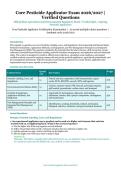
Core Pesticide Applicator Exam 2026/2027 |
Verified Questions
Official State Agricultural and Environmental Regulatory Board | Verified Q&A | Aspiring
Pesticide Applicators
Core Pesticide Applicator Certification Examination | 75 scored multiple-choice questions |
Academic cycle 2026/2027
Introduction
This original 75-question set covers Pesticide Labeling, Laws, and Regulations; Environmental and Human Safety;
Pesticide Formulations, Application Methods, and Equipment; and Pest Management Principles and Integrated
Pest Management (IPM). The questions emphasize the principle that the label is the law, drift prevention, proper
calibration, threshold-based decision-making, pesticide resistance management, and applicator and environmental
safety. The content is designed to reinforce official course objectives, strengthen exam readiness, and support
certified academic success for aspiring commercial and private pesticide applicators, agricultural professionals, and
pest management technicians. Federal concepts are presented in a general core-exam format; applicable state
requirements may be more specific or more protective.
Content Area Overview
Questi Weigh
Content Area Key Topics
ons t
Pesticide Labeling, Laws, and Federal and state registration, label interpretation, signal
15 20%
Regulations words, RUPs, REI/PHI, records, WPS, and legal use
Toxicity, exposure routes, PPE, first aid, poisoning response,
Environmental and Human Safety 19 25%
spill control, groundwater, surface water, and transport
Pesticide Formulations, Liquid and dry formulations, adjuvants, tank mixing,
Application Methods, and 19 calibration, nozzles, drift, sprayer components, chemigation, 25%
Equipment and maintenance
Pest Management Principles and
Identification, scouting, thresholds, cultural, mechanical,
Integrated Pest Management 22 30%
biological, selective, resistance, and post-treatment decisions
(IPM)
Actual Questions
Domain: Pesticide Labeling, Laws, and Regulations
1. An experienced applicator says a product can be used at a higher rate because that rate has
worked well on a neighboring farm. What is the correct response?
A. Use the higher rate if the crop appears severely infested.
B. Follow the product label exactly; customary practice does not authorize a higher rate.
C. Ask the customer to sign a waiver and then use the higher rate.
D. Mix the higher rate with extra water to make it legal.
Answer: B
Rationale: The label is a legally enforceable direction for use. An applicator may not substitute local custom
or a customer waiver for the labeled rate, site, method, or other restriction.
Core Pesticide Applicator Exam 2026/2027
,2. Why must a pesticide product generally have a current federal registration before it is
distributed or used?
A. Registration guarantees the product will eliminate every pest.
B. Registration removes the need for state oversight.
C. Registration evaluates the product and its proposed uses for regulatory compliance and risk.
D. Registration allows the applicator to ignore label precautions.
Answer: C
Rationale: Under federal pesticide law, registration is the regulatory process that authorizes a product and
its labeled uses after review of efficacy, risks, labeling, and required safeguards. Registration is not a
guarantee of complete pest control or zero risk.
3. Which statement best describes a restricted-use pesticide (RUP)?
A. It may be purchased and applied by anyone without training.
B. It may be used only on ornamental plants.
C. It is a pesticide that has no environmental hazard statement.
D. It may be applied only by a certified applicator or under the required direct supervision.
Answer: D
Rationale: An RUP is classified because its acute toxicity, chronic effects, environmental hazards, or other
risks require additional control. Purchase and use are limited to certified applicators or legally permitted
supervised applications.
4. A state regulation requires a longer record-retention period than the federal minimum. Which
requirement should the applicator follow?
A. The shorter requirement because federal law always overrides state law.
B. Neither requirement if the product is used on a farm.
C. The longer state requirement, because states may impose additional or more protective requirements.
D. Only the requirement printed in a retailer's advertisement.
Answer: C
Rationale: Federal pesticide law establishes a baseline, while states may add requirements or restrictions
that are more protective or specific to local conditions. Applicators must comply with the federal label and
applicable state rules.
5. Which label signal-word combination indicates the greatest acute toxicity category among the
choices?
A. CAUTION
B. WARNING
C. DANGER-POISON with the skull-and-crossbones symbol
D. NOTICE
Answer: C
Rationale: DANGER-POISON with the skull-and-crossbones symbol identifies products in the highest acute-
toxicity category. Signal words communicate relative acute hazard; they do not replace reading the complete
label.
6. A fruit-tree label specifies a 14-day preharvest interval (PHI). What does this interval mean?
A. Workers may not enter the orchard for 14 days.
B. The pesticide must be stored for 14 days before use.
C. The spray equipment must be cleaned every 14 days.
D. At least 14 days must pass between the final application and harvest.
Answer: D
Rationale: The PHI is the minimum time between the last application and harvest. It helps ensure residues on
food remain within established tolerances and is different from the restricted-entry interval.
7. What is the primary purpose of a restricted-entry interval (REI) on an agricultural pesticide
label?
A. To specify how long a pesticide remains effective against the pest.
B. To specify how long workers must stay out of a treated area unless a legal early-entry provision applies.
C. To identify how long a product can remain in a storage shed.
D. To tell the applicator when to recalibrate the sprayer.
Answer: B
Rationale: The REI protects agricultural workers from exposure after an application. Entry is prohibited
until the interval expires unless a specific Worker Protection Standard early-entry provision is met.
Core Pesticide Applicator Exam 2026/2027
, 8. On a pesticide label, the active ingredient statement primarily tells the applicator:
A. Which component is responsible for controlling the target pest and its concentration in the product.
B. How many acres the container will cover regardless of application rate.
C. Whether the product can be mixed with every other pesticide.
D. The exact weather conditions that will occur during application.
Answer: A
Rationale: The active ingredient statement identifies the pesticidal component and its concentration, often by
percentage or amount per unit weight or volume. The formulation and labeled rate determine how it is used.
9. A herbicide label lists corn and soybeans but does not list a neighboring vegetable crop. The
customer asks the applicator to treat the vegetables. What should the applicator do?
A. Apply the product at half rate to make the use legal.
B. Apply it only at night when residues are lower.
C. Do not apply it to the vegetables unless a legally applicable label or supplemental direction authorizes that use.
D. Apply it if the customer accepts responsibility for crop injury.
Answer: C
Rationale: Using a pesticide on a site not listed on the applicable label is not authorized merely because the
customer requests it or accepts liability. The labeled crop, site, rate, and method must support the
application.
10. Before applying a product with an endangered-species protection requirement, what is the
applicator's responsibility?
A. Ignore the requirement if no endangered species is visible that day.
B. Check and follow any required geographic bulletins, buffer zones, or application restrictions for the site.
C. Apply at twice the rate so fewer applications are needed.
D. Replace the required restriction with a customer's written permission.
Answer: B
Rationale: Endangered-species protections may be implemented through label directions, bulletins,
geographic restrictions, or buffers. Applicators must check the applicable information for the location and
follow it as part of lawful use.
11. Which set of information is most useful for a required restricted-use pesticide application
record?
A. Only the customer's name and the weather forecast.
B. Only the product brand name and the applicator's signature.
C. The product, EPA registration number, date, treated site or crop, amount used, and location as required.
D. Only the total number of gallons remaining in storage.
Answer: C
Rationale: RUP records must allow an application to be identified and reconstructed. Required elements
commonly include the product and registration number, date, site or crop, location, and quantity; state rules
may add details and retention periods.
12. Which activity is a core Worker Protection Standard responsibility for an agricultural employer
when applicable?
A. Allow untrained workers to handle pesticide containers if they wear gloves.
B. Provide required worker and handler training, notification, decontamination supplies, and information about
treated areas.
C. Remove all warning signs after the application is completed.
D. Permit workers to enter during the REI without following early-entry requirements.
Answer: B
Rationale: The Worker Protection Standard establishes protections for agricultural workers and pesticide
handlers, including training, hazard communication, decontamination, emergency information, and
restrictions around treated areas.
Core Pesticide Applicator Exam 2026/2027
Verified Questions
Official State Agricultural and Environmental Regulatory Board | Verified Q&A | Aspiring
Pesticide Applicators
Core Pesticide Applicator Certification Examination | 75 scored multiple-choice questions |
Academic cycle 2026/2027
Introduction
This original 75-question set covers Pesticide Labeling, Laws, and Regulations; Environmental and Human Safety;
Pesticide Formulations, Application Methods, and Equipment; and Pest Management Principles and Integrated
Pest Management (IPM). The questions emphasize the principle that the label is the law, drift prevention, proper
calibration, threshold-based decision-making, pesticide resistance management, and applicator and environmental
safety. The content is designed to reinforce official course objectives, strengthen exam readiness, and support
certified academic success for aspiring commercial and private pesticide applicators, agricultural professionals, and
pest management technicians. Federal concepts are presented in a general core-exam format; applicable state
requirements may be more specific or more protective.
Content Area Overview
Questi Weigh
Content Area Key Topics
ons t
Pesticide Labeling, Laws, and Federal and state registration, label interpretation, signal
15 20%
Regulations words, RUPs, REI/PHI, records, WPS, and legal use
Toxicity, exposure routes, PPE, first aid, poisoning response,
Environmental and Human Safety 19 25%
spill control, groundwater, surface water, and transport
Pesticide Formulations, Liquid and dry formulations, adjuvants, tank mixing,
Application Methods, and 19 calibration, nozzles, drift, sprayer components, chemigation, 25%
Equipment and maintenance
Pest Management Principles and
Identification, scouting, thresholds, cultural, mechanical,
Integrated Pest Management 22 30%
biological, selective, resistance, and post-treatment decisions
(IPM)
Actual Questions
Domain: Pesticide Labeling, Laws, and Regulations
1. An experienced applicator says a product can be used at a higher rate because that rate has
worked well on a neighboring farm. What is the correct response?
A. Use the higher rate if the crop appears severely infested.
B. Follow the product label exactly; customary practice does not authorize a higher rate.
C. Ask the customer to sign a waiver and then use the higher rate.
D. Mix the higher rate with extra water to make it legal.
Answer: B
Rationale: The label is a legally enforceable direction for use. An applicator may not substitute local custom
or a customer waiver for the labeled rate, site, method, or other restriction.
Core Pesticide Applicator Exam 2026/2027
,2. Why must a pesticide product generally have a current federal registration before it is
distributed or used?
A. Registration guarantees the product will eliminate every pest.
B. Registration removes the need for state oversight.
C. Registration evaluates the product and its proposed uses for regulatory compliance and risk.
D. Registration allows the applicator to ignore label precautions.
Answer: C
Rationale: Under federal pesticide law, registration is the regulatory process that authorizes a product and
its labeled uses after review of efficacy, risks, labeling, and required safeguards. Registration is not a
guarantee of complete pest control or zero risk.
3. Which statement best describes a restricted-use pesticide (RUP)?
A. It may be purchased and applied by anyone without training.
B. It may be used only on ornamental plants.
C. It is a pesticide that has no environmental hazard statement.
D. It may be applied only by a certified applicator or under the required direct supervision.
Answer: D
Rationale: An RUP is classified because its acute toxicity, chronic effects, environmental hazards, or other
risks require additional control. Purchase and use are limited to certified applicators or legally permitted
supervised applications.
4. A state regulation requires a longer record-retention period than the federal minimum. Which
requirement should the applicator follow?
A. The shorter requirement because federal law always overrides state law.
B. Neither requirement if the product is used on a farm.
C. The longer state requirement, because states may impose additional or more protective requirements.
D. Only the requirement printed in a retailer's advertisement.
Answer: C
Rationale: Federal pesticide law establishes a baseline, while states may add requirements or restrictions
that are more protective or specific to local conditions. Applicators must comply with the federal label and
applicable state rules.
5. Which label signal-word combination indicates the greatest acute toxicity category among the
choices?
A. CAUTION
B. WARNING
C. DANGER-POISON with the skull-and-crossbones symbol
D. NOTICE
Answer: C
Rationale: DANGER-POISON with the skull-and-crossbones symbol identifies products in the highest acute-
toxicity category. Signal words communicate relative acute hazard; they do not replace reading the complete
label.
6. A fruit-tree label specifies a 14-day preharvest interval (PHI). What does this interval mean?
A. Workers may not enter the orchard for 14 days.
B. The pesticide must be stored for 14 days before use.
C. The spray equipment must be cleaned every 14 days.
D. At least 14 days must pass between the final application and harvest.
Answer: D
Rationale: The PHI is the minimum time between the last application and harvest. It helps ensure residues on
food remain within established tolerances and is different from the restricted-entry interval.
7. What is the primary purpose of a restricted-entry interval (REI) on an agricultural pesticide
label?
A. To specify how long a pesticide remains effective against the pest.
B. To specify how long workers must stay out of a treated area unless a legal early-entry provision applies.
C. To identify how long a product can remain in a storage shed.
D. To tell the applicator when to recalibrate the sprayer.
Answer: B
Rationale: The REI protects agricultural workers from exposure after an application. Entry is prohibited
until the interval expires unless a specific Worker Protection Standard early-entry provision is met.
Core Pesticide Applicator Exam 2026/2027
, 8. On a pesticide label, the active ingredient statement primarily tells the applicator:
A. Which component is responsible for controlling the target pest and its concentration in the product.
B. How many acres the container will cover regardless of application rate.
C. Whether the product can be mixed with every other pesticide.
D. The exact weather conditions that will occur during application.
Answer: A
Rationale: The active ingredient statement identifies the pesticidal component and its concentration, often by
percentage or amount per unit weight or volume. The formulation and labeled rate determine how it is used.
9. A herbicide label lists corn and soybeans but does not list a neighboring vegetable crop. The
customer asks the applicator to treat the vegetables. What should the applicator do?
A. Apply the product at half rate to make the use legal.
B. Apply it only at night when residues are lower.
C. Do not apply it to the vegetables unless a legally applicable label or supplemental direction authorizes that use.
D. Apply it if the customer accepts responsibility for crop injury.
Answer: C
Rationale: Using a pesticide on a site not listed on the applicable label is not authorized merely because the
customer requests it or accepts liability. The labeled crop, site, rate, and method must support the
application.
10. Before applying a product with an endangered-species protection requirement, what is the
applicator's responsibility?
A. Ignore the requirement if no endangered species is visible that day.
B. Check and follow any required geographic bulletins, buffer zones, or application restrictions for the site.
C. Apply at twice the rate so fewer applications are needed.
D. Replace the required restriction with a customer's written permission.
Answer: B
Rationale: Endangered-species protections may be implemented through label directions, bulletins,
geographic restrictions, or buffers. Applicators must check the applicable information for the location and
follow it as part of lawful use.
11. Which set of information is most useful for a required restricted-use pesticide application
record?
A. Only the customer's name and the weather forecast.
B. Only the product brand name and the applicator's signature.
C. The product, EPA registration number, date, treated site or crop, amount used, and location as required.
D. Only the total number of gallons remaining in storage.
Answer: C
Rationale: RUP records must allow an application to be identified and reconstructed. Required elements
commonly include the product and registration number, date, site or crop, location, and quantity; state rules
may add details and retention periods.
12. Which activity is a core Worker Protection Standard responsibility for an agricultural employer
when applicable?
A. Allow untrained workers to handle pesticide containers if they wear gloves.
B. Provide required worker and handler training, notification, decontamination supplies, and information about
treated areas.
C. Remove all warning signs after the application is completed.
D. Permit workers to enter during the REI without following early-entry requirements.
Answer: B
Rationale: The Worker Protection Standard establishes protections for agricultural workers and pesticide
handlers, including training, hazard communication, decontamination, emergency information, and
restrictions around treated areas.
Core Pesticide Applicator Exam 2026/2027


