Juliette Duncan
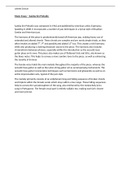
Music Essay – Samba Em Preludio
Samba Em Preludio was composed in 1962 and published by American artist, Esperanza
Spalding in 2008. It incorporates a number of jazz techniques in a lyrical style of Brazilian
Samba and American jazz.
The harmony of this piece is predominantly based off American jazz, making heavy use of
extended and altered chords. These chords are complex and are rarely simple triads, as they
often involve an added 7th, 9th and possibly and added 11th too. This creates a rich harmony,
while also producing a clashing dissonant sound to the piece. The harmony also includes
chromaticism between phrases, especially within the introduction as the acoustic bass
guitar plays on its own. This piece also makes use of flattened 3rds and 5ths, also known as
the blues notes. This helps to convey a more sombre tone to the piece, as well as enhancing
the tonality of B minor.
The female voice holds the main melody throughout the majority of the piece, whereas the
acoustic bass guitar as well as the nylon string guitar act as accompanying instruments. The
acoustic bass guitar incorporates techniques such as harmonics and glissandos as well as an
entire improvisation solo, typical of the jazz style.
The melody primarily consists of an antiphonal rising and falling sequence of broken chords
and triplets within the female vocals which stays within a low range. These falling sequences
help to convey the sad atmosphere of the song, also reinforced by the melancholy lyrics
sung in Portuguese. The female vocal part is entirely syllabic too, making each lyric clearer
and more precise.
Music Essay – Samba Em Preludio
Samba Em Preludio was composed in 1962 and published by American artist, Esperanza
Spalding in 2008. It incorporates a number of jazz techniques in a lyrical style of Brazilian
Samba and American jazz.
The harmony of this piece is predominantly based off American jazz, making heavy use of
extended and altered chords. These chords are complex and are rarely simple triads, as they
often involve an added 7th, 9th and possibly and added 11th too. This creates a rich harmony,
while also producing a clashing dissonant sound to the piece. The harmony also includes
chromaticism between phrases, especially within the introduction as the acoustic bass
guitar plays on its own. This piece also makes use of flattened 3rds and 5ths, also known as
the blues notes. This helps to convey a more sombre tone to the piece, as well as enhancing
the tonality of B minor.
The female voice holds the main melody throughout the majority of the piece, whereas the
acoustic bass guitar as well as the nylon string guitar act as accompanying instruments. The
acoustic bass guitar incorporates techniques such as harmonics and glissandos as well as an
entire improvisation solo, typical of the jazz style.
The melody primarily consists of an antiphonal rising and falling sequence of broken chords
and triplets within the female vocals which stays within a low range. These falling sequences
help to convey the sad atmosphere of the song, also reinforced by the melancholy lyrics
sung in Portuguese. The female vocal part is entirely syllabic too, making each lyric clearer
and more precise.