

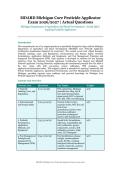
MDARD Michigan Core Pesticide Applicator
Exam 2026/2027 | Actual Questions
Michigan Department of Agriculture and Rural Development | Actual Q&A |
Aspiring Pesticide Applicators
Introduction
This comprehensive set of 75 original questions is specifically designed to align with the Michigan
Department of Agriculture and Rural Development (MDARD) Core Pesticide Applicator
Certification Examination blueprint for 2026/2027. The content covers four critical domains:
Pesticide Labeling, Laws, and Regulations; Environmental and Human Safety; Pesticide
Formulations, Application Methods, and Equipment; and Pest Management Principles and
Integrated Pest Management (IPM). Each question is developed to reinforce the key learning
objectives from the National Pesticide Applicator Certification Core Manual and MDARD
Pesticide Applicator Training Materials, emphasizing the foundational principle that 'the label is
the law,' along with drift prevention, proper calibration, IPM strategies, and
applicator/environmental safety. This original content is intended for aspiring Commercial and
Private Pesticide Applicators, Agricultural Professionals, and Pest Management Technicians in
Michigan, providing rigorous exam readiness and practical knowledge for Michigan Core
Pesticide Applicator Certification Mastery.
Content Area Overview
Content Area Questions Key Topics Weight
1. Pesticide Q 1-15 (15 Qs) EPA registration, Michigan 20%
Labeling, Laws, and pesticide laws (Reg. 636 &
Regulations 637), label interpretation,
signal words, RUP vs General
Use, REI, WPS, recordkeeping
2. Environmental Q 16-34 (19 Qs) Toxicity (LD50, LC50), 25%
and Human Safety exposure routes, PPE, first aid,
heat stress,
groundwater/surface water
protection, pollinator
protection, endangered
species, spill management
3. Pesticide Q 35-53 (19 Qs) Liquid & dry formulations, 25%
Formulations, adjuvants, compatibility (jar
Application test), calibration, sprayer
Methods, and components, nozzles, drift
Equipment mitigation, pressure, triple
rinse, ULV/fumigants
4. Pest Management Q 54-75 (22 Qs) Pest identification, disease 30%
Principles and triangle, metamorphosis,
Integrated Pest weeds, ET/EIL, scouting,
Management (IPM) biological/cultural/mechanical
controls, selectivity, systemic,
resistance management
MDARD Michigan Core Pesticide Applicator Exam 2026/2027
,Domain: Pesticide Labeling, Laws, and Regulations (15 Questions - 20%)
1. What is the legal significance of the statement 'The label is the law' under FIFRA
and Michigan pesticide law?
A. The label is only a recommendation and applicators may use their professional judgment to
exceed labeled rates.
B. It is a violation of federal and Michigan law to use any pesticide in a manner inconsistent with
its labeling.
C. The label is legally binding only for Restricted-Use Pesticides, not for General-Use Pesticides.
D. The label must be followed only if the applicator is being inspected by MDARD.
Answer: B
Rationale: Per FIFRA and MDARD Regulation 636, the label is a legally binding document.
Using a pesticide in any manner inconsistent with labeling is a federal and state violation,
reinforcing that applicators must read and follow all label directions, which is a core principle
in the National Core Manual.
2. What information does the EPA Registration Number (e.g., EPA Reg. No. 524-
445) provide on a pesticide label?
A. It indicates the toxicity category of the pesticide.
B. It identifies the specific formulation's registration with EPA and that EPA has reviewed and
approved the product for use as directed.
C. It shows the Michigan certification category required for purchase.
D. It is the batch number for recall purposes only.
Answer: B
Rationale: The EPA Registration Number signifies the product is registered with EPA, meaning
EPA has reviewed data on its safety, efficacy, and labeling. Split numbers (company-product)
identify manufacturer and product. This is distinct from EPA Establishment Number.
3. A pesticide label displays the signal word DANGER along with a skull and
crossbones symbol. What does this indicate?
A. The product is a Category III pesticide with low toxicity and requires moderate caution.
B. The product is highly toxic (Category I) by one or more routes of exposure and may be
corrosive to eyes or skin.
C. The product is slightly toxic and is approved for homeowner use only.
D. The product is not acutely toxic but poses chronic health effects.
Answer: B
Rationale: Signal words indicate acute toxicity: DANGER (Category I) = highly toxic,
WARNING = moderately toxic Category II, CAUTION = slightly toxic Category III/IV. DANGER
with skull and crossbones indicates high oral, dermal, or inhalation toxicity.
4. Where on the pesticide label is the 'Keep Out of Reach of Children' warning
statement required to appear, according to EPA labeling requirements?
A. Only on supplemental labeling, not the main container.
B. On the front panel of every pesticide label, separate from other text where children can see it
clearly.
C. On the back panel under Environmental Hazards only.
D. Only on products with REI greater than 48 hours.
Answer: B
Rationale: EPA requires the child hazard warning 'Keep Out of Reach of Children' on the front
panel of all pesticide products, ensuring high visibility. It is a mandatory precautionary
statement for all classes regardless of toxicity category.
5. What is the primary practical difference between a Restricted-Use Pesticide
(RUP) and a General-Use Pesticide in Michigan?
MDARD Michigan Core Pesticide Applicator Exam 2026/2027
, A. General-Use pesticides are never harmful to the environment, while RUPs always cause
groundwater contamination.
B. Restricted-Use Pesticides must be purchased and applied only by certified applicators (or
under their supervision) due to higher potential for adverse effects; General-Use can be
purchased by the public.
C. General-Use pesticides require MDARD records, Restricted-Use pesticides do not.
D. There is no difference; the terms refer to price categories.
Answer: B
Rationale: Under FIFRA and Michigan law, RUPs are classified due to potential for human
health or environmental harm if misused. They are restricted to certified applicators. General-
Use pesticides have lower risk and are widely available. Certification is required to purchase
and apply RUPs.
6. Under Michigan pesticide law, how long must both Private and Commercial
applicators retain records of Restricted-Use Pesticide applications?
A. 6 months from application date.
B. 1 year from application date.
C. 3 years from application date.
D. 7 years from application date.
Answer: C
Rationale: MDARD Regulation 637 requires applicators to keep application records for 3 years,
exceeding the federal 2-year minimum. Records must be available for inspection and include
product name, EPA registration number, rate, location, date, applicator name, certification
number, and target pest.
7. Which of the following is REQUIRED to be included in a Michigan pesticide
application record per Regulation 637?
A. The cost of the pesticide and the dealer's invoice number.
B. The brand/product name, EPA registration number, total amount applied, location, date,
applicator name/certification number, and target pest.
C. Only the date and the common name of the active ingredient.
D. The weather forecast for the next 48 hours after application.
Answer: B
Rationale: MDARD requires complete documentation: product/brand name, EPA Reg. No.,
active ingredient, rate per acre, total amount, application site/location with size treated, date,
time (if RUP with special environmental hazards), applicator name and certification, and target
pest/crop. This ensures traceability and compliance verification.
8. What is supplemental labeling (e.g., bulletins, special local needs 24(c) labeling)?
A. Marketing material that can be ignored by the applicator.
B. Additional labeling that is part of the legal label and must be in the applicator's possession
during application when referenced on the container label.
C. Optional information that replaces the original container label.
D. Only available online and never legally binding.
Answer: B
Rationale: Supplemental labeling, including EPA-approved Section 24(c) Special Local Need
labels, FIFRA Section 18 emergency exemptions, and other referenced bulletins, is a legal
extension of the label. The Core Manual states you must have it in your possession during use if
the container refers to it.
9. Under Michigan Pesticide Regulation 636, when is a person required to be a
MDARD certified applicator?
A. Only when applying pesticides on their own property for personal use.
MDARD Michigan Core Pesticide Applicator Exam 2026/2027
Exam 2026/2027 | Actual Questions
Michigan Department of Agriculture and Rural Development | Actual Q&A |
Aspiring Pesticide Applicators
Introduction
This comprehensive set of 75 original questions is specifically designed to align with the Michigan
Department of Agriculture and Rural Development (MDARD) Core Pesticide Applicator
Certification Examination blueprint for 2026/2027. The content covers four critical domains:
Pesticide Labeling, Laws, and Regulations; Environmental and Human Safety; Pesticide
Formulations, Application Methods, and Equipment; and Pest Management Principles and
Integrated Pest Management (IPM). Each question is developed to reinforce the key learning
objectives from the National Pesticide Applicator Certification Core Manual and MDARD
Pesticide Applicator Training Materials, emphasizing the foundational principle that 'the label is
the law,' along with drift prevention, proper calibration, IPM strategies, and
applicator/environmental safety. This original content is intended for aspiring Commercial and
Private Pesticide Applicators, Agricultural Professionals, and Pest Management Technicians in
Michigan, providing rigorous exam readiness and practical knowledge for Michigan Core
Pesticide Applicator Certification Mastery.
Content Area Overview
Content Area Questions Key Topics Weight
1. Pesticide Q 1-15 (15 Qs) EPA registration, Michigan 20%
Labeling, Laws, and pesticide laws (Reg. 636 &
Regulations 637), label interpretation,
signal words, RUP vs General
Use, REI, WPS, recordkeeping
2. Environmental Q 16-34 (19 Qs) Toxicity (LD50, LC50), 25%
and Human Safety exposure routes, PPE, first aid,
heat stress,
groundwater/surface water
protection, pollinator
protection, endangered
species, spill management
3. Pesticide Q 35-53 (19 Qs) Liquid & dry formulations, 25%
Formulations, adjuvants, compatibility (jar
Application test), calibration, sprayer
Methods, and components, nozzles, drift
Equipment mitigation, pressure, triple
rinse, ULV/fumigants
4. Pest Management Q 54-75 (22 Qs) Pest identification, disease 30%
Principles and triangle, metamorphosis,
Integrated Pest weeds, ET/EIL, scouting,
Management (IPM) biological/cultural/mechanical
controls, selectivity, systemic,
resistance management
MDARD Michigan Core Pesticide Applicator Exam 2026/2027
,Domain: Pesticide Labeling, Laws, and Regulations (15 Questions - 20%)
1. What is the legal significance of the statement 'The label is the law' under FIFRA
and Michigan pesticide law?
A. The label is only a recommendation and applicators may use their professional judgment to
exceed labeled rates.
B. It is a violation of federal and Michigan law to use any pesticide in a manner inconsistent with
its labeling.
C. The label is legally binding only for Restricted-Use Pesticides, not for General-Use Pesticides.
D. The label must be followed only if the applicator is being inspected by MDARD.
Answer: B
Rationale: Per FIFRA and MDARD Regulation 636, the label is a legally binding document.
Using a pesticide in any manner inconsistent with labeling is a federal and state violation,
reinforcing that applicators must read and follow all label directions, which is a core principle
in the National Core Manual.
2. What information does the EPA Registration Number (e.g., EPA Reg. No. 524-
445) provide on a pesticide label?
A. It indicates the toxicity category of the pesticide.
B. It identifies the specific formulation's registration with EPA and that EPA has reviewed and
approved the product for use as directed.
C. It shows the Michigan certification category required for purchase.
D. It is the batch number for recall purposes only.
Answer: B
Rationale: The EPA Registration Number signifies the product is registered with EPA, meaning
EPA has reviewed data on its safety, efficacy, and labeling. Split numbers (company-product)
identify manufacturer and product. This is distinct from EPA Establishment Number.
3. A pesticide label displays the signal word DANGER along with a skull and
crossbones symbol. What does this indicate?
A. The product is a Category III pesticide with low toxicity and requires moderate caution.
B. The product is highly toxic (Category I) by one or more routes of exposure and may be
corrosive to eyes or skin.
C. The product is slightly toxic and is approved for homeowner use only.
D. The product is not acutely toxic but poses chronic health effects.
Answer: B
Rationale: Signal words indicate acute toxicity: DANGER (Category I) = highly toxic,
WARNING = moderately toxic Category II, CAUTION = slightly toxic Category III/IV. DANGER
with skull and crossbones indicates high oral, dermal, or inhalation toxicity.
4. Where on the pesticide label is the 'Keep Out of Reach of Children' warning
statement required to appear, according to EPA labeling requirements?
A. Only on supplemental labeling, not the main container.
B. On the front panel of every pesticide label, separate from other text where children can see it
clearly.
C. On the back panel under Environmental Hazards only.
D. Only on products with REI greater than 48 hours.
Answer: B
Rationale: EPA requires the child hazard warning 'Keep Out of Reach of Children' on the front
panel of all pesticide products, ensuring high visibility. It is a mandatory precautionary
statement for all classes regardless of toxicity category.
5. What is the primary practical difference between a Restricted-Use Pesticide
(RUP) and a General-Use Pesticide in Michigan?
MDARD Michigan Core Pesticide Applicator Exam 2026/2027
, A. General-Use pesticides are never harmful to the environment, while RUPs always cause
groundwater contamination.
B. Restricted-Use Pesticides must be purchased and applied only by certified applicators (or
under their supervision) due to higher potential for adverse effects; General-Use can be
purchased by the public.
C. General-Use pesticides require MDARD records, Restricted-Use pesticides do not.
D. There is no difference; the terms refer to price categories.
Answer: B
Rationale: Under FIFRA and Michigan law, RUPs are classified due to potential for human
health or environmental harm if misused. They are restricted to certified applicators. General-
Use pesticides have lower risk and are widely available. Certification is required to purchase
and apply RUPs.
6. Under Michigan pesticide law, how long must both Private and Commercial
applicators retain records of Restricted-Use Pesticide applications?
A. 6 months from application date.
B. 1 year from application date.
C. 3 years from application date.
D. 7 years from application date.
Answer: C
Rationale: MDARD Regulation 637 requires applicators to keep application records for 3 years,
exceeding the federal 2-year minimum. Records must be available for inspection and include
product name, EPA registration number, rate, location, date, applicator name, certification
number, and target pest.
7. Which of the following is REQUIRED to be included in a Michigan pesticide
application record per Regulation 637?
A. The cost of the pesticide and the dealer's invoice number.
B. The brand/product name, EPA registration number, total amount applied, location, date,
applicator name/certification number, and target pest.
C. Only the date and the common name of the active ingredient.
D. The weather forecast for the next 48 hours after application.
Answer: B
Rationale: MDARD requires complete documentation: product/brand name, EPA Reg. No.,
active ingredient, rate per acre, total amount, application site/location with size treated, date,
time (if RUP with special environmental hazards), applicator name and certification, and target
pest/crop. This ensures traceability and compliance verification.
8. What is supplemental labeling (e.g., bulletins, special local needs 24(c) labeling)?
A. Marketing material that can be ignored by the applicator.
B. Additional labeling that is part of the legal label and must be in the applicator's possession
during application when referenced on the container label.
C. Optional information that replaces the original container label.
D. Only available online and never legally binding.
Answer: B
Rationale: Supplemental labeling, including EPA-approved Section 24(c) Special Local Need
labels, FIFRA Section 18 emergency exemptions, and other referenced bulletins, is a legal
extension of the label. The Core Manual states you must have it in your possession during use if
the container refers to it.
9. Under Michigan Pesticide Regulation 636, when is a person required to be a
MDARD certified applicator?
A. Only when applying pesticides on their own property for personal use.
MDARD Michigan Core Pesticide Applicator Exam 2026/2027


